


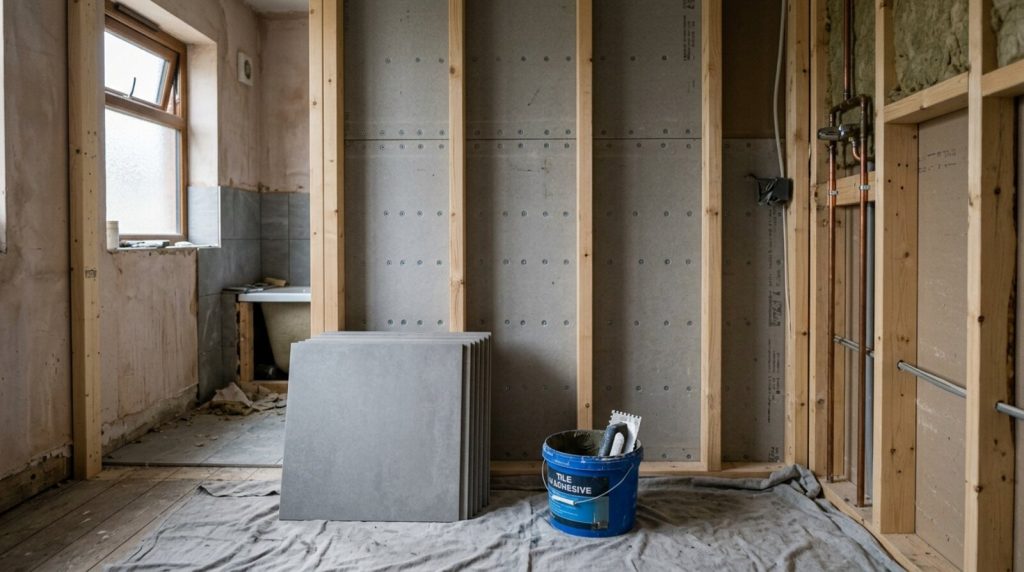
Porcelain tiles keep getting bigger and heavier, but most South East London bathrooms still have plasterboard, often with a plaster skim, behind the existing tiles. Whether that wall can carry your new tiles, and whether it survives ten years of daily showers, depends on what you fix them to. This guide covers when plasterboard is acceptable, when you need a tile backer board, and how to choose between the cement, foam-core and glass-reinforced types sold in the UK.
The short answer
Plasterboard is fine for light to medium tiles in the dry parts of a bathroom, provided you tile onto the bare board rather than a plaster skim and stay inside the weight limits below. A shower enclosure deserves a proper tile backer board, and a wet room demands one. The boards cost more, but they carry three to six times the weight, they do not collapse when water finds a way in, and the saving on plasterboard is trivial against the cost of stripping out a failure.
What the British Standard allows on plasterboard
BS 5385-1, the British Standard for internal wall tiling (current edition 2018), sets maximum weights for tiling on gypsum backgrounds, and the figures are repeated in guidance from British Gypsum and The Tile Association:
- Gypsum plasterboard, tiled direct: up to 32 kg per square metre.
- Gypsum plaster (a skimmed wall): up to 20 kg per square metre.
Both figures include the adhesive and grout, which typically add 3 to 4 kg per square metre. So a skimmed wall really gives you roughly 16 kg of actual tile per square metre, which rules out most 10mm porcelain and almost all natural stone.
Why does a skim coat reduce the capacity by more than a third? Because a tiled wall is only as strong as its weakest layer. Tile fixed over a skim is not hanging off the plasterboard at all; it is hanging off a few millimetres of finish plaster, which has a weaker bond to the board behind it and lower strength within itself than the board’s paper face. When an overloaded skimmed wall fails, the plaster delaminates and the tiles come away with a layer of pink dust on the back. If a wall is skimmed and your tiles are heavy, either remove the skim back to sound board or over-board with a backer board.
What happens when plasterboard gets wet
Plasterboard is a gypsum core wrapped in paper. Gypsum is soluble and loses most of its strength when saturated, and the paper facing softens, swells and feeds mould. Once water gets behind tiling on plasterboard, through a cracked grout line, a failed silicone joint or a leaking shower screen, the board sags, the adhesive bond lets go and the tiles loosen. The damage usually stays invisible until tiles sound hollow or a bulge appears, by which point the board needs cutting out.
Moisture-resistant plasterboard, the green board, is often misunderstood. Its core contains water-repellent additives, so it tolerates humidity and the odd splash far better than standard board, and it is the sensible minimum for any bathroom wall. But it is moisture resistant, not waterproof: it does nothing to waterproof the wall, it carries the same 32 kg per square metre limit, and it will still fail if it sits wet inside an untanked shower enclosure. Green board changes how slowly a problem develops, not whether it develops.
Types of tile backer board and what each suits
Tile backer boards fall into three broad families, all widely stocked in the UK.
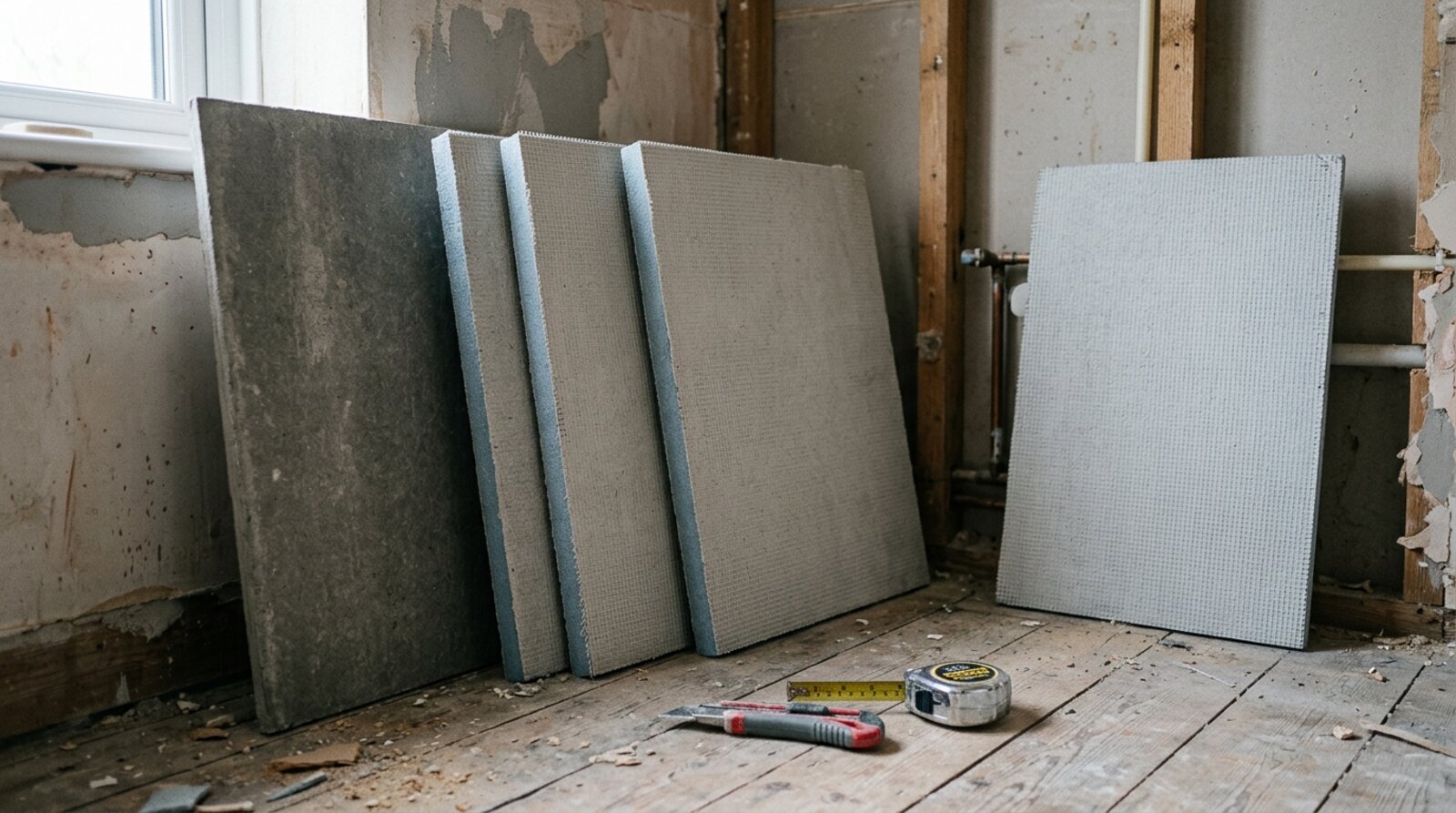
Cement boards, such as HardieBacker
Cement boards are made from Portland cement, sand and cellulose fibres. HardieBacker is the best known: it comes in 6mm and 12mm thicknesses and James Hardie rates it for tile loads up to 200 kg per square metre on residential timber stud walls. The boards are dimensionally stable when damp, non-combustible and resistant to mould. The trade-offs: the boards are heavy, cutting creates dust, and cement board is water resistant rather than waterproof, so it still needs tanking in wet zones. Best for: heavy tiles, stud walls in showers, and floors.
Foam-core XPS boards, such as Marmox Multiboard and Jackoboard Plano
These have a core of extruded polystyrene faced both sides with glass-fibre mesh and a thin polymer-cement coating. Marmox Multiboard comes in thicknesses from 4mm to 60mm; Jackoboard Plano is BBA tested to carry 100 kg of tiling per square metre. The XPS core is closed-cell, so the board itself will not absorb water; only the screw points and board joints need sealing in a wet area. They are very light, cut with a Stanley knife, and insulate, which makes walls warmer and reduces condensation. Best for: over-boarding dodgy walls, shower enclosures, bath panels and anywhere you want waterproofing and insulation in one layer.
Glass-reinforced wet-room boards, such as wedi
wedi building board is also XPS-cored but faced with a glass-fibre reinforced polymer cement, holds BBA approval, and is the basis of a full wet-room system: boards, preformed shower trays, sealing tape and adhesive sealant designed to work together. It is waterproof through the board itself, so a correctly built and joint-sealed wedi enclosure does not need a separate tanking membrane. Best for: wet rooms and full shower systems where one manufacturer warranty covering the whole waterproof build-up is worth paying for.
Fixing: how backer board and plasterboard go up differently
Plasterboard installation is familiar: screws to studs, or dot-and-dab adhesive to masonry. Backer boards need a little more care, and the manufacturer’s instructions are not optional if you want the load ratings to hold:
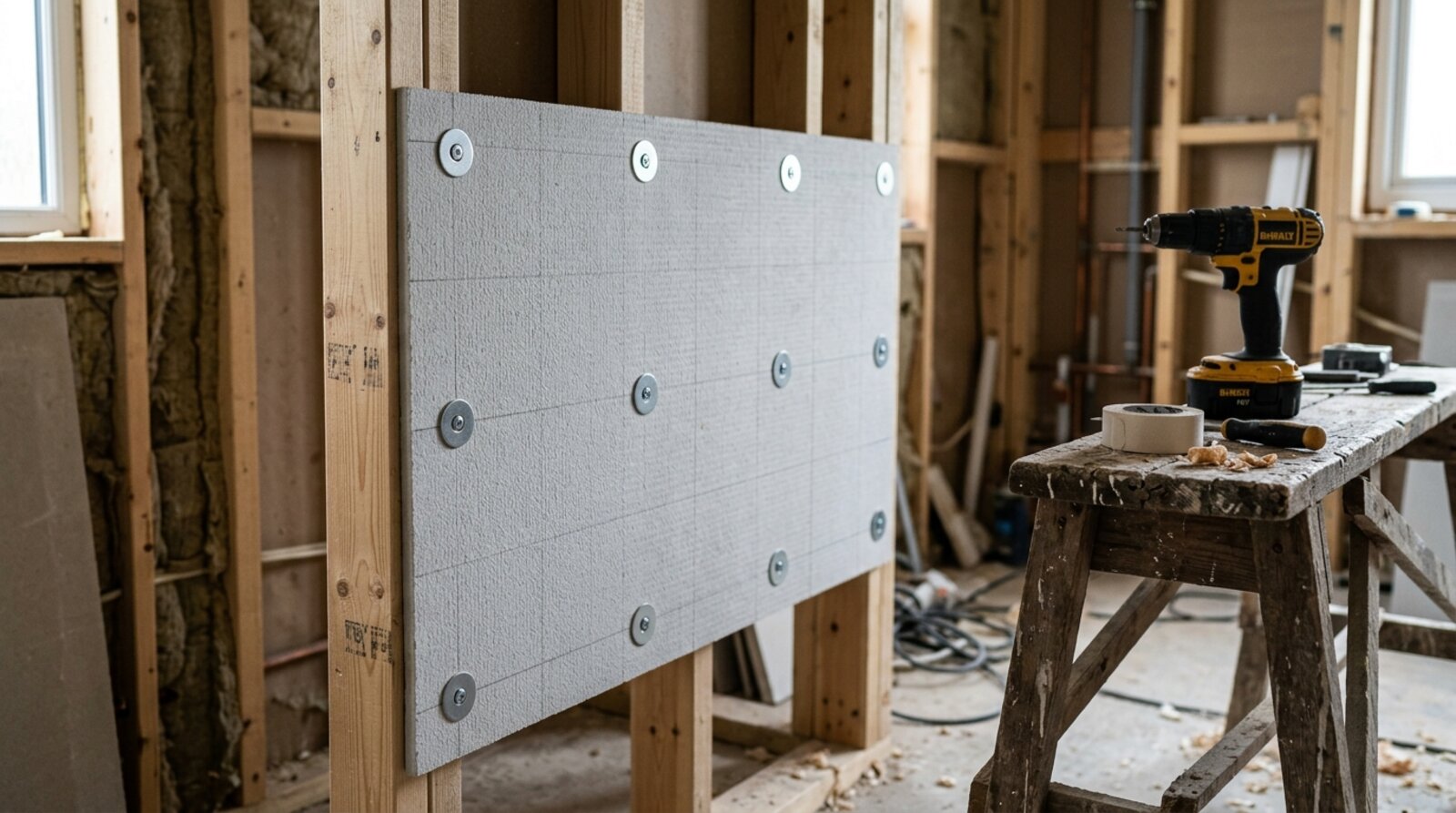
- Cement board on studs: screwed at close centres with corrosion-resistant cement board screws; 12mm board is the usual choice for spanning studs, with 6mm reserved for over-boarding solid surfaces and floors.
- Foam boards on studs: screws with 35mm metal washers spread the load over the soft core; plain screw heads will pull straight through. Thin 4mm and 6mm boards are for bonding to solid walls only, never for spanning studs.
- Foam boards on masonry: bedded on dabs or a serrated-trowel coat of cementitious tile adhesive, usually with a few mechanical fixings per board as well.
- Joints: taped or sealed per the system, and in wet areas the screw heads and board edges are sealed too.
None of this is difficult, but it is exacting, and it is where most DIY backer board jobs go wrong. If you would rather hand it over, Bromley Tilers board, tank and tile bathrooms across Bromley and South East London and will tell you honestly whether your existing walls can stay.
Wet zones still need tanking, whatever the board
One rule sits above the board choice: inside a shower enclosure or around a wet-room floor, the wall behind the tiles must be waterproofed. BS 5385-4 covers tiling in wet conditions, and as The Tile Association puts it, water-resistant adhesive and grout are no substitute for a waterproof tanking system. Cement board needs a tanking membrane over it in wet zones; XPS and wedi boards need their joints and fixings sealed to make the system continuous. We have covered tanking in detail elsewhere on this site, so the short version here: budget for it, every time, in every shower.
The cost reality
Plasterboard is one of the cheapest sheet materials sold; backer boards typically cost several times more per square metre. For a shower enclosure of 4 to 6 square metres, though, the whole difference is usually under a hundred pounds of materials.
Set against that the cost of failure. A collapsed or leaking tiled shower means stripping the tiles, cutting out saturated board, drying or repairing the studwork, re-boarding, tanking and retiling, plus making good any ceiling below. That is many times the money saved on boards, before you count weeks without a shower. The substrate is the one part of a bathroom you cannot upgrade later without starting again.
Which board for which job: a decision summary
- Splashback only (basin or worktop): standard or moisture-resistant plasterboard tiled direct is fine; almost no splashback tile approaches 32 kg per square metre.
- Full bathroom walls outside the shower: moisture-resistant plasterboard, tiled direct, suits tiles up to about 28 kg per square metre once adhesive is counted. If the walls are skimmed and your tiles are heavy, over-board or strip the skim.
- Shower enclosure: backer board. Cement board plus a tanking membrane, or an XPS or wedi board with sealed joints. Do not use plasterboard of any colour as the tiled surface inside the enclosure.
- Wet room: a complete wet-room board system (wedi, Marmox or Jackoboard with the matching tray, tapes and sealants) so the waterproofing is continuous across floor and walls and sits under one warranty.
Frequently asked questions
Can I tile straight onto plasterboard in a bathroom?
Yes, outside the shower enclosure, provided the board is rigid, dry and unskimmed, and the combined weight of tile, adhesive and grout stays within 32 kg per square metre. Prime the board if your adhesive manufacturer asks for it.
How much weight can a tile backer board hold compared with plasterboard?
Plasterboard carries up to 32 kg per square metre tiled direct, and a plaster skim only 20 kg. Jackoboard Plano is BBA tested to 100 kg per square metre, and James Hardie rates HardieBacker at up to 200 kg on residential timber studs. Backer board removes tile weight as a constraint for any domestic job.
Is green moisture-resistant plasterboard waterproof?
No. The additives in the core slow moisture absorption, which is valuable in a humid room, but the board is not waterproof and does not waterproof the wall. Inside a shower it must not be relied on without tanking, and even then a backer board is the better base.
Do I need to remove a plaster skim before tiling?
Only if the weight demands it. Light ceramics under the 20 kg per square metre limit can go onto sound, well-adhered plaster. Heavier porcelain or stone needs the skim stripped back to board, or the wall over-boarded, because the skim becomes the weakest layer holding everything up.
Do I still need tanking over cement backer board?
In wet zones, yes. Cement boards are structurally unaffected by moisture but not waterproof, so water can pass through to the studs behind; a liquid or sheet tanking membrane goes over the board inside the enclosure. Foam-core XPS and wedi boards are waterproof through the board, so only joints and fixing points need sealing.
What thickness of backer board do I need on a stud wall?
For cement board, 12mm is the standard choice for fixing across studs, with 6mm used over existing solid surfaces. For foam-core boards, follow the manufacturer’s span guidance for your stud spacing; the thin 4mm and 6mm sheets are only for bonding to solid walls.
Related guides
- How to Tile a Bathroom Wall: A UK Step-by-Step Guide
- How Much Does Tiling Cost in the UK? A Realistic Price Guide
- How to Remove Old Wall Tiles Without Damaging the Wall
- Porcelain vs Ceramic Tiles: Which Is Right for Your Bathroom or Kitchen?
- How to Tank and Waterproof a Wet Room Before Tiling: A Bromley Homeowner’s Guide
- Do You Need to Seal Natural Stone Tiles Before Grouting? A Tiler Explains
- How to Tile a Bathroom Floor (Including Around the Toilet)
- How to Tile a Shower: Walls, Niche and Waterproofing
- Construction Trade News: June 2026
- Bathroom Tiling Guide: How to Plan, Prep and Finish a Lasting Job
- Best Tiles for Small Bathrooms (and How to Make a Space Look Bigger)
- Wall and Floor Tiles for a Wet Room: What Actually Works
- Tiling vs Wall Panels for a Bathroom: Which Is Better?
- Do You Tile the Floor or Walls First in a Bathroom?
- Tiling and Bathroom Trade News: Mid-June 2026
- Kitchen Tiling: Splashbacks, Walls and Floors Explained
- How to Tile a Kitchen Splashback: Step-by-Step Bromley Guide
- How to Tile Around Kitchen Sockets, Switches and Worktops
- Kitchen Splashback Tile Ideas: 12 Looks That Work
- Tiling and Bathroom Trade News: Late June 2026
- How to Lay Metro Tiles in a Herringbone Pattern
- Tiled vs Glass Splashback (and Acrylic): Which Is Best?
- How High Should a Kitchen Splashback Be Tiled? UK Heights Guide
- Tiling and Bathroom Trade News: Early July 2026
- Types of Tiles: The Complete UK Buyer’s Guide
- Porcelain vs Natural Stone Tiles: Which Should You Choose?
- Natural Stone Tiles Explained: Marble, Travertine, Slate and Limestone
- Tiling and Bathroom Trade News: Mid-July 2026
- Mosaic Tiles: Where to Use Them and How They’re Fixed
- Tile Slip Ratings Explained: R Ratings and PTV for UK Floors
- Matt vs Gloss Tiles: Which Finish Is Right for Your Room?
- Cost to Tile a Bathroom in the UK: 2026 Price Breakdown
- Polystyrene Ceiling Tiles: Are They Any Good?
- Cost to Tile a Kitchen in 2026: Floor and Splashback Prices
- Tiling and Bathroom Trade News: Mid-July 2026
- Tiling Cost Per Square Metre 2026: Labour and All-In Prices
- Tiler Day Rate UK: What Tilers Charge Per Day in 2026
- Cost to Regrout a Bathroom in 2026: UK Prices Explained
- Floor Tile Prices UK 2026: What You Will Pay Per Square Metre
- Is It Cheaper to Tile or Use Wall Panels? A UK Cost Comparison
- How to Tile: A Complete Beginner’s Guide (UK)
- How to Cut Tiles: Manual Cutter, Wet Saw and Nippers
- How to Cut Holes in Tiles for Pipes and Taps
- How to Grout Tiles (and Get Clean, Even Lines)
- Cork Flooring: Pros, Cons and Where It Works in UK Homes
- Tiling and Bathroom Trade News: Late July 2026
- How to Mix and Apply Tile Adhesive Correctly
- How to Set Out Tiles for a Perfect Layout
- How to Seal Grout and Tiles in a Bathroom (UK Guide)
- Can You Tile Over Tiles? When It Works and When It Doesn’t
- Tiling Tools List: What You Need for a Professional Finish
- How Much Tile Adhesive Do I Need? Coverage Per Square Metre
- Tiling Trade News: Topps App, Costs Up 6% (Aug 2026)
- Tile Problems: 9 Common Faults and How to Fix Each
- How to Fix Loose Tiles Without Removing Them
- Cracked Grout Repair: Why It Happens and How to Fix It
- Tiling Trade News: TTA Silica Warning, 2% Retentions
- How to Replace a Broken Tile Without Redoing the Wall
- Water Leaking Through Shower Tiles: 6 Causes and Fixes
- Remove Mouldy Silicone Sealant: A 24-Hour Reseal Job
- How to Clean Grout: What Works, and What Etches Stone
- Why Are My Floor Tiles Lifting? The 40m² Bay Rule
- Tiling Trade News: 3,841 Construction Firms Failed
- How to Lay Porcelain Paving: 1:80 Fall, 150mm Below DPC
- Tile Patterns: Why Big Tiles Need a One-Third Offset
- Grout Colour Ideas: How to Get the Shade You Chose
- Can You Paint Tiles? Yes on Walls, No in the Shower
- Decoupling Membrane for Tiles: When You Actually Need One
- Can You Tile Over a Wooden Floor? What Changed in 2024
- Tiling Cost 2026: £25 to £95 per m² Labour, UK Rates
- Tile Ideas: 7 Looks and the One Rule Each Needs
- Metro Tiles: Sizes, Bevels and the 1/3 Offset Rule
- Tile Feature Wall: The Weight Limit That Decides Yours
- Tiling Over Underfloor Heating: 14 Days Before Heat On
- How to Tile a Hallway Floor: Set Out From the Door
- Wood Effect Tiles and Marble Effect: 5 Specs to Check
- Tile Levelling Systems: The 3mm Rule That Decides It
- Tiling Trade News: Repair Work Up 1.7%, Headlam Fails
- Floor Levelling Compound: How Deep and How Long to Dry
- How to Find a Good Tiler: 9 Checks Before You Book
- Tiling Quote: The 10 Lines a Proper One Must Show
- Tile Trim: Sizes, Profiles and the One-Size-Up Rule
- Tile Spacers: 2mm or 3mm, and When to Pull Them Out
- Tiling the Fireplace: 125mm Hearths, Adhesive and Tiles
- Tiling Trade News: Shaws Sinks Reprice on 1 November
- Porcelain vs Stone Paving: Grip, Sealing and Upkeep
- Tiling a Large Floor: Movement Joints Every 10 Metres
- DIY Tiling vs Professional: 6 Jobs to Never Do Yourself
- Terracotta Tiles: Seal Before Grouting, Wait 7 Days
- Tile Drill Bits: Which Bit Won’t Crack Porcelain
- Tiling Corners With Trim: Which Profile, and When to Mitre
- Travertine Tiles: Filled or Unfilled, and How to Seal Them
- Slate Tiles: Calibrated or Riven, and How to Lay Them
- Zellige Tiles: Order 15% Extra and Fix Them Edge to Edge
- Terrazzo Tiles: Real 20mm vs Porcelain, Seal Before Grouting
- Tiling Trade News: 36% Now Add a Bathroom Accent Wall
- Split Face Tiles: Will Your Wall Take 27kg per m²?
- Tile Sealer: Which Tiles Need It and Which Type to Buy
- How to Remove Grout Haze: Which Cleaner for Which Grout
- Efflorescence on Tiles: Why It Comes Back and How to Stop It
- Tile Primer: Which Surfaces Need It and How Much to Dilute
- Epoxy Grout: Where It’s Worth It and How to Apply It
- How to Tile Stairs: Keep Every Riser the Same Height
- Shower Niche: Sizes, Height and Which Wall Can Take One
- How Many Tiles Do I Need? Add 10% to 20% by Layout
- How to Tile a Window Sill: Sill Last, Silicone at the Frame
- Tiling Trade News: Victorian Plumbing Tile Sales Up 76%
- How to Tile Around a Toilet: Lift the Pan or Cut Round It
- Tile to Carpet Transition: Pick the Strip by the Height Gap
- Tile Skirting: Leave a 6mm Gap and Seal, Never Grout
- Tile Backer Board: Cement or Foam, Which Thickness, Fixings
- Quarry Tiles: Seal Them or Not, and How to Clean Them
- Rapid Set Tile Adhesive vs Standard: 30 Mins or 24 Hours