


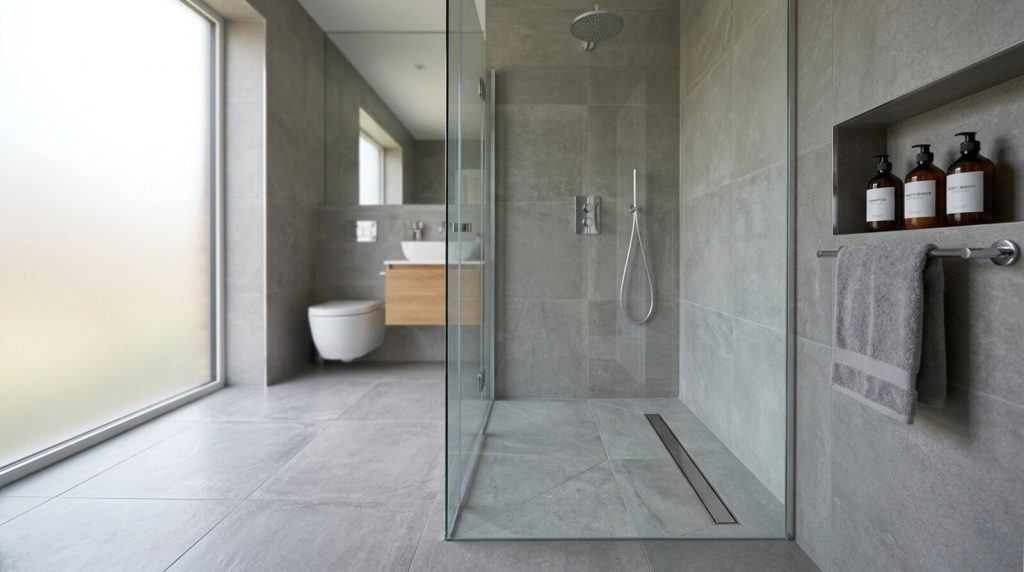
A wet room is the hardest tiling job a bathroom can throw at you. There is no tray, no enclosure and no upstand to hide behind. The whole floor is the shower, water runs across it to a single drain, and the tile is doing two jobs at once: keeping water moving in the right direction, and keeping bare wet feet upright. Get the tile choice wrong and you end up with a floor that stains, a fall that does not drain, or a surface that turns into a skating rink the moment it gets soapy.
This guide covers what genuinely works on a fully tiled wet room across Bromley and south east London, based on UK slip standards and how the materials behave once they are wet every day. We have fitted enough of these to know where the corners get cut.
Porcelain, ceramic or natural stone: what belongs in a wet room
The single most useful number when choosing a wet room tile is water absorption, measured to BS EN ISO 10545-3. The lower the figure, the less water the tile body soaks up, and a wet room floor is wet for hours every week.
Porcelain is the default choice, and for good reason. True porcelain is defined by a water absorption of 0.5 per cent or less, so the body is effectively vitrified and barely takes on water at all. That density also makes it harder, more resistant to chipping at the drain cuts, and easy to keep clean. For a fully tiled wet room, porcelain on the floor is the safe specification.
Ceramic is more porous than porcelain and absorbs more water, which is why it is better kept to walls than floors in a wet area. A good glazed ceramic is perfectly fine on a wet room wall, where it sits behind a tanking membrane and never has to carry weight or take a fall. Where people get caught out is using a soft, high-absorption ceramic on the floor, where it has neither the slip resistance nor the durability the job needs.
Natural stone looks the part, but it is the most demanding option in a wet room. Stone is porous to varying degrees, so it absorbs water, can stain and discolour, and needs sealing on installation and then resealing periodically for the life of the floor. Polished marble in particular is slippery underfoot when wet. Stone can be done well, but only if the client accepts the maintenance and you specify a honed or textured finish rather than a polish. For most wet rooms, porcelain that imitates stone or concrete gives the look without the upkeep.
Slip ratings for wet floors: R ratings, PTV and the barefoot test
This is where wet room tiling lives or dies, and where most thin online guides stop short. There are three rating systems in play and they are not interchangeable.
R ratings (the oiled ramp test)
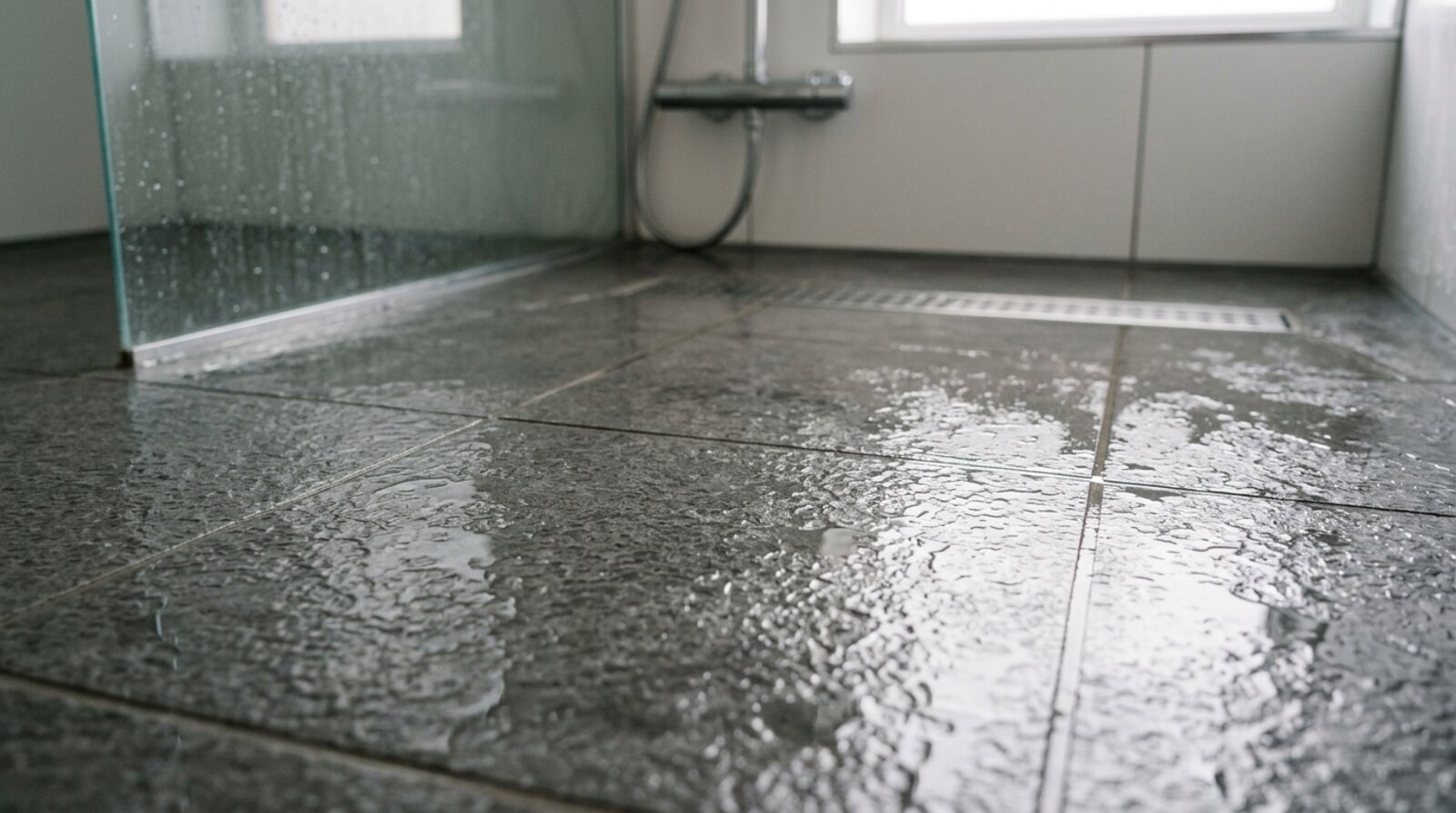
The R rating runs from R9 (lowest slip resistance) to R13 (highest), derived from a German ramp test (DIN 51130) using an operator in boots on an oil-contaminated surface. It is a useful first filter on a manufacturer’s data sheet. R9 and R10 are commonly quoted for domestic bathrooms, and R13 is what many specifiers want for public wet areas such as changing-room showers and pool surrounds. The catch is that the R test uses oil and a shod foot, which is not what happens in a home shower. Treat the R rating as a starting point, not proof.
PTV (the pendulum test)
The pendulum test, run to BS 7976-2, is the method the Health and Safety Executive relies on in the UK, and it is the figure that actually matters for a wet floor. It swings a rubber slider across the wet tile to mimic a heel strike and returns a Pendulum Test Value (PTV). The accepted reading is straightforward: a wet PTV of 36 or above is treated as low slip risk, 25 to 35 is moderate and needs mitigation, and 24 or below is high risk. For a wet room floor, specify a tile with a tested wet PTV of 36 or more. In the wettest zone right around the drain, aiming higher again, towards 45, is sensible.
One important point: an R rating does not convert to a PTV. A tile marked R10 does not automatically reach PTV 36, because the two tests use different contaminants and different feet. If slip safety matters, ask for the PTV, not just the R number.
The barefoot ABC test
Because nobody showers in shoes, the barefoot ramp test to DIN 51097 is the most relevant of all for a wet room. It grades surfaces A, B and C using an operator with bare feet on a wet ramp with a soapy solution. Class B covers showers and pool surrounds; Class C is for the very wettest barefoot conditions such as pool steps and walk-through pools. For a home wet room floor, a tile that achieves at least barefoot Class B is the sensible target, and it pairs naturally with a PTV of 36 plus.
Tile format on the floor: working with the falls to the drain
A wet room floor is not flat. It is laid to a fall so that water runs to the drain, and the gradient (built into the former or the screed beneath the tile) is typically around 1:60, roughly a 12mm drop per metre towards the outlet. The tile format you choose has to cope with that slope.
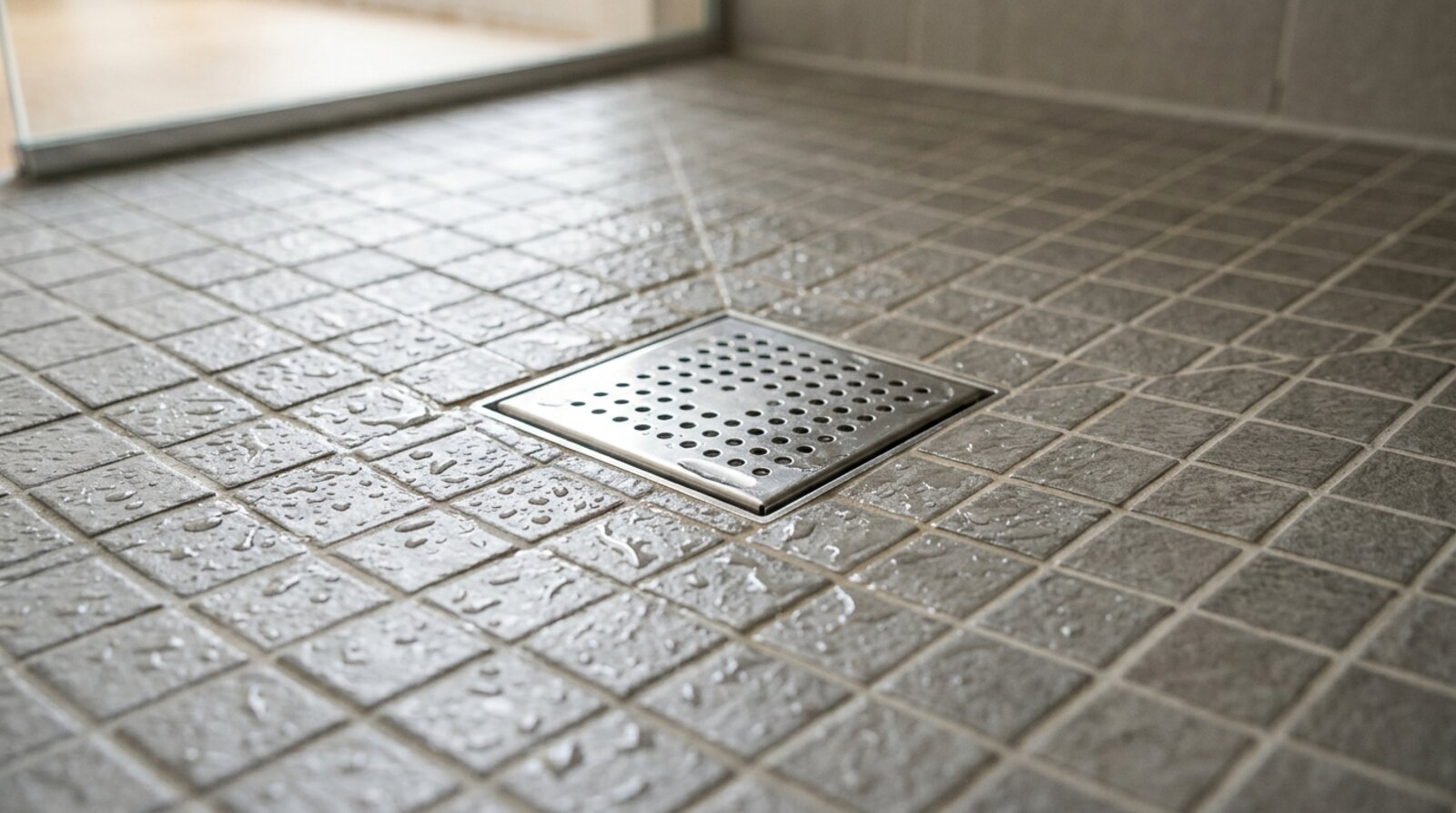
Mosaic and small format is the reliable answer on the drainage area itself. Small tiles on a mesh sheet, often up to around 50mm square, flex across the contours of the fall without needing complicated cuts, so they follow the gradient down to the drain cleanly. The extra grout joints also give grip underfoot, which is exactly what you want where the water collects. Mosaic on the former or wet zone is standard practice for this reason.
Large format tiles look contemporary and have fewer grout lines to clean, but a single rigid tile cannot bend to a fall. With a central drain, laying large format over a graded floor means cutting the tile (an envelope or pie cut) so the pieces step down to the drain, which is skilled work and unforgiving if the falls are not perfect. A linear drain set against one wall lets the floor fall in a single direction, which makes larger formats more workable. Even so, large format is better suited to the flat areas of the floor away from the drain, or to the walls.
A common and tidy approach is to mix formats: larger tiles across the main floor and walls for a clean look, with a mosaic insert in the shower zone where the fall is steepest and grip matters most. The change in texture also flags the wet zone underfoot.
Walls, grout and movement: the details that fail first
Walls are the easier half. Behind every wet room wall tile there should be a tanking (waterproofing) membrane taken over the whole shower area and lapped into the floor system, because the tile and grout are decorative, not the waterproof layer. With tanking in place, glazed ceramic or porcelain both work well on the walls, and format is a free choice.
Grout is where wet rooms are won or lost on the snagging list. Use the grout the adhesive and membrane manufacturers specify for wet areas, mix it consistently so colour does not vary, and do not over-wash the joints, which weakens them. Movement joints matter too: leave a flexible silicone joint in internal corners, around the drain and at floor-to-wall junctions rather than grouting them rigid, because a wet room expands, contracts and takes a lot of foot traffic, and rigid corners crack.
If a client wants to push slip resistance further on a tile they have set their heart on, an applied anti-slip treatment can raise the wet PTV of an existing surface, but it is better to specify the right tile from the start than to rely on a coating to rescue a slippery one.
If you are planning a wet room in Bromley or the surrounding area and want the floor specified and laid properly, you can see more of our work and get in touch via the Bromley Tilers homepage. For the underlying slip-safety guidance, the HSE slips and trips pages set out how floor surfaces are assessed in the UK.
Frequently asked questions
What is the best tile for a wet room floor?
A porcelain tile with a water absorption of 0.5 per cent or less, a tested wet PTV of 36 or above, and ideally a barefoot DIN 51097 Class B or C rating. Porcelain resists water and wear better than ceramic or natural stone, and the slip figures keep the floor safe once it is soapy.
Can I use the same tiles on the wet room walls and floor?
You can use one tile throughout for a unified look, provided it carries the floor slip ratings and is laid in a format that follows the fall near the drain. Many fitters keep the same range but switch to a small-format or mosaic version of it in the shower zone, which improves grip and avoids difficult cuts on the slope.
Is natural stone a bad idea in a wet room?
Not bad, but high maintenance. Stone is porous, so it needs sealing on installation and resealing over time, and polished finishes are slippery when wet. If a client wants stone, specify a honed or textured finish, accept the upkeep, or choose a stone-effect porcelain that gives the look without the sealing.
What slip rating do I need for a wet room floor in the UK?
Aim for a wet pendulum test value (PTV) of 36 or above, which the HSE treats as low slip risk, and higher again right around the drain. Because people shower barefoot, a barefoot DIN 51097 Class B rating is a good additional target. Do not rely on an R rating alone, as it does not convert to a PTV.
Should I use big tiles or small tiles on a wet room floor?
Use small format or mosaic in the drainage zone, because the many joints let the tile follow the fall to the drain and grip underfoot. Larger tiles suit the flatter areas and the walls. Mixing the two, mosaic in the shower and larger tiles elsewhere, is common and works well.
Does the tile make the wet room waterproof?
No. Waterproofing comes from a tanking membrane and the linked floor system underneath, taken across the whole shower area. The tile and grout are the finish and the wearing surface. If the tanking is wrong, no tile or grout will keep the water out.
Related guides
- How to Tile a Bathroom Wall: A UK Step-by-Step Guide
- How Much Does Tiling Cost in the UK? A Realistic Price Guide
- How to Remove Old Wall Tiles Without Damaging the Wall
- Porcelain vs Ceramic Tiles: Which Is Right for Your Bathroom or Kitchen?
- How to Tank and Waterproof a Wet Room Before Tiling: A Bromley Homeowner’s Guide
- Do You Need to Seal Natural Stone Tiles Before Grouting? A Tiler Explains
- How to Tile a Bathroom Floor (Including Around the Toilet)
- How to Tile a Shower: Walls, Niche and Waterproofing
- Construction Trade News: June 2026
- Bathroom Tiling Guide: How to Plan, Prep and Finish a Lasting Job
- Tile Backer Board vs Plasterboard for Bathrooms
- Best Tiles for Small Bathrooms (and How to Make a Space Look Bigger)
- Tiling vs Wall Panels for a Bathroom: Which Is Better?
- Do You Tile the Floor or Walls First in a Bathroom?
- Tiling and Bathroom Trade News: Mid-June 2026
- Kitchen Tiling: Splashbacks, Walls and Floors Explained
- How to Tile a Kitchen Splashback: Step-by-Step Bromley Guide
- How to Tile Around Kitchen Sockets, Switches and Worktops
- Kitchen Splashback Tile Ideas: 12 Looks That Work
- Tiling and Bathroom Trade News: Late June 2026
- How to Lay Metro Tiles in a Herringbone Pattern
- Tiled vs Glass Splashback (and Acrylic): Which Is Best?
- How High Should a Kitchen Splashback Be Tiled? UK Heights Guide
- Tiling and Bathroom Trade News: Early July 2026
- Types of Tiles: The Complete UK Buyer’s Guide
- Porcelain vs Natural Stone Tiles: Which Should You Choose?
- Natural Stone Tiles Explained: Marble, Travertine, Slate and Limestone
- Tiling and Bathroom Trade News: Mid-July 2026
- Mosaic Tiles: Where to Use Them and How They’re Fixed
- Tile Slip Ratings Explained: R Ratings and PTV for UK Floors
- Matt vs Gloss Tiles: Which Finish Is Right for Your Room?
- Cost to Tile a Bathroom in the UK: 2026 Price Breakdown
- Polystyrene Ceiling Tiles: Are They Any Good?
- Cost to Tile a Kitchen in 2026: Floor and Splashback Prices
- Tiling and Bathroom Trade News: Mid-July 2026
- Tiling Cost Per Square Metre 2026: Labour and All-In Prices
- Tiler Day Rate UK: What Tilers Charge Per Day in 2026
- Cost to Regrout a Bathroom in 2026: UK Prices Explained
- Floor Tile Prices UK 2026: What You Will Pay Per Square Metre
- Is It Cheaper to Tile or Use Wall Panels? A UK Cost Comparison
- How to Tile: A Complete Beginner’s Guide (UK)
- How to Cut Tiles: Manual Cutter, Wet Saw and Nippers
- How to Cut Holes in Tiles for Pipes and Taps
- How to Grout Tiles (and Get Clean, Even Lines)
- Cork Flooring: Pros, Cons and Where It Works in UK Homes
- Tiling and Bathroom Trade News: Late July 2026
- How to Mix and Apply Tile Adhesive Correctly
- How to Set Out Tiles for a Perfect Layout
- How to Seal Grout and Tiles in a Bathroom (UK Guide)
- Can You Tile Over Tiles? When It Works and When It Doesn’t
- Tiling Tools List: What You Need for a Professional Finish
- How Much Tile Adhesive Do I Need? Coverage Per Square Metre
- Tiling Trade News: Topps App, Costs Up 6% (Aug 2026)
- Tile Problems: 9 Common Faults and How to Fix Each
- How to Fix Loose Tiles Without Removing Them
- Cracked Grout Repair: Why It Happens and How to Fix It
- Tiling Trade News: TTA Silica Warning, 2% Retentions
- How to Replace a Broken Tile Without Redoing the Wall
- Water Leaking Through Shower Tiles: 6 Causes and Fixes
- Remove Mouldy Silicone Sealant: A 24-Hour Reseal Job
- How to Clean Grout: What Works, and What Etches Stone
- Why Are My Floor Tiles Lifting? The 40m² Bay Rule
- Tiling Trade News: 3,841 Construction Firms Failed
- How to Lay Porcelain Paving: 1:80 Fall, 150mm Below DPC
- Tile Patterns: Why Big Tiles Need a One-Third Offset
- Grout Colour Ideas: How to Get the Shade You Chose
- Can You Paint Tiles? Yes on Walls, No in the Shower
- Decoupling Membrane for Tiles: When You Actually Need One
- Can You Tile Over a Wooden Floor? What Changed in 2024
- Tiling Cost 2026: £25 to £95 per m² Labour, UK Rates
- Tile Ideas: 7 Looks and the One Rule Each Needs
- Metro Tiles: Sizes, Bevels and the 1/3 Offset Rule
- Tile Feature Wall: The Weight Limit That Decides Yours
- Tiling Over Underfloor Heating: 14 Days Before Heat On
- How to Tile a Hallway Floor: Set Out From the Door
- Wood Effect Tiles and Marble Effect: 5 Specs to Check
- Tile Levelling Systems: The 3mm Rule That Decides It
- Tiling Trade News: Repair Work Up 1.7%, Headlam Fails
- Floor Levelling Compound: How Deep and How Long to Dry
- How to Find a Good Tiler: 9 Checks Before You Book
- Tiling Quote: The 10 Lines a Proper One Must Show
- Tile Trim: Sizes, Profiles and the One-Size-Up Rule
- Tile Spacers: 2mm or 3mm, and When to Pull Them Out
- Tiling the Fireplace: 125mm Hearths, Adhesive and Tiles
- Tiling Trade News: Shaws Sinks Reprice on 1 November
- Porcelain vs Stone Paving: Grip, Sealing and Upkeep
- Tiling a Large Floor: Movement Joints Every 10 Metres
- DIY Tiling vs Professional: 6 Jobs to Never Do Yourself
- Terracotta Tiles: Seal Before Grouting, Wait 7 Days
- Tile Drill Bits: Which Bit Won’t Crack Porcelain
- Tiling Corners With Trim: Which Profile, and When to Mitre
- Travertine Tiles: Filled or Unfilled, and How to Seal Them
- Slate Tiles: Calibrated or Riven, and How to Lay Them
- Zellige Tiles: Order 15% Extra and Fix Them Edge to Edge
- Terrazzo Tiles: Real 20mm vs Porcelain, Seal Before Grouting
- Tiling Trade News: 36% Now Add a Bathroom Accent Wall
- Split Face Tiles: Will Your Wall Take 27kg per m²?
- Tile Sealer: Which Tiles Need It and Which Type to Buy
- How to Remove Grout Haze: Which Cleaner for Which Grout
- Efflorescence on Tiles: Why It Comes Back and How to Stop It
- Tile Primer: Which Surfaces Need It and How Much to Dilute
- Epoxy Grout: Where It’s Worth It and How to Apply It
- How to Tile Stairs: Keep Every Riser the Same Height
- Shower Niche: Sizes, Height and Which Wall Can Take One
- How Many Tiles Do I Need? Add 10% to 20% by Layout
- How to Tile a Window Sill: Sill Last, Silicone at the Frame
- Tiling Trade News: Victorian Plumbing Tile Sales Up 76%
- How to Tile Around a Toilet: Lift the Pan or Cut Round It
- Tile to Carpet Transition: Pick the Strip by the Height Gap
- Tile Skirting: Leave a 6mm Gap and Seal, Never Grout
- Tile Backer Board: Cement or Foam, Which Thickness, Fixings
- Quarry Tiles: Seal Them or Not, and How to Clean Them
- Rapid Set Tile Adhesive vs Standard: 30 Mins or 24 Hours