


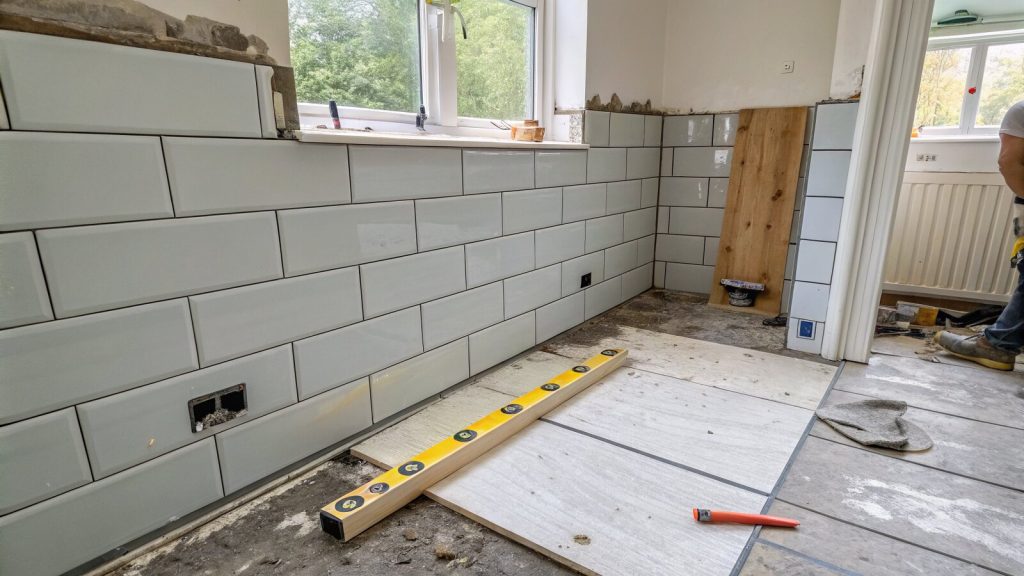
The short answer: in a standard bathroom where both the walls and the floor are being tiled, most professional tilers tile the walls first, then the floor. The bottom row of wall tiles is left off, the floor is laid, and that last row is fitted afterwards so it sits cleanly on top of the floor tiles. It is a tidy, forgiving way to work.
That is the default, not a rule. There are several common situations where you tile the floor first, and getting the order wrong can leave you with gaps, lippage, water tracking into the joists, or a row of awkward slivers along the skirting line. Below is how working tilers actually sequence a job, and how the bath, shower tray and screed change the decision.
Why walls first is the usual professional approach
When the floor is going to be tiled too, tiling the walls first has a few practical advantages that add up on site.
- You protect a finished floor. Wall tiling is messy: adhesive squeezes out, grout drips, spacers fall, and the odd tile gets dropped. If the floor is already tiled and grouted, every drop is a risk to a finished surface. Doing the walls while the floor is still bare screed or board means spills land somewhere you do not care about.
- The floor tiles tuck under the walls. Tilers usually leave the bottom row of wall tiles off, tile the floor up to and slightly under where the wall tiles will sit, then drop the last wall row in afterwards. The wall tiles overlap the floor edge, so the joint reads as a clean line rather than a visible gap, and any small inaccuracy in the floor cut is hidden behind the wall tile.
- You can hang off a level batten. A timber batten screwed across the wall gives the first full row of wall tiles a dead-level base to rest on while the adhesive sets, so nothing slips. The floor does not need to be finished for that, which is exactly why the walls can go up first.
- You set out from the right datum. Walls almost never meet the floor in a perfectly level line. Setting out the wall tiles from a level batten rather than off the existing floor stops a sloping floor from throwing every wall course out of true.
When you tile the floor first instead
Plenty of jobs call for the reverse. Tile the floor first when one of these applies.
- The existing floor is staying. If you are only retiling the walls and the floor tiles, vinyl or screed are remaining, there is nothing to do but tile the walls down to the existing surface and finish with a trim or silicone. The order question does not really arise.
- A shower tray or bath needs tiles running under it. If you want floor tiles to continue under a shower tray, the floor has to be tiled, and the tray bedded on top, before the surrounding walls go up. Running the floor (or a waterproof layer) under the tray means any leak is contained over a tiled, tanked surface rather than soaking straight into the chipboard or ply and down into the joists.
- It is a wet room. Wet rooms and level-access showers are almost always floor first. The waterproofing has to be continuous from the walls, down to the floor and into the drain, and the falls in the floor are formed before the walls are tiled. The tanking membrane is laid and lapped before any tile goes on.
- Wall-hung fittings change the sequence. A wall-hung WC or basin on a concealed frame, or large-format wall tiles that are heavy and unforgiving, sometimes pushes a tiler to settle the floor level first so the fittings and tile coursing line up exactly.
How the bath, shower tray and screed change the order
The single biggest thing that decides your sequence is what is happening with the bath or shower, because tiling and “first fix” plumbing have to interleave.
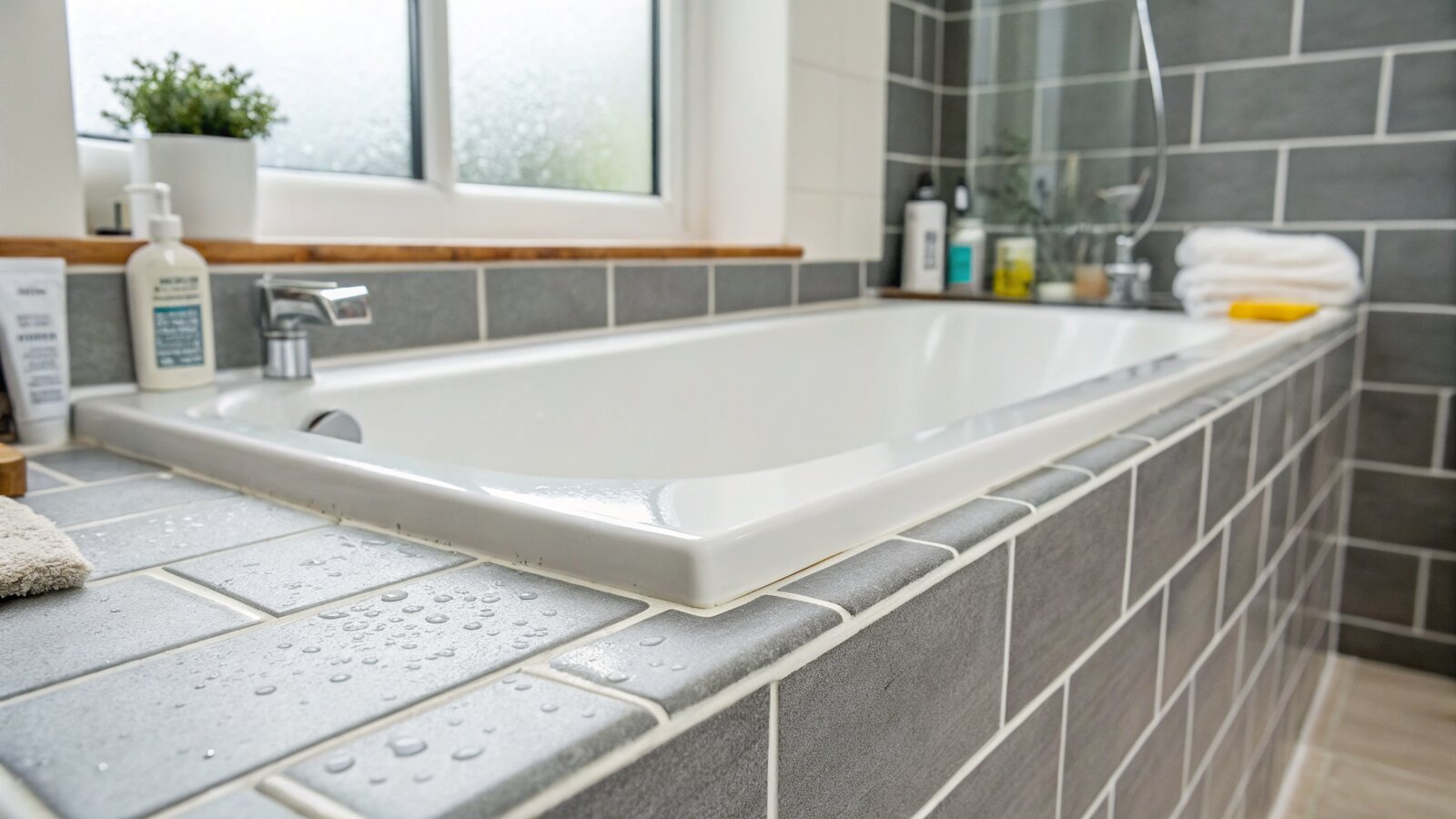
Tiling around a bath
With a standard fitted bath, the usual order is: fit and level the bath, then tile the walls down onto the bath edge. You tile to the bath, not behind it, and finish the joint with a low-modulus silicone or a bath seal trim. A common professional trick is to fill the bath with water before sealing so it sits at its loaded level, then seal the gap, which stops the silicone joint pulling open the first time someone gets in. Tiles should overlap the bath lip slightly so water runs back into the bath rather than behind it.
Tiling with a shower tray
For a shower tray, decide early whether tiles run under it or up to it. If tiles run under the tray, tile the floor, bed the tray, then tile the walls down to the tray edge. If the tray sits on the screed or subfloor, fit and level the tray first, then tile the walls down onto it and seal the joint. Either way, the tray goes in before the surrounding wall tiles so you can tile down to a fixed, level edge.
Screed and floor levelling
If the floor needs a self-levelling compound or a new screed, that has to cure before floor tiles go down, and the walls can be tiled while it does. On a timber floor, an overboard such as a tile backer board or marine ply is fixed and, in a wet area, tanked before tiling. Trying to tile a floor that has not been levelled or properly decoupled is where cracked tiles and hollow spots come from later.
Waterproofing comes before the tiles, whichever order you choose
Order of work is a finishing question. Waterproofing is a structural one, and it sits underneath both. The British Standard for wall and floor tiling, BS 5385, covers internal tiling, and its guidance for wet areas is that the substrate in showers and wet rooms should be protected with a suitable proprietary tanking membrane system before tiling. Tile, adhesive and grout on their own are not a waterproof layer; they let water through over time, so the tanking behind them is what actually keeps the wall dry. The Tile Association sets out the same guidance in its technical advice, which you can read on the Tile Association website.
In practice that means: tank the shower zone and any splash area first, lap the membrane correctly between wall and floor, and only then start tiling. If you tile in the wrong order and skip or break the tanking, no amount of neat grouting will save the wall behind it.
The practical risks of getting the order wrong
- Damaging a finished floor. Tiling walls over a freshly grouted floor risks chips, scratches and adhesive stains on tiles you have already paid to lay.
- A visible gap at the base of the wall. Tile the floor last without leaving the bottom wall row off and you can end up with an ugly joint, or thin sliver cuts where the floor meets the wall.
- Water getting behind the bath or tray. Sealing to fittings in the wrong sequence, or tiling behind a tray that should have been bedded first, can let water track into the floor structure.
- Coursing that does not line up. Setting wall tiles off an uneven floor instead of a level batten throws every row out, and the error grows the higher you go.
- Trapped tolerances. If the floor finishes higher or lower than planned, a fitted bottom wall row gives you nowhere to absorb it. Leaving that row until the floor is down keeps a margin for adjustment.
None of this is hard once the sequence is planned at the start. The mistakes happen when someone tiles the easy surface first without thinking about what has to land on top of it.
A simple way to decide
Run through it in order. Is it a wet room or a level-access shower? Floor first, after tanking. Do you want tiles under the shower tray? Floor first, then tray, then walls. Standard bathroom with a bath and a floor both being tiled? Walls first, leave the bottom row off, tile the floor, fit the last row. Only the walls being retiled over a floor that is staying? Walls only, finish neatly to the existing floor. That covers the vast majority of UK bathrooms.
If you are in Bromley or south east London and would rather have the sequencing, tanking and setting out handled properly, Bromley Tilers plans the order of work around your bath, tray and floor before any tile goes up.
Frequently asked questions
Do professional tilers always tile the walls first?
No. Walls first is the common default for a standard bathroom where both surfaces are being tiled, because it protects the floor and lets the wall tiles overlap it. Wet rooms, level-access showers, and jobs where tiles run under a shower tray are usually tiled floor first.
Why is the bottom row of wall tiles left off?
So the floor can be tiled up to and slightly under the wall line, then the final wall row dropped on top. It hides the floor edge cut, gives a clean joint, and leaves room to absorb any small variation in the finished floor height.
Should floor tiles run under the bath or shower tray?
Under a shower tray it is often worth it, so a leak sits over a tiled, waterproofed surface instead of bare boards. Under a standard bath it is not usually necessary; tilers fit and level the bath, then tile the walls down to it and seal the joint.
Do I waterproof before or after tiling?
Before. BS 5385 advises tanking the substrate in wet areas with a proper membrane system before any tile is fixed. Tile, adhesive and grout are not a waterproof layer on their own, so the tanking has to go on first.
Does the order matter if I am only retiling the walls?
Not much. If the floor is staying, you tile the walls down to the existing floor and finish with silicone or a trim. The floor-or-walls-first question mainly applies when both surfaces are being tiled in the same job.
What happens if I tile the floor first by mistake in a normal bathroom?
It can still work, but you risk chipping or staining the finished floor while tiling the walls above it, and you lose the easy way to hide the floor edge under the wall tiles. Protect the floor well and plan the wall-to-floor joint carefully if you go this way.
Related guides
- How to Tile a Bathroom Wall: A UK Step-by-Step Guide
- How Much Does Tiling Cost in the UK? A Realistic Price Guide
- How to Remove Old Wall Tiles Without Damaging the Wall
- Porcelain vs Ceramic Tiles: Which Is Right for Your Bathroom or Kitchen?
- How to Tank and Waterproof a Wet Room Before Tiling: A Bromley Homeowner’s Guide
- Do You Need to Seal Natural Stone Tiles Before Grouting? A Tiler Explains
- How to Tile a Bathroom Floor (Including Around the Toilet)
- How to Tile a Shower: Walls, Niche and Waterproofing
- Construction Trade News: June 2026
- Bathroom Tiling Guide: How to Plan, Prep and Finish a Lasting Job
- Tile Backer Board vs Plasterboard for Bathrooms
- Best Tiles for Small Bathrooms (and How to Make a Space Look Bigger)
- Wall and Floor Tiles for a Wet Room: What Actually Works
- Tiling vs Wall Panels for a Bathroom: Which Is Better?
- Tiling and Bathroom Trade News: Mid-June 2026
- Kitchen Tiling: Splashbacks, Walls and Floors Explained
- How to Tile a Kitchen Splashback: Step-by-Step Bromley Guide
- How to Tile Around Kitchen Sockets, Switches and Worktops
- Kitchen Splashback Tile Ideas: 12 Looks That Work
- Tiling and Bathroom Trade News: Late June 2026
- How to Lay Metro Tiles in a Herringbone Pattern
- Tiled vs Glass Splashback (and Acrylic): Which Is Best?
- How High Should a Kitchen Splashback Be Tiled? UK Heights Guide
- Tiling and Bathroom Trade News: Early July 2026
- Types of Tiles: The Complete UK Buyer’s Guide
- Porcelain vs Natural Stone Tiles: Which Should You Choose?
- Natural Stone Tiles Explained: Marble, Travertine, Slate and Limestone
- Tiling and Bathroom Trade News: Mid-July 2026
- Mosaic Tiles: Where to Use Them and How They’re Fixed
- Tile Slip Ratings Explained: R Ratings and PTV for UK Floors
- Matt vs Gloss Tiles: Which Finish Is Right for Your Room?
- Cost to Tile a Bathroom in the UK: 2026 Price Breakdown
- Polystyrene Ceiling Tiles: Are They Any Good?
- Cost to Tile a Kitchen in 2026: Floor and Splashback Prices
- Tiling and Bathroom Trade News: Mid-July 2026
- Tiling Cost Per Square Metre 2026: Labour and All-In Prices
- Tiler Day Rate UK: What Tilers Charge Per Day in 2026
- Cost to Regrout a Bathroom in 2026: UK Prices Explained
- Floor Tile Prices UK 2026: What You Will Pay Per Square Metre
- Is It Cheaper to Tile or Use Wall Panels? A UK Cost Comparison
- How to Tile: A Complete Beginner’s Guide (UK)
- How to Cut Tiles: Manual Cutter, Wet Saw and Nippers
- How to Cut Holes in Tiles for Pipes and Taps
- How to Grout Tiles (and Get Clean, Even Lines)
- Cork Flooring: Pros, Cons and Where It Works in UK Homes
- Tiling and Bathroom Trade News: Late July 2026
- How to Mix and Apply Tile Adhesive Correctly
- How to Set Out Tiles for a Perfect Layout
- How to Seal Grout and Tiles in a Bathroom (UK Guide)
- Can You Tile Over Tiles? When It Works and When It Doesn’t
- Tiling Tools List: What You Need for a Professional Finish
- How Much Tile Adhesive Do I Need? Coverage Per Square Metre
- Tiling Trade News: Topps App, Costs Up 6% (Aug 2026)
- Tile Problems: 9 Common Faults and How to Fix Each
- How to Fix Loose Tiles Without Removing Them
- Cracked Grout Repair: Why It Happens and How to Fix It
- Tiling Trade News: TTA Silica Warning, 2% Retentions
- How to Replace a Broken Tile Without Redoing the Wall
- Water Leaking Through Shower Tiles: 6 Causes and Fixes
- Remove Mouldy Silicone Sealant: A 24-Hour Reseal Job
- How to Clean Grout: What Works, and What Etches Stone
- Why Are My Floor Tiles Lifting? The 40m² Bay Rule
- Tiling Trade News: 3,841 Construction Firms Failed
- How to Lay Porcelain Paving: 1:80 Fall, 150mm Below DPC
- Tile Patterns: Why Big Tiles Need a One-Third Offset
- Grout Colour Ideas: How to Get the Shade You Chose
- Can You Paint Tiles? Yes on Walls, No in the Shower
- Decoupling Membrane for Tiles: When You Actually Need One
- Can You Tile Over a Wooden Floor? What Changed in 2024
- Tiling Cost 2026: £25 to £95 per m² Labour, UK Rates
- Tile Ideas: 7 Looks and the One Rule Each Needs
- Metro Tiles: Sizes, Bevels and the 1/3 Offset Rule
- Tile Feature Wall: The Weight Limit That Decides Yours
- Tiling Over Underfloor Heating: 14 Days Before Heat On
- How to Tile a Hallway Floor: Set Out From the Door
- Wood Effect Tiles and Marble Effect: 5 Specs to Check
- Tile Levelling Systems: The 3mm Rule That Decides It
- Tiling Trade News: Repair Work Up 1.7%, Headlam Fails
- Floor Levelling Compound: How Deep and How Long to Dry
- How to Find a Good Tiler: 9 Checks Before You Book
- Tiling Quote: The 10 Lines a Proper One Must Show
- Tile Trim: Sizes, Profiles and the One-Size-Up Rule
- Tile Spacers: 2mm or 3mm, and When to Pull Them Out
- Tiling the Fireplace: 125mm Hearths, Adhesive and Tiles
- Tiling Trade News: Shaws Sinks Reprice on 1 November
- Porcelain vs Stone Paving: Grip, Sealing and Upkeep
- Tiling a Large Floor: Movement Joints Every 10 Metres
- DIY Tiling vs Professional: 6 Jobs to Never Do Yourself
- Terracotta Tiles: Seal Before Grouting, Wait 7 Days
- Tile Drill Bits: Which Bit Won’t Crack Porcelain
- Tiling Corners With Trim: Which Profile, and When to Mitre
- Travertine Tiles: Filled or Unfilled, and How to Seal Them
- Slate Tiles: Calibrated or Riven, and How to Lay Them
- Zellige Tiles: Order 15% Extra and Fix Them Edge to Edge
- Terrazzo Tiles: Real 20mm vs Porcelain, Seal Before Grouting
- Tiling Trade News: 36% Now Add a Bathroom Accent Wall
- Split Face Tiles: Will Your Wall Take 27kg per m²?
- Tile Sealer: Which Tiles Need It and Which Type to Buy
- How to Remove Grout Haze: Which Cleaner for Which Grout
- Efflorescence on Tiles: Why It Comes Back and How to Stop It
- Tile Primer: Which Surfaces Need It and How Much to Dilute
- Epoxy Grout: Where It’s Worth It and How to Apply It
- How to Tile Stairs: Keep Every Riser the Same Height
- Shower Niche: Sizes, Height and Which Wall Can Take One
- How Many Tiles Do I Need? Add 10% to 20% by Layout
- How to Tile a Window Sill: Sill Last, Silicone at the Frame
- Tiling Trade News: Victorian Plumbing Tile Sales Up 76%
- How to Tile Around a Toilet: Lift the Pan or Cut Round It
- Tile to Carpet Transition: Pick the Strip by the Height Gap
- Tile Skirting: Leave a 6mm Gap and Seal, Never Grout
- Tile Backer Board: Cement or Foam, Which Thickness, Fixings
- Quarry Tiles: Seal Them or Not, and How to Clean Them
- Rapid Set Tile Adhesive vs Standard: 30 Mins or 24 Hours
- Can You Tile Onto Plaster? Yes, Up to 20kg per m²