


Most “porcelain vs ceramic” guides you will find online are written by retailers. They give you a spec table, list the water absorption figures, then leave you to work out what any of it means for your bathroom or your kitchen floor. After fitting both materials in homes across Bromley and south east London for years, here is the part those pages skip: where each tile actually fails, and what choosing one over the other does to your bill.
The short version is that porcelain and ceramic are close cousins. Both are fired clay with a glaze. The difference comes down to how dense the body is, and that single property decides almost everything that matters: how much water it soaks up, whether it survives a frost, how hard it is to cut, and what the tiler charges to fit it.
The one number that separates them: water absorption
Porcelain is fired hotter and pressed harder than ordinary ceramic, so the finished body is denser and less porous. The accepted dividing line is water absorption, set out in the international tile standard BS EN ISO 13006. A true porcelain tile absorbs 0.5% or less of its weight in water. Standard ceramic sits above that, commonly anywhere from around 3% up to 10% or more for soft-bodied wall tiles. That single figure is the whole story behind every other difference between the two.
Higher firing temperatures are why porcelain ends up so dense. Porcelain bodies are typically fired in the region of 1,200 to 1,400 degrees C, while ceramic is fired lower, often closer to 1,000 to 1,100 degrees C. The hotter firing fuses the clay particles tighter together and closes off the tiny pores that let water in. That extra density is also why porcelain weighs more in your hand and feels colder to the touch.
For a homeowner, the takeaway is simple. Water is the enemy in a bathroom or kitchen, and porcelain keeps more of it out. But that does not mean you need porcelain on every surface, and paying for it where it does no good is just wasted money.
Where ceramic is the right call
Ceramic gets unfairly written off as the cheap option. On walls, it is often the better choice, not just the cheaper one.
- Bathroom and kitchen walls. Walls do not take foot traffic and they do not sit in standing water. A glazed ceramic wall tile sheds splashes perfectly well, and the glaze, not the body, is what keeps water out. The lower density simply does not matter on a vertical surface.
- Kitchen splashbacks. The area behind a hob or sink needs a wipeable, sealed surface. Ceramic does that job for less, and the lighter body is easier to cut around sockets and pipework cleanly.
- Decorative and patterned tiles. A lot of the best looking encaustic-effect and hand-glazed tiles are ceramic. If you want a feature wall, you are not compromising by choosing ceramic for it.
The catch with ceramic is the body underneath the glaze. Chip the edge of a ceramic tile and you often see a pale, sometimes reddish clay body that contrasts with the surface colour. Chip a porcelain tile and, on a full-bodied or “through-body” porcelain, the colour runs all the way through, so a knock is far less obvious. On a wall this rarely comes up. On a busy floor it does.
Where porcelain earns its money: floors and wet areas
The moment a tile goes on the floor, the priorities change. Now you care about abrasion resistance, slip resistance and how the tile copes with repeated wetting. This is porcelain territory.
For wear, look at the PEI rating, which grades a glazed tile’s surface from 0 to 5 against foot traffic. PEI 0 and 1 are wall-only. PEI 3 covers most normal household floors. PEI 4 and 5 suit busy kitchens, hallways and anywhere shoes are worn. A wall ceramic dropped onto a kitchen floor will wear a dull walking path within a couple of years; a PEI 4 porcelain shrugs it off. Always check the rating before you fall in love with a tile, because the same design is sometimes sold in both a wall and a floor version.
For wet floors, slip resistance is the figure that actually protects people. UK tiles are commonly given an R rating from R9 to R13, measured on an oiled ramp under the German standard DIN 51130. The higher the number, the steeper the angle a person can walk before they slip.
- R9: dry domestic areas only, no good for a wet floor.
- R10: the sensible minimum for a domestic bathroom or shower floor.
- R11 and above: wet rooms, level-access showers, utility floors, anywhere water pools regularly. R11 can also be used outside.
There is a second system you will see for barefoot wet areas, the A, B and C ramp classification under DIN 51097, where B and above suits shower floors and wet rooms. If a tile is rated, say, R11 B, it covers both shod and barefoot use.
For any floor that gets genuinely wet, the reference that matters in the UK is the Health and Safety Executive’s own guidance. The HSE uses the pendulum test, and a Pendulum Test Value of 36 or above is treated as low slip risk. You can read the HSE note on assessing the slip resistance of flooring if you want the detail behind the numbers. In practice, for a home, choosing an R10 minimum for a shower floor and R11 for a true wet room keeps you on the right side of it.
The porch and conservatory trap: frost
This is the failure I get called out to most, and it is almost always avoidable. Ceramic’s higher water absorption is fine indoors where the temperature never drops below freezing. Put that same ceramic in an unheated porch, an open-sided car port, a step up to a back door or a cold conservatory, and you have a problem.
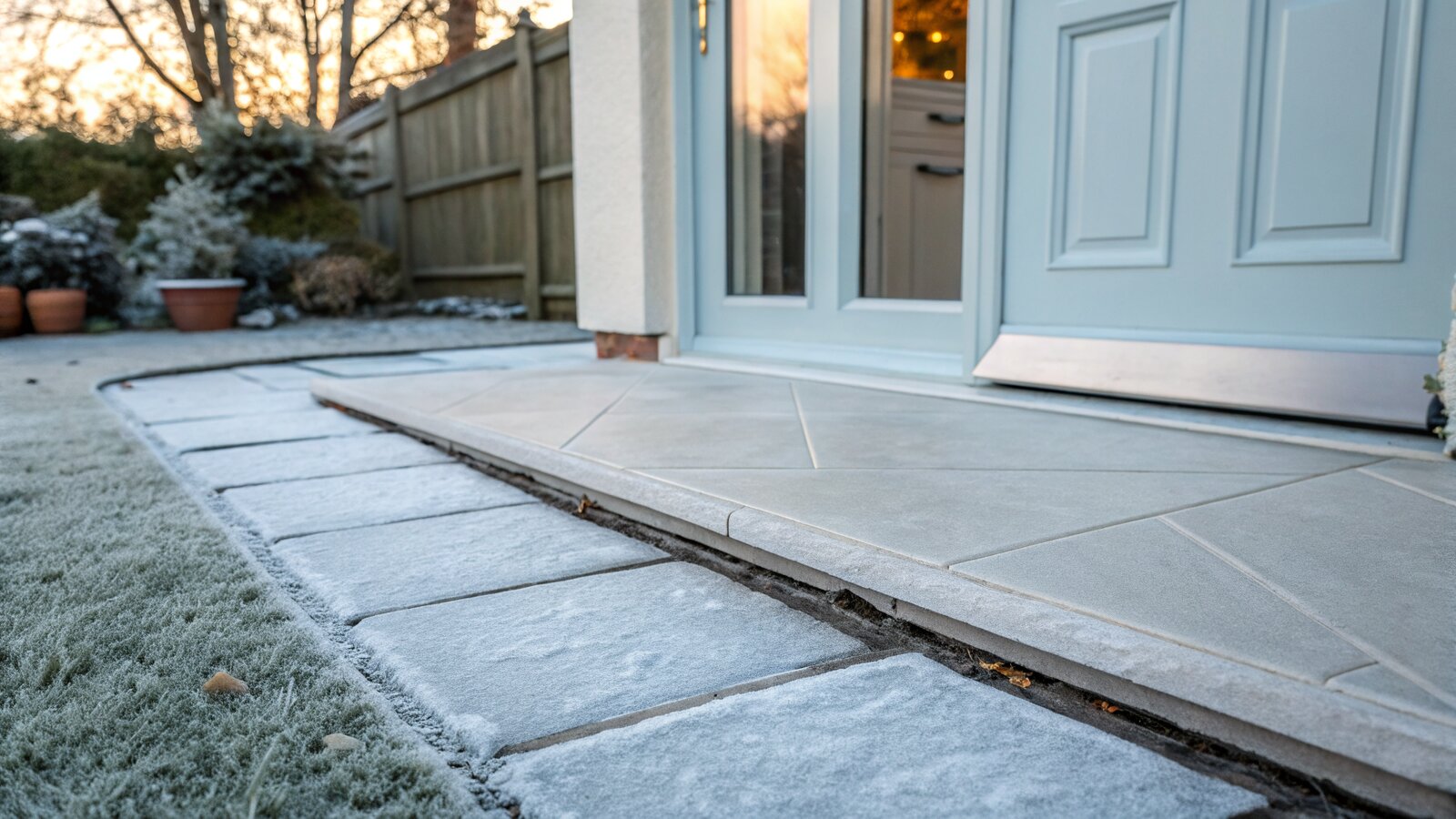
Water soaks into the body, the temperature drops below zero overnight, the water freezes and expands, and the tile face spalls or cracks. It is called frost damage, and once it starts it spreads. Porcelain, because it barely absorbs water, is frost-resistant and survives the same conditions year after year. If any part of your project sees outside temperatures, an entrance hall open to the front door, a garden room, a threshold, that area needs frost-resistant porcelain. Do not let anyone talk you into ceramic there to save a few pounds, because you will pay for it twice when it lifts.
What the difference costs you in labour, not just materials
Here is the part the retailer blogs leave out entirely, because they only sell you the tile, not the fitting.
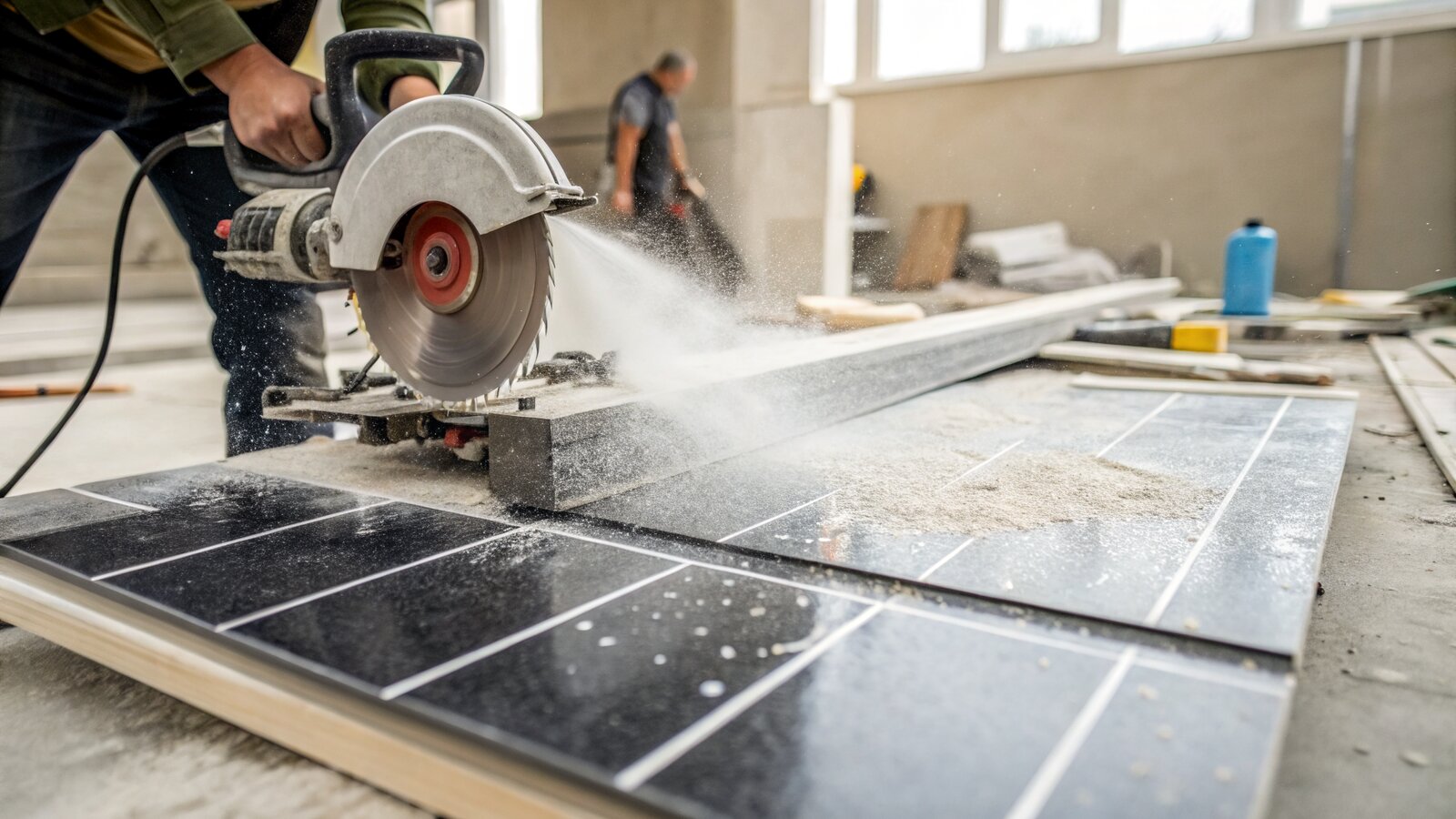
Porcelain is harder and denser than ceramic, which is exactly why it lasts. It is also why it is much more difficult to cut. A standard manual score-and-snap tile cutter will handle most ceramic happily. With porcelain, especially large-format and full-bodied tiles, that snap cutter struggles, chips the edge or refuses to break cleanly. For reliable cuts the tiler needs a wet saw with a diamond blade, where a stream of water cools the blade and clears the dust. The water stops the blade overheating and gives a clean, chip-free edge on holes for pipes, neat L-shapes around door frames and mitred external corners.
What that means for your quote:
- Slower cutting. Each porcelain cut takes longer than the equivalent ceramic cut, so a fiddly bathroom with lots of pipe boxings and niches takes more hours.
- Specialist kit and consumables. Diamond blades for porcelain wear out and are not cheap, and a wet saw is a different machine to a hand cutter.
- Large-format and thin porcelain. Big porcelain panels need two people to handle, a flat bed of adhesive with no voids, and a levelling system to stop lippage. That is skilled work and it is reflected in the day rate.
None of this is a reason to avoid porcelain. It is a reason to understand why a porcelain floor quote is higher than a ceramic wall quote even when the tiles cost similar money. You are paying for the time and the tools the material demands. As a rough guide, fitted tiling labour in the south east varies widely with the complexity of the room, the tile size and the substrate, so always get the cost broken down rather than comparing headline rates.
Both still need the right base: don’t skip the prep
Whichever tile you pick, the prep underneath decides whether it lasts. In bathrooms, wet rooms and any frequently wetted area, UK best practice follows the British Standard for wall and floor tiling, BS 5385, and the guidance of The Tile Association. The structure behind a wet room or shower should be tanked so it is watertight before a single tile goes on, plaster and plasterboard are not suitable on their own in frequently wetted areas, and tiles should be solidly bedded with no voids behind them. A beautiful porcelain floor laid on a flexing or unsealed base will still fail. The tile is only ever as good as what it sits on.
A quick recommendation by room
- Bathroom walls: ceramic is fine and often the smarter spend. Choose porcelain only if you want a specific large-format or full-body look.
- Bathroom and shower floors: porcelain, R10 minimum, R11 for a level-access or wet room floor.
- Kitchen splashbacks: ceramic.
- Kitchen floors: porcelain, PEI 4 or 5, because of shoes, dropped pans and constant traffic.
- Porches, thresholds, conservatories and anything that sees outside cold: frost-resistant porcelain, no exceptions.
- Feature and decorative walls: whatever you love the look of, usually ceramic.
If you are weighing up a job and want a straight answer for your exact rooms, that is the kind of thing we sort out on a site visit every week. You can see the work and get in touch through the Bromley Tilers homepage.
Frequently asked questions
Are porcelain tiles always better than ceramic?
No. Porcelain is better where water, frost or heavy foot traffic are involved, so floors, wet rooms and outdoor thresholds. On a dry interior wall, glazed ceramic does the same job for less and is easier to cut around obstacles. Paying for porcelain on a bathroom wall rarely buys you anything you will notice.
Can I use the same tile on the wall and the floor?
Sometimes, but check two things first. The tile needs a PEI rating high enough for floor traffic, ideally PEI 3 for a bathroom or PEI 4 for a kitchen, and a slip rating of at least R10 for any wet floor. Many wall tiles are rated PEI 0 or 1 and are not safe underfoot, even though the design is sold as a matching pair.
Why is a porcelain tiling quote more expensive than ceramic?
Partly the tile, but mostly the labour. Porcelain is dense and hard, so it needs a wet saw with a diamond blade rather than a hand cutter, every cut takes longer, and large-format porcelain often needs two fitters and a levelling system. You are paying for the time and the kit the material requires, not just the box of tiles.
Which tile is best for a wet room floor?
A frost-resistant porcelain with a slip rating of R11, or R11 B for barefoot use, laid over a properly tanked base. The floor must be watertight before tiling, in line with BS 5385, and the tiles bedded solidly with no voids. Slip resistance and tanking matter more here than the look.
Will ceramic tiles crack in a cold porch or conservatory?
They can, and frost is usually the reason. Ceramic absorbs more water, and when that water freezes it expands and breaks the tile face. Anywhere that drops below freezing, an open porch, a step to a back door, an unheated conservatory, needs frost-resistant porcelain instead.
Do porcelain floors feel colder than ceramic?
Slightly, because the denser body conducts heat away from your feet a little faster, which is why both materials pair so well with underfloor heating. If you are tiling a bathroom or kitchen floor, it is worth deciding on underfloor heating before the tiling starts, since it goes in under the adhesive.
Related guides
- How to Tile a Bathroom Wall: A UK Step-by-Step Guide
- How Much Does Tiling Cost in the UK? A Realistic Price Guide
- How to Remove Old Wall Tiles Without Damaging the Wall
- How to Tank and Waterproof a Wet Room Before Tiling: A Bromley Homeowner’s Guide
- Do You Need to Seal Natural Stone Tiles Before Grouting? A Tiler Explains
- How to Tile a Bathroom Floor (Including Around the Toilet)
- How to Tile a Shower: Walls, Niche and Waterproofing
- Construction Trade News: June 2026
- Bathroom Tiling Guide: How to Plan, Prep and Finish a Lasting Job
- Tile Backer Board vs Plasterboard for Bathrooms
- Best Tiles for Small Bathrooms (and How to Make a Space Look Bigger)
- Wall and Floor Tiles for a Wet Room: What Actually Works
- Tiling vs Wall Panels for a Bathroom: Which Is Better?
- Do You Tile the Floor or Walls First in a Bathroom?
- Tiling and Bathroom Trade News: Mid-June 2026
- Kitchen Tiling: Splashbacks, Walls and Floors Explained
- How to Tile a Kitchen Splashback: Step-by-Step Bromley Guide
- How to Tile Around Kitchen Sockets, Switches and Worktops
- Kitchen Splashback Tile Ideas: 12 Looks That Work
- Tiling and Bathroom Trade News: Late June 2026
- How to Lay Metro Tiles in a Herringbone Pattern
- Tiled vs Glass Splashback (and Acrylic): Which Is Best?
- How High Should a Kitchen Splashback Be Tiled? UK Heights Guide
- Tiling and Bathroom Trade News: Early July 2026
- Types of Tiles: The Complete UK Buyer’s Guide
- Porcelain vs Natural Stone Tiles: Which Should You Choose?
- Natural Stone Tiles Explained: Marble, Travertine, Slate and Limestone
- Tiling and Bathroom Trade News: Mid-July 2026
- Mosaic Tiles: Where to Use Them and How They’re Fixed
- Tile Slip Ratings Explained: R Ratings and PTV for UK Floors
- Matt vs Gloss Tiles: Which Finish Is Right for Your Room?
- Cost to Tile a Bathroom in the UK: 2026 Price Breakdown
- Polystyrene Ceiling Tiles: Are They Any Good?
- Cost to Tile a Kitchen in 2026: Floor and Splashback Prices
- Tiling and Bathroom Trade News: Mid-July 2026
- Tiling Cost Per Square Metre 2026: Labour and All-In Prices
- Tiler Day Rate UK: What Tilers Charge Per Day in 2026
- Cost to Regrout a Bathroom in 2026: UK Prices Explained
- Floor Tile Prices UK 2026: What You Will Pay Per Square Metre
- Is It Cheaper to Tile or Use Wall Panels? A UK Cost Comparison
- How to Tile: A Complete Beginner’s Guide (UK)
- How to Cut Tiles: Manual Cutter, Wet Saw and Nippers
- How to Cut Holes in Tiles for Pipes and Taps
- How to Grout Tiles (and Get Clean, Even Lines)
- Cork Flooring: Pros, Cons and Where It Works in UK Homes
- Tiling and Bathroom Trade News: Late July 2026
- How to Mix and Apply Tile Adhesive Correctly
- How to Set Out Tiles for a Perfect Layout
- How to Seal Grout and Tiles in a Bathroom (UK Guide)
- Can You Tile Over Tiles? When It Works and When It Doesn’t
- Tiling Tools List: What You Need for a Professional Finish
- How Much Tile Adhesive Do I Need? Coverage Per Square Metre
- Tiling Trade News: Topps App, Costs Up 6% (Aug 2026)
- Tile Problems: 9 Common Faults and How to Fix Each
- How to Fix Loose Tiles Without Removing Them
- Cracked Grout Repair: Why It Happens and How to Fix It
- Tiling Trade News: TTA Silica Warning, 2% Retentions
- How to Replace a Broken Tile Without Redoing the Wall
- Water Leaking Through Shower Tiles: 6 Causes and Fixes
- Remove Mouldy Silicone Sealant: A 24-Hour Reseal Job
- How to Clean Grout: What Works, and What Etches Stone
- Why Are My Floor Tiles Lifting? The 40m² Bay Rule
- Tiling Trade News: 3,841 Construction Firms Failed
- How to Lay Porcelain Paving: 1:80 Fall, 150mm Below DPC
- Tile Patterns: Why Big Tiles Need a One-Third Offset
- Grout Colour Ideas: How to Get the Shade You Chose
- Can You Paint Tiles? Yes on Walls, No in the Shower
- Decoupling Membrane for Tiles: When You Actually Need One
- Can You Tile Over a Wooden Floor? What Changed in 2024
- Tiling Cost 2026: £25 to £95 per m² Labour, UK Rates
- Tile Ideas: 7 Looks and the One Rule Each Needs
- Metro Tiles: Sizes, Bevels and the 1/3 Offset Rule
- Tile Feature Wall: The Weight Limit That Decides Yours
- Tiling Over Underfloor Heating: 14 Days Before Heat On
- How to Tile a Hallway Floor: Set Out From the Door
- Wood Effect Tiles and Marble Effect: 5 Specs to Check
- Tile Levelling Systems: The 3mm Rule That Decides It
- Tiling Trade News: Repair Work Up 1.7%, Headlam Fails
- Floor Levelling Compound: How Deep and How Long to Dry
- How to Find a Good Tiler: 9 Checks Before You Book
- Tiling Quote: The 10 Lines a Proper One Must Show
- Tile Trim: Sizes, Profiles and the One-Size-Up Rule
- Tile Spacers: 2mm or 3mm, and When to Pull Them Out
- Tiling the Fireplace: 125mm Hearths, Adhesive and Tiles
- Tiling Trade News: Shaws Sinks Reprice on 1 November
- Porcelain vs Stone Paving: Grip, Sealing and Upkeep
- Tiling a Large Floor: Movement Joints Every 10 Metres
- DIY Tiling vs Professional: 6 Jobs to Never Do Yourself
- Terracotta Tiles: Seal Before Grouting, Wait 7 Days
- Tile Drill Bits: Which Bit Won’t Crack Porcelain
- Tiling Corners With Trim: Which Profile, and When to Mitre
- Travertine Tiles: Filled or Unfilled, and How to Seal Them
- Slate Tiles: Calibrated or Riven, and How to Lay Them
- Zellige Tiles: Order 15% Extra and Fix Them Edge to Edge
- Terrazzo Tiles: Real 20mm vs Porcelain, Seal Before Grouting
- Tiling Trade News: 36% Now Add a Bathroom Accent Wall
- Split Face Tiles: Will Your Wall Take 27kg per m²?
- Tile Sealer: Which Tiles Need It and Which Type to Buy
- How to Remove Grout Haze: Which Cleaner for Which Grout
- Efflorescence on Tiles: Why It Comes Back and How to Stop It
- Tile Primer: Which Surfaces Need It and How Much to Dilute
- Epoxy Grout: Where It’s Worth It and How to Apply It
- How to Tile Stairs: Keep Every Riser the Same Height
- Shower Niche: Sizes, Height and Which Wall Can Take One
- How Many Tiles Do I Need? Add 10% to 20% by Layout
- How to Tile a Window Sill: Sill Last, Silicone at the Frame
- Tiling Trade News: Victorian Plumbing Tile Sales Up 76%
- How to Tile Around a Toilet: Lift the Pan or Cut Round It
- Tile to Carpet Transition: Pick the Strip by the Height Gap
- Tile Skirting: Leave a 6mm Gap and Seal, Never Grout
- Tile Backer Board: Cement or Foam, Which Thickness, Fixings
- Quarry Tiles: Seal Them or Not, and How to Clean Them
- Rapid Set Tile Adhesive vs Standard: 30 Mins or 24 Hours