


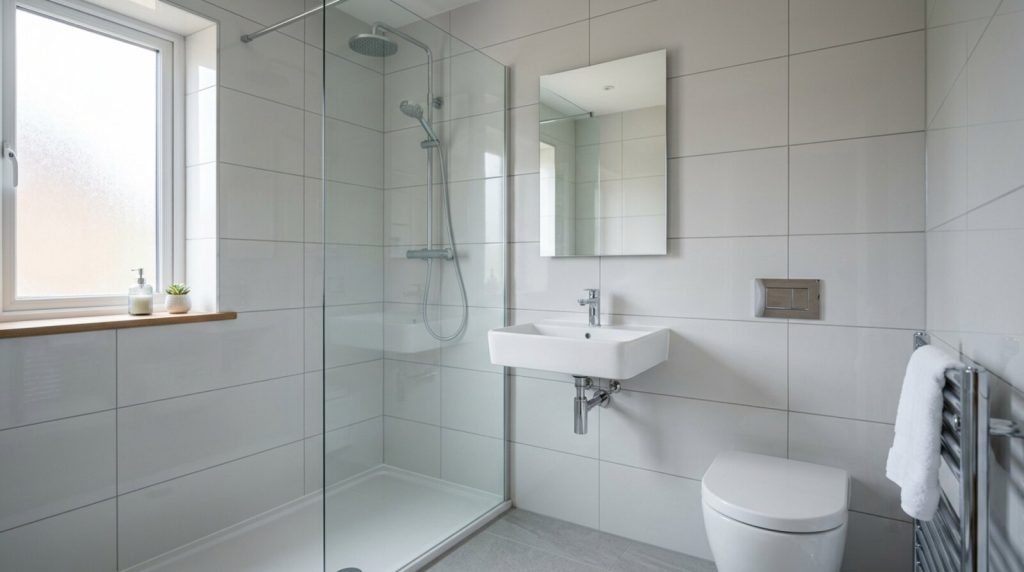
A small bathroom is the room where tile choices show up the fastest. Pick the wrong size, the wrong finish or a fussy grout colour and a compact space starts to feel like a cupboard. Get it right and the same floor area can read as calm, bright and noticeably larger. None of this is sleight of hand: it is the way the eye reads grout lines, reflected light and continuous surfaces. Below is what actually makes a difference for a typical UK bathroom of around 2 to 4 square metres, the kind found in countless terraced and semi-detached homes across Bromley and the rest of the country.
We fit these rooms week in, week out, so this is the advice we give clients before they spend a penny at the tile shop. It works whether you are doing the job yourself or briefing a tiler.
Tile size: why bigger usually wins in a small room
It feels backwards, but large tiles tend to make a small bathroom look larger, not smaller. The reason is grout. Every grout joint is a visual interruption, and the more of them there are, the more the eye chops the surface into small segments and reads the room as busy and cramped. Cover the same wall in fewer, bigger tiles and you get broad, quiet planes that the eye glides across, which makes the boundaries feel further away.
Large-format tiles, generally taken to mean any tile with one edge longer than roughly 60cm, are the usual choice for this reason. Common UK sizes that suit a small bathroom well are 30x60cm and 60x60cm, with 60x120cm working on a feature wall if the substrate is flat enough to lay it without lipping. The flatness point matters: big tiles are unforgiving on a bowed wall, and getting them dead flat is where a competent tiler earns their fee.
Tiny mosaics are the opposite play. They have their place as a border or inside a niche, but covering a whole small bathroom in 2.5cm mosaic creates a grid of hundreds of grout lines that shrinks the room visually and is a chore to keep clean. Use them as an accent, not the main event.
Light, colour and finish that bounce light around
Small bathrooms are often short on natural light, so the tiles need to do some of the lifting. Pale colours reflect more light than dark ones, so whites, soft greys, sand and pale stone tones keep the space feeling open. That does not mean the room has to be clinical; a warm off-white or a light greige reads as larger while still feeling like a room rather than a hospital.
Finish matters as much as colour. A gloss or polished finish reflects light and visually pushes the walls back, which is why it is a popular wall choice in a windowless bathroom. The trade-off is that gloss shows water spots and smears more readily. A satin or honed finish is a sensible middle ground: it lifts light without the mirror-like glare, and it hides everyday marks better. Save the matt, heavily textured surfaces for the floor, where you actively want grip rather than shine (more on that below).
One practical tip: take samples home and look at them in the actual bathroom, at the times of day you use it. Tile that looks crisp under bright shop lighting can fall flat under a single warm ceiling light.
Layout tricks that stretch the room
The same tiles laid in a different direction can change how big a room feels. A few reliable moves:
- Run the floor tiles to the longest dimension. Laying rectangular tiles so the long edge points down the length of the room draws the eye along and exaggerates the run, much like floorboards do.
- Go vertical to lift a low ceiling. Stacking rectangular wall tiles vertically, or running a vertical pattern up one wall, leads the eye upward and makes the ceiling feel higher. This is useful in older UK homes where bathrooms were carved out of small rooms with awkward heights.
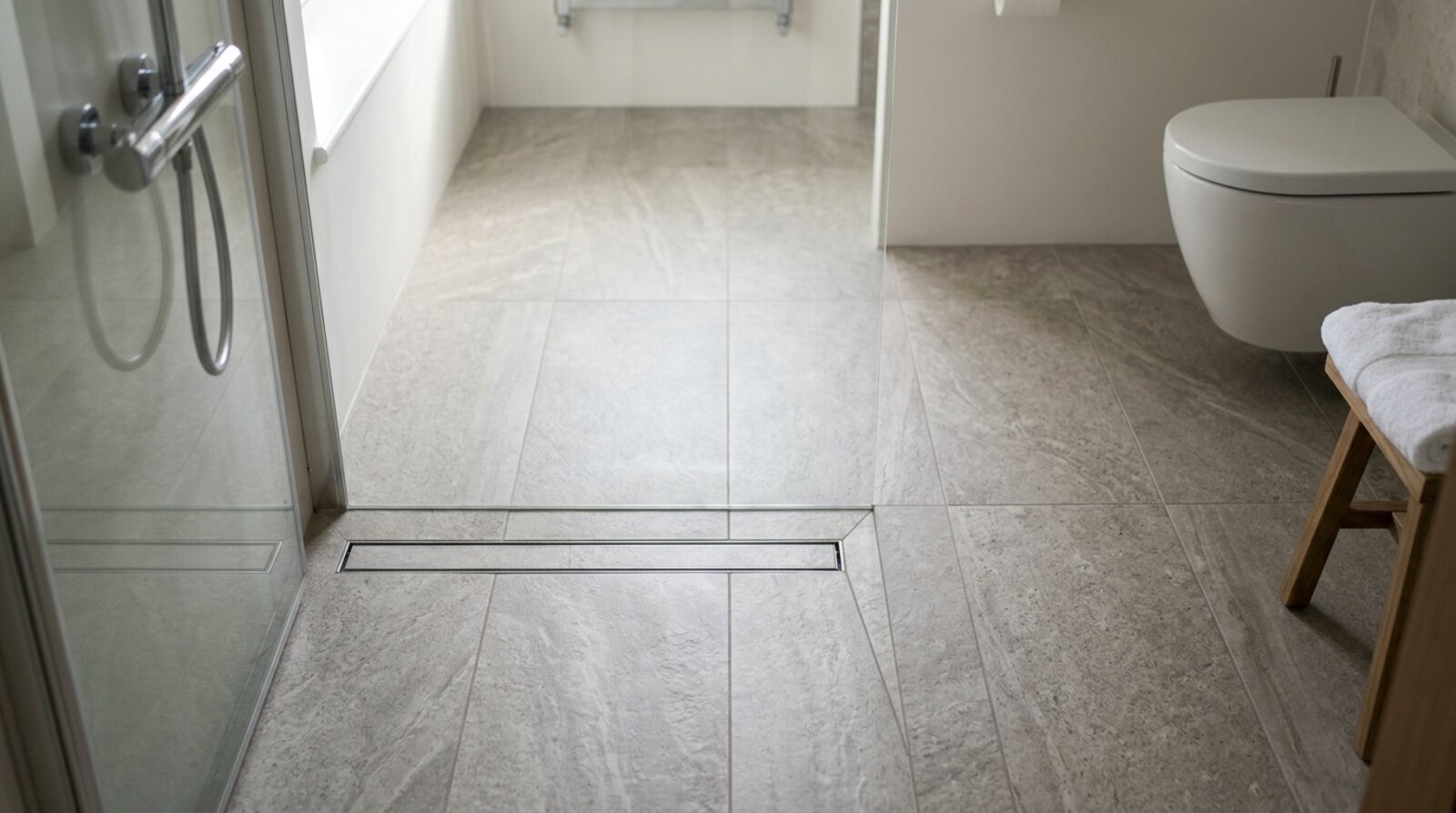
- Carry one floor tile straight into the shower. Using the same floor tile across the whole room and continuing it into a level-access or low-threshold shower removes the visual line where the floor stops. The room reads as one unbroken surface, which makes it feel larger. You step the slip rating up in the wet zone (covered below) rather than switching to a different tile.
- Take wall tiles up to the ceiling on at least one wall. Stopping tiles at chest height creates a horizontal band that caps the room. Full-height tiling on a shower wall or behind the basin lets the eye travel up and reads as taller.
- Keep the floor and walls in the same tonal family. A hard colour break between floor and walls draws a line around the room and shrinks it. Closely related tones blur that boundary.
Grout: the detail that quietly makes or breaks it
Grout colour is the cheapest design decision in the room and one of the most powerful. Match the grout closely to the tile and the joints almost disappear, so even a small wall reads as a single calm surface. Choose a contrasting grout, such as charcoal grout with white tiles, and you draw a hard grid that emphasises every joint and makes a small room feel busier and smaller. Contrast grout can look great in a larger room or a deliberately graphic scheme; in a tight bathroom it usually works against you.
There is a maintenance angle too. White or pale grout on a shower floor discolours over time with soap and grime. A mid-tone grout that is still close to the tile colour hides everyday staining better while keeping the joints quiet. For wet areas, an epoxy or a good-quality cement grout with added stain resistance will stay looking tidy for far longer than basic grout.
Large-format porcelain helps here as well: fewer tiles means fewer grout lines to clean and fewer lines to discolour, so the room stays looking newer for longer with less effort.
Materials: porcelain, ceramic and natural stone in plain terms
The three materials you will be choosing between behave differently, and the differences matter more in a wet, small room. If you want the underlying installation detail, The Tile Association publishes a free tiling guide covering substrates, adhesives and common installation issues.
Porcelain is fired denser and harder than standard ceramic and absorbs very little water. The recognised dividing line is a water absorption of 0.5 per cent or less, measured under the ceramic tile test standard BS EN ISO 10545-3, with the broader product requirements set out in BS EN 14411. That low porosity is why porcelain is hard-wearing, easy to keep clean and the default choice for bathroom floors. It comes in large formats and in finishes that convincingly mimic stone, concrete and timber, which lets you get a natural look without the upkeep of the real thing.
Ceramic tiles are softer and more porous than porcelain. They are perfectly good on walls, where they take less wear, and they are usually cheaper and easier to cut. They are less suited to floors that see heavy use, but on a small domestic bathroom wall a quality glazed ceramic is a sound, economical choice.
Natural stone, such as marble, limestone, slate or travertine, brings a depth that printed tiles cannot quite match. The catch is that most stone is porous and needs sealing on installation and periodically afterwards, and some stones etch when they meet acidic cleaners or limescale removers. In a small bathroom where every surface gets splashed, stone is a commitment to ongoing care. If you love the look but not the maintenance, a porcelain stone-effect tile gets you most of the way there.
Slip resistance: getting the floor right
A wet bathroom floor is exactly where slip resistance counts, and it is easy to overlook when you are choosing on looks alone. In the UK, the recognised measure is the Pendulum Test Value (PTV), the method the Health and Safety Executive favours for assessing how slippery a floor is. The HSE classification treats a PTV of 36 or above as low slip risk, with values of 25 to 35 classed as moderate and below 25 as high. The detail sits in the HSE’s published guidance on assessing the slip resistance of flooring.
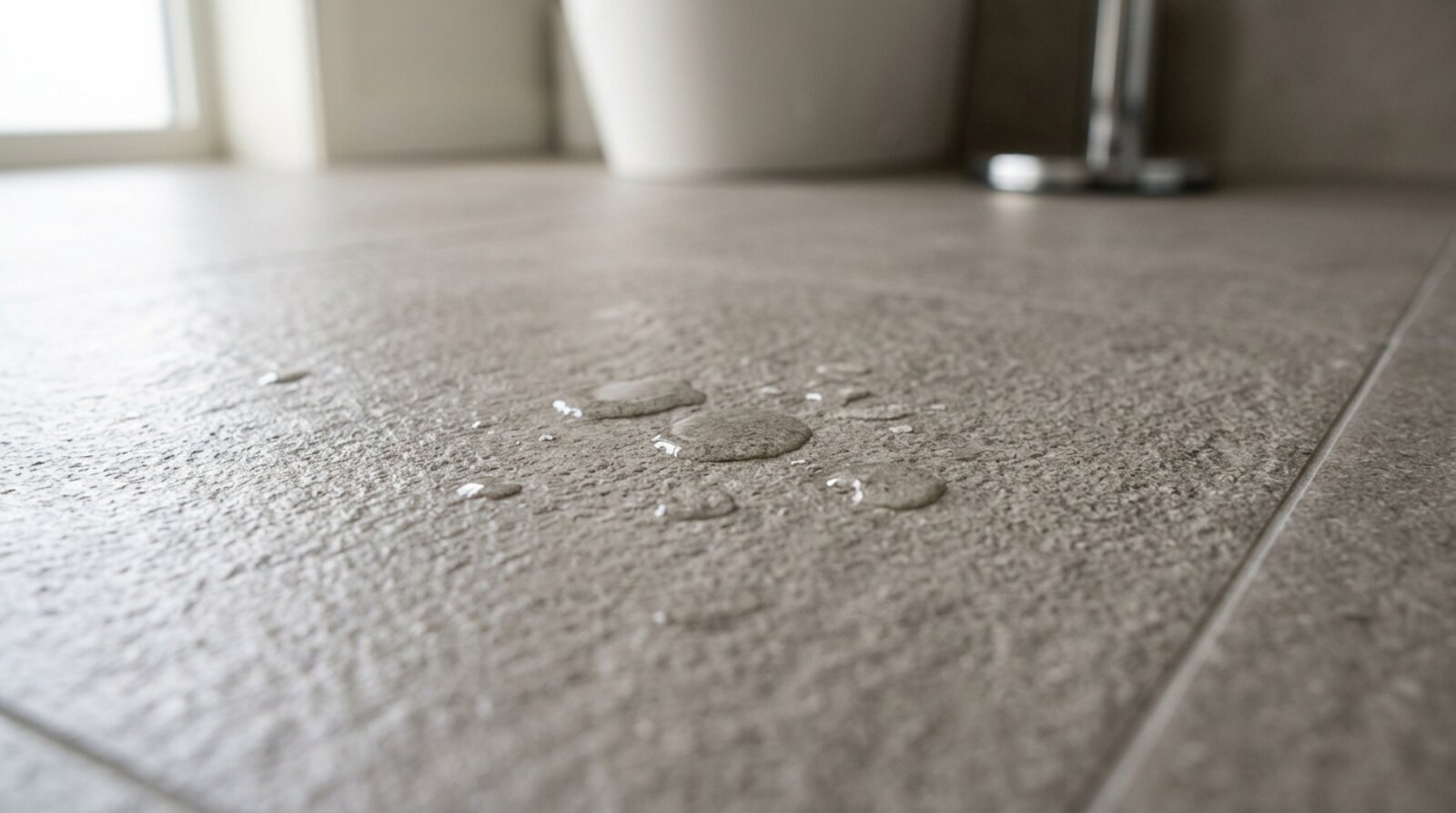
You will also see tiles labelled with an R rating (R9 up to R13), a German ramp-test scale that many UK suppliers quote. It is a useful shorthand, but be aware it is not the UK’s official measure and an R rating does not map cleanly onto a PTV figure. For a bathroom floor, aiming for something around R10 to R11, and ideally checking the PTV is 36 or higher in wet conditions, gives sensible grip without a surface so rough it is hard to clean. Inside the shower itself, step up to a more textured tile or use a smaller tile so the extra grout lines add grip underfoot.
The honed-or-gloss-on-walls, textured-on-floors split solves the apparent conflict: you get the light-bouncing finish where you want it on the walls and the grip where you need it underfoot.
Mistakes we see most often
- Using polished floor tiles for the look. A polished or high-gloss floor is dangerous when wet. Keep gloss to the walls.
- Contrasting grout in a tiny room. It looks sharp in photos and busy in a 2-metre space. Match the grout to the tile.
- Tiling only halfway up the wall. The horizontal band caps the room. Take tiles higher on at least one wall.
- Different floor tile inside the shower. Switching tile breaks the floor visually and shrinks the room. Carry the same tile through and change the grip, not the tile, where you can.
- Big tiles on a bowed wall. Large formats expose every undulation. The wall has to be flat first, or the tiles will lip.
- Skipping the slip rating. Choosing purely on colour and finding the floor is treacherous wet is a common and avoidable error.
If you want a second opinion on a layout, a tile choice or whether a wall is flat enough for large format, our team at Bromley Tilers is happy to look at the room before you buy. Getting the plan right on paper costs nothing and saves a lot of regret at grouting stage.
Frequently asked questions
Do large tiles really make a small bathroom look bigger?
Yes, in most cases. Larger tiles mean fewer grout lines, and fewer grout lines give the eye broad, uninterrupted surfaces to read, which makes the room feel more open. The wall does need to be flat for big tiles to lie well, so the substrate matters as much as the tile.
What slip rating should a small bathroom floor have?
For wet conditions, aim for a Pendulum Test Value of 36 or above, which the HSE classes as low slip risk. In R-rating terms many suppliers quote, something around R10 to R11 is sensible for a bathroom floor, with extra grip or smaller tiles inside the shower. The PTV figure is the UK’s recognised measure, so check it where you can.
Should I use the same tile on the floor and walls?
You do not have to use the identical tile, but keeping the floor and walls in the same tonal family blurs the boundary between them and makes the room feel larger. A hard colour break draws a line around the space and shrinks it. Continuing the floor tile into the shower has the same room-stretching effect.
What grout colour works best in a small bathroom?
A grout matched closely to the tile, so the joints almost vanish, keeps a small room looking calm and continuous. Contrasting grout creates a busy grid that emphasises every joint and makes the space feel smaller. A mid-tone matched grout also hides everyday staining better than bright white.
Is porcelain better than ceramic for a small bathroom?
For floors, yes. Porcelain is denser, harder and absorbs very little water (0.5 per cent or less), so it wears well and stays clean. Ceramic is fine and more economical on walls, where it takes less punishment. Porcelain also comes in large formats and convincing stone and wood effects, which suits the bigger-tile approach.
Can I use natural stone in a small bathroom?
You can, and it looks beautiful, but most stone is porous and needs sealing and ongoing care, and some types etch when they meet acidic cleaners or limescale. In a small, heavily splashed bathroom that is a real maintenance commitment. A porcelain stone-effect tile gives a similar look with far less upkeep.
Related guides
- How to Tile a Bathroom Wall: A UK Step-by-Step Guide
- How Much Does Tiling Cost in the UK? A Realistic Price Guide
- How to Remove Old Wall Tiles Without Damaging the Wall
- Porcelain vs Ceramic Tiles: Which Is Right for Your Bathroom or Kitchen?
- How to Tank and Waterproof a Wet Room Before Tiling: A Bromley Homeowner’s Guide
- Do You Need to Seal Natural Stone Tiles Before Grouting? A Tiler Explains
- How to Tile a Bathroom Floor (Including Around the Toilet)
- How to Tile a Shower: Walls, Niche and Waterproofing
- Construction Trade News: June 2026
- Bathroom Tiling Guide: How to Plan, Prep and Finish a Lasting Job
- Tile Backer Board vs Plasterboard for Bathrooms
- Wall and Floor Tiles for a Wet Room: What Actually Works
- Tiling vs Wall Panels for a Bathroom: Which Is Better?
- Do You Tile the Floor or Walls First in a Bathroom?
- Tiling and Bathroom Trade News: Mid-June 2026
- Kitchen Tiling: Splashbacks, Walls and Floors Explained
- How to Tile a Kitchen Splashback: Step-by-Step Bromley Guide
- How to Tile Around Kitchen Sockets, Switches and Worktops
- Kitchen Splashback Tile Ideas: 12 Looks That Work
- Tiling and Bathroom Trade News: Late June 2026
- How to Lay Metro Tiles in a Herringbone Pattern
- Tiled vs Glass Splashback (and Acrylic): Which Is Best?
- How High Should a Kitchen Splashback Be Tiled? UK Heights Guide
- Tiling and Bathroom Trade News: Early July 2026
- Types of Tiles: The Complete UK Buyer’s Guide
- Porcelain vs Natural Stone Tiles: Which Should You Choose?
- Natural Stone Tiles Explained: Marble, Travertine, Slate and Limestone
- Tiling and Bathroom Trade News: Mid-July 2026
- Mosaic Tiles: Where to Use Them and How They’re Fixed
- Tile Slip Ratings Explained: R Ratings and PTV for UK Floors
- Matt vs Gloss Tiles: Which Finish Is Right for Your Room?
- Cost to Tile a Bathroom in the UK: 2026 Price Breakdown
- Polystyrene Ceiling Tiles: Are They Any Good?
- Cost to Tile a Kitchen in 2026: Floor and Splashback Prices
- Tiling and Bathroom Trade News: Mid-July 2026
- Tiling Cost Per Square Metre 2026: Labour and All-In Prices
- Tiler Day Rate UK: What Tilers Charge Per Day in 2026
- Cost to Regrout a Bathroom in 2026: UK Prices Explained
- Floor Tile Prices UK 2026: What You Will Pay Per Square Metre
- Is It Cheaper to Tile or Use Wall Panels? A UK Cost Comparison
- How to Tile: A Complete Beginner’s Guide (UK)
- How to Cut Tiles: Manual Cutter, Wet Saw and Nippers
- How to Cut Holes in Tiles for Pipes and Taps
- How to Grout Tiles (and Get Clean, Even Lines)
- Cork Flooring: Pros, Cons and Where It Works in UK Homes
- Tiling and Bathroom Trade News: Late July 2026
- How to Mix and Apply Tile Adhesive Correctly
- How to Set Out Tiles for a Perfect Layout
- How to Seal Grout and Tiles in a Bathroom (UK Guide)
- Can You Tile Over Tiles? When It Works and When It Doesn’t
- Tiling Tools List: What You Need for a Professional Finish
- How Much Tile Adhesive Do I Need? Coverage Per Square Metre
- Tiling Trade News: Topps App, Costs Up 6% (Aug 2026)
- Tile Problems: 9 Common Faults and How to Fix Each
- How to Fix Loose Tiles Without Removing Them
- Cracked Grout Repair: Why It Happens and How to Fix It
- Tiling Trade News: TTA Silica Warning, 2% Retentions
- How to Replace a Broken Tile Without Redoing the Wall
- Water Leaking Through Shower Tiles: 6 Causes and Fixes
- Remove Mouldy Silicone Sealant: A 24-Hour Reseal Job
- How to Clean Grout: What Works, and What Etches Stone
- Why Are My Floor Tiles Lifting? The 40m² Bay Rule
- Tiling Trade News: 3,841 Construction Firms Failed
- How to Lay Porcelain Paving: 1:80 Fall, 150mm Below DPC
- Tile Patterns: Why Big Tiles Need a One-Third Offset
- Grout Colour Ideas: How to Get the Shade You Chose
- Can You Paint Tiles? Yes on Walls, No in the Shower
- Decoupling Membrane for Tiles: When You Actually Need One
- Can You Tile Over a Wooden Floor? What Changed in 2024
- Tiling Cost 2026: £25 to £95 per m² Labour, UK Rates
- Tile Ideas: 7 Looks and the One Rule Each Needs
- Metro Tiles: Sizes, Bevels and the 1/3 Offset Rule
- Tile Feature Wall: The Weight Limit That Decides Yours
- Tiling Over Underfloor Heating: 14 Days Before Heat On
- How to Tile a Hallway Floor: Set Out From the Door
- Wood Effect Tiles and Marble Effect: 5 Specs to Check
- Tile Levelling Systems: The 3mm Rule That Decides It
- Tiling Trade News: Repair Work Up 1.7%, Headlam Fails
- Floor Levelling Compound: How Deep and How Long to Dry
- How to Find a Good Tiler: 9 Checks Before You Book
- Tiling Quote: The 10 Lines a Proper One Must Show
- Tile Trim: Sizes, Profiles and the One-Size-Up Rule
- Tile Spacers: 2mm or 3mm, and When to Pull Them Out
- Tiling the Fireplace: 125mm Hearths, Adhesive and Tiles
- Tiling Trade News: Shaws Sinks Reprice on 1 November
- Porcelain vs Stone Paving: Grip, Sealing and Upkeep
- Tiling a Large Floor: Movement Joints Every 10 Metres
- DIY Tiling vs Professional: 6 Jobs to Never Do Yourself
- Terracotta Tiles: Seal Before Grouting, Wait 7 Days
- Tile Drill Bits: Which Bit Won’t Crack Porcelain
- Tiling Corners With Trim: Which Profile, and When to Mitre
- Travertine Tiles: Filled or Unfilled, and How to Seal Them
- Slate Tiles: Calibrated or Riven, and How to Lay Them
- Zellige Tiles: Order 15% Extra and Fix Them Edge to Edge
- Terrazzo Tiles: Real 20mm vs Porcelain, Seal Before Grouting
- Tiling Trade News: 36% Now Add a Bathroom Accent Wall
- Split Face Tiles: Will Your Wall Take 27kg per m²?
- Tile Sealer: Which Tiles Need It and Which Type to Buy
- How to Remove Grout Haze: Which Cleaner for Which Grout
- Efflorescence on Tiles: Why It Comes Back and How to Stop It
- Tile Primer: Which Surfaces Need It and How Much to Dilute
- Epoxy Grout: Where It’s Worth It and How to Apply It
- How to Tile Stairs: Keep Every Riser the Same Height
- Shower Niche: Sizes, Height and Which Wall Can Take One
- How Many Tiles Do I Need? Add 10% to 20% by Layout
- How to Tile a Window Sill: Sill Last, Silicone at the Frame
- Tiling Trade News: Victorian Plumbing Tile Sales Up 76%
- How to Tile Around a Toilet: Lift the Pan or Cut Round It
- Tile to Carpet Transition: Pick the Strip by the Height Gap
- Tile Skirting: Leave a 6mm Gap and Seal, Never Grout
- Tile Backer Board: Cement or Foam, Which Thickness, Fixings
- Quarry Tiles: Seal Them or Not, and How to Clean Them
- Rapid Set Tile Adhesive vs Standard: 30 Mins or 24 Hours
- Can You Tile Onto Plaster? Yes, Up to 20kg per m²
- How to Tile a Balcony: 1.5-2% Fall, Drain Mat, 150mm Upstand