



Porcelain vs stone paving is the decision most patio projects stall on, and it is usually argued on looks when the things that actually decide it are grip in the wet, how the slab behaves in a frost, and how much work it needs in year five. We lay both across Bromley and south east London, and neither is simply better. One is a manufactured product with a tightly controlled specification; the other is a natural material with variation built into it. Knowing which of those you want is most of the choice.
What porcelain and stone paving actually are
Outdoor porcelain is a fired ceramic slab, pressed and vitrified so that it absorbs almost no water. Under BS EN 14411 (and the equivalent ISO 13006), the porcelain group is BIa: water absorption of 0.5% or less. Outdoors it is normally supplied at 20mm thick rather than the 8mm to 12mm used indoors, because it has to span an imperfect mortar bed and take point loads from furniture legs.
Natural stone paving is quarried and cut, and is covered by a different standard: BS EN 1341:2012, which sets requirements and test methods for natural stone slabs used for external paving. The usual UK choices are Indian sandstone, limestone, granite, slate and porphyry, and we compare the materials themselves in porcelain vs natural stone tiles. Because it is a natural material, the standard deals in tolerances and declared values rather than a single fixed specification, and two slabs from the same pack will not be identical.
That difference runs through everything else. Porcelain gives you repeatability. Stone gives you variation, and variation is either the charm you paid for or the thing that annoys you, depending on what you expected.
Slip resistance: read the PTV, not the R rating
This is where most buyers are misled, and it is worth being blunt about it. Showrooms and websites advertise outdoor paving with an R rating, usually R11. That figure comes from DIN 51130, a German ramp test in which a person walks a sloped sample wearing cleated safety boots while the surface is contaminated with motor oil. It was designed for industrial floors. It is not a measure of how a wet patio behaves under a trainer or a bare foot.
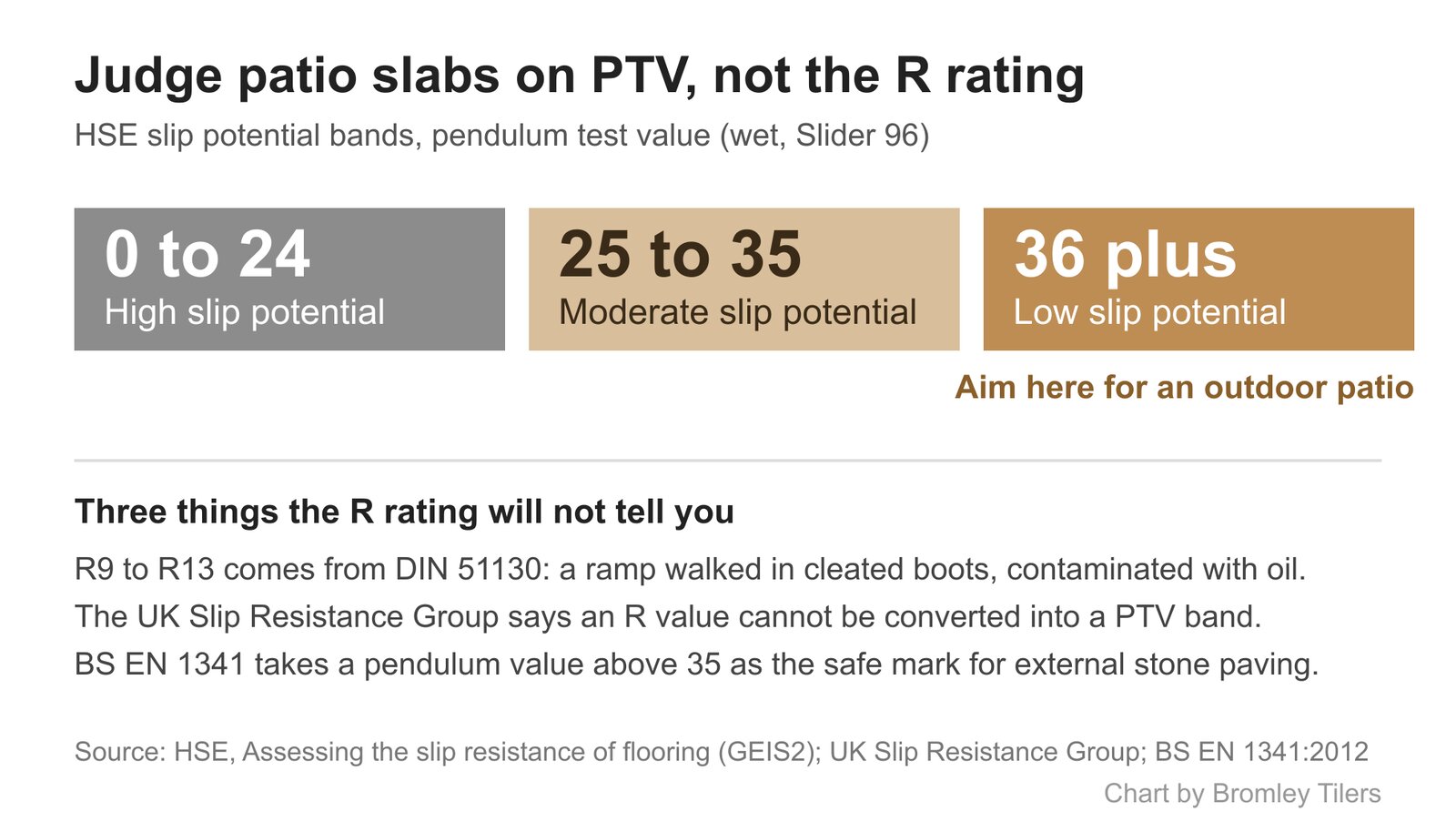
The measure UK guidance actually uses is the pendulum test value, or PTV, from BS 7976. The Health and Safety Executive sets the bands in its guidance note Assessing the slip resistance of flooring: a PTV of 0 to 24 is high slip potential, 25 to 35 is moderate, and 36 or above is low slip potential. BS EN 1341 takes the same line for external stone, treating a pendulum value above 35 as the generally safe mark.
The UK Slip Resistance Group is explicit that the pendulum and the DIN ramp test do not measure the same thing, and that a value from one cannot be converted into the other’s category. So an R11 sticker tells you very little on its own. Ask the supplier for a wet pendulum figure, tested with the Slider 96 rubber, and check it clears 36. We go into this in more detail in our piece on whether porcelain tiles are slippery.
Neither material wins outright. Textured, sawn or flamed stone and a grip-finish porcelain both test well; a polished surface of either does not. The common mistake is putting indoor-style polished porcelain outside, where it will be wet and shaded for months at a time.
Frost, water and what porosity costs you
Porcelain’s very low water absorption is why it copes with UK winters so easily: water it cannot take in cannot freeze inside it and spall the face off. It is also why porcelain does not really stain, as wine, barbecue fat and leaf tannin sit on the surface.
Stone is porous to varying degrees. Granite is dense and close to indifferent to weather. Sandstone and limestone are far more absorbent, which is why they darken when wet, hold algae in a shaded north-facing garden, and can keep a permanent shadow from an oil spill. It is also why a poorly bedded stone slab shows picture framing, the pale border left by salts drawn up through the joint.
None of that makes stone a bad buy. It means stone asks for a sealer and periodic cleaning, and porcelain largely does not.
Laying: porcelain is far less forgiving
Both materials are covered by BS 7533-102:2021, the code of practice for constructing pavements with modular paving units, which includes porcelain in both bound and unbound builds. The build-up is broadly the same: a compacted sub-base, then a full mortar bed, typically around 30mm to 40mm.
The critical extra step with porcelain is the slurry primer. Because the back of a porcelain slab is effectively non-absorbent, mortar has nothing to key into. A cement-based slurry primer has to be brushed onto the full underside of every slab and laid into wet mortar so the two cure together. Skip it, or prime only the corners, and the slabs will sound hollow and eventually lift. This is not optional detailing, it is the difference between a patio that lasts and one that fails in three winters.
Porcelain also needs a full bed with no voids, because a 20mm ceramic slab bridging a gap will crack under a point load where a sandstone flag would not. It takes a diamond blade to cut, too. The full sequence is set out in our step by step on laying outdoor porcelain paving.
Two rules apply whichever you pick. Build in a fall so water runs off: 1:80, or 12.5mm per metre, is the usual minimum, and many installers prefer 1:60 for porcelain because the surface is non-porous and every drop has to be moved by gradient alone. And keep the finished paving level well below the damp proof course. Approved Document C practice is at least 150mm; where that genuinely cannot be achieved on an existing house, 75mm is the absolute floor, with drainage to suit. A patio laid up to the brickwork is one of the most common causes of damp we get called to.
Planning permission and drainage
This catches people out on front gardens rather than back patios. Under permitted development for houses, laying more than five square metres of traditional impermeable surfacing in a front garden needs planning permission if the water cannot run to a permeable area. If the surface is permeable, or the rainwater is directed to a lawn or border to soak away naturally, no permission is needed. The rules do not apply to flats and maisonettes, and an Article 4 direction or a planning condition can remove the right entirely. The Planning Portal sets out the current position.
Both porcelain and stone are impermeable surfaces in this sense, so neither gets you out of it. What matters is where the water goes: a permeable jointing system, a gravel margin, or a fall onto a border will usually keep you inside permitted development.
Sourcing and ethics on natural stone
One point that rarely comes up in a showroom. Much of the sandstone laid in British gardens comes from Rajasthan, and child labour in those quarries has been documented for two decades. Marshalls was the first stone company to join the Ethical Trading Initiative, in 2006, and went on to audit its Indian supply chain and fund schooling in quarrying communities. The ETI’s own account of that work is published on its site.
If you buy natural stone, ask where it was quarried and whether the supply chain is independently audited. Reputable merchants answer that immediately.
Which one should you actually buy
Choose porcelain if you want a patio that looks the same in ten years as on day one, you have a shaded garden where algae is a recurring nuisance, or you are matching an indoor floor across a threshold. Accept that it costs more to lay properly and can look flat over a large area if you pick a heavily printed pattern.
Choose natural stone if you want depth and variation, or you have a period property where a uniform ceramic surface would look wrong. Accept that it needs sealing, that it will change colour, and that it wants a proper clean every couple of years.
On cost, porcelain is generally dearer once laying is included: the slurry priming, the cutting and the lower tolerance for a sloppy bed all add labour. Stone is cheaper to buy and quicker to lay, but carries a maintenance cost porcelain does not. Get both quoted on the same drawing, with the same build-up specified.
Frequently asked questions
Is porcelain paving slippery when wet?
Good outdoor porcelain is not, but you have to check the right number. Ask for the wet pendulum test value rather than the R rating, and look for 36 or above, which is the HSE’s low slip potential band. Polished or indoor-grade porcelain laid outside genuinely is slippery and should not be used.
Does porcelain paving need sealing?
No. With water absorption of 0.5% or less it has almost nothing for a sealer to penetrate, and sealing it can leave a residue on the surface. Natural stone, particularly sandstone and limestone, does benefit from a breathable impregnating sealer.
Can porcelain paving be laid on sand?
Not for a domestic patio. Twenty millimetre porcelain needs a full mortar bed with a slurry primer on the back of each slab so it bonds. Laid on sand it will rock, sound hollow and crack under point loads. Pedestal systems on a flat roof or balcony are a different case, but that is not a garden patio build.
Do I need planning permission for a patio?
A rear patio normally does not need permission. A front garden is different: more than five square metres of impermeable surfacing needs permission unless the water drains to a permeable area such as a lawn or border. Flats, maisonettes and properties under an Article 4 direction are not covered by the permitted development right.
How much fall does a patio need?
A minimum of 1:80, which is 12.5mm of fall for every metre, away from the house. On porcelain many installers use 1:60, because the slab absorbs nothing and all the water has to be moved by gradient. Build the fall into the sub-base and mortar bed rather than trying to correct it at the surface.
Getting it laid in Bromley
The specification matters more than the material. A stone patio laid on a full bed with the right fall will outlive a porcelain one dropped on five dabs of mortar. If you want either quoted properly, with the build-up written down, Bromley Tilers covers Bromley and south east London.
Related guides
- How to Tile a Bathroom Wall: A UK Step-by-Step Guide
- How Much Does Tiling Cost in the UK? A Realistic Price Guide
- How to Remove Old Wall Tiles Without Damaging the Wall
- Porcelain vs Ceramic Tiles: Which Is Right for Your Bathroom or Kitchen?
- How to Tank and Waterproof a Wet Room Before Tiling: A Bromley Homeowner’s Guide
- Do You Need to Seal Natural Stone Tiles Before Grouting? A Tiler Explains
- How to Tile a Bathroom Floor (Including Around the Toilet)
- How to Tile a Shower: Walls, Niche and Waterproofing
- Construction Trade News: June 2026
- Bathroom Tiling Guide: How to Plan, Prep and Finish a Lasting Job
- Tile Backer Board vs Plasterboard for Bathrooms
- Best Tiles for Small Bathrooms (and How to Make a Space Look Bigger)
- Wall and Floor Tiles for a Wet Room: What Actually Works
- Tiling vs Wall Panels for a Bathroom: Which Is Better?
- Do You Tile the Floor or Walls First in a Bathroom?
- Tiling and Bathroom Trade News: Mid-June 2026
- Kitchen Tiling: Splashbacks, Walls and Floors Explained
- How to Tile a Kitchen Splashback: Step-by-Step Bromley Guide
- How to Tile Around Kitchen Sockets, Switches and Worktops
- Kitchen Splashback Tile Ideas: 12 Looks That Work
- Tiling and Bathroom Trade News: Late June 2026
- How to Lay Metro Tiles in a Herringbone Pattern
- Tiled vs Glass Splashback (and Acrylic): Which Is Best?
- How High Should a Kitchen Splashback Be Tiled? UK Heights Guide
- Tiling and Bathroom Trade News: Early July 2026
- Types of Tiles: The Complete UK Buyer’s Guide
- Porcelain vs Natural Stone Tiles: Which Should You Choose?
- Natural Stone Tiles Explained: Marble, Travertine, Slate and Limestone
- Tiling and Bathroom Trade News: Mid-July 2026
- Mosaic Tiles: Where to Use Them and How They’re Fixed
- Tile Slip Ratings Explained: R Ratings and PTV for UK Floors
- Matt vs Gloss Tiles: Which Finish Is Right for Your Room?
- Cost to Tile a Bathroom in the UK: 2026 Price Breakdown
- Polystyrene Ceiling Tiles: Are They Any Good?
- Cost to Tile a Kitchen in 2026: Floor and Splashback Prices
- Tiling and Bathroom Trade News: Mid-July 2026
- Tiling Cost Per Square Metre 2026: Labour and All-In Prices
- Tiler Day Rate UK: What Tilers Charge Per Day in 2026
- Cost to Regrout a Bathroom in 2026: UK Prices Explained
- Floor Tile Prices UK 2026: What You Will Pay Per Square Metre
- Is It Cheaper to Tile or Use Wall Panels? A UK Cost Comparison
- How to Tile: A Complete Beginner’s Guide (UK)
- How to Cut Tiles: Manual Cutter, Wet Saw and Nippers
- How to Cut Holes in Tiles for Pipes and Taps
- How to Grout Tiles (and Get Clean, Even Lines)
- Cork Flooring: Pros, Cons and Where It Works in UK Homes
- Tiling and Bathroom Trade News: Late July 2026
- How to Mix and Apply Tile Adhesive Correctly
- How to Set Out Tiles for a Perfect Layout
- How to Seal Grout and Tiles in a Bathroom (UK Guide)
- Can You Tile Over Tiles? When It Works and When It Doesn’t
- Tiling Tools List: What You Need for a Professional Finish
- How Much Tile Adhesive Do I Need? Coverage Per Square Metre
- Tiling Trade News: Topps App, Costs Up 6% (Aug 2026)
- Tile Problems: 9 Common Faults and How to Fix Each
- How to Fix Loose Tiles Without Removing Them
- Cracked Grout Repair: Why It Happens and How to Fix It
- Tiling Trade News: TTA Silica Warning, 2% Retentions
- How to Replace a Broken Tile Without Redoing the Wall
- Water Leaking Through Shower Tiles: 6 Causes and Fixes
- Remove Mouldy Silicone Sealant: A 24-Hour Reseal Job
- How to Clean Grout: What Works, and What Etches Stone
- Why Are My Floor Tiles Lifting? The 40m² Bay Rule
- Tiling Trade News: 3,841 Construction Firms Failed
- How to Lay Porcelain Paving: 1:80 Fall, 150mm Below DPC
- Tile Patterns: Why Big Tiles Need a One-Third Offset
- Grout Colour Ideas: How to Get the Shade You Chose
- Can You Paint Tiles? Yes on Walls, No in the Shower
- Decoupling Membrane for Tiles: When You Actually Need One
- Can You Tile Over a Wooden Floor? What Changed in 2024
- Tiling Cost 2026: £25 to £95 per m² Labour, UK Rates
- Tile Ideas: 7 Looks and the One Rule Each Needs
- Metro Tiles: Sizes, Bevels and the 1/3 Offset Rule
- Tile Feature Wall: The Weight Limit That Decides Yours
- Tiling Over Underfloor Heating: 14 Days Before Heat On
- How to Tile a Hallway Floor: Set Out From the Door
- Wood Effect Tiles and Marble Effect: 5 Specs to Check
- Tile Levelling Systems: The 3mm Rule That Decides It
- Tiling Trade News: Repair Work Up 1.7%, Headlam Fails
- Floor Levelling Compound: How Deep and How Long to Dry
- How to Find a Good Tiler: 9 Checks Before You Book
- Tiling Quote: The 10 Lines a Proper One Must Show
- Tile Trim: Sizes, Profiles and the One-Size-Up Rule
- Tile Spacers: 2mm or 3mm, and When to Pull Them Out
- Tiling the Fireplace: 125mm Hearths, Adhesive and Tiles
- Tiling Trade News: Shaws Sinks Reprice on 1 November
- Tiling a Large Floor: Movement Joints Every 10 Metres