


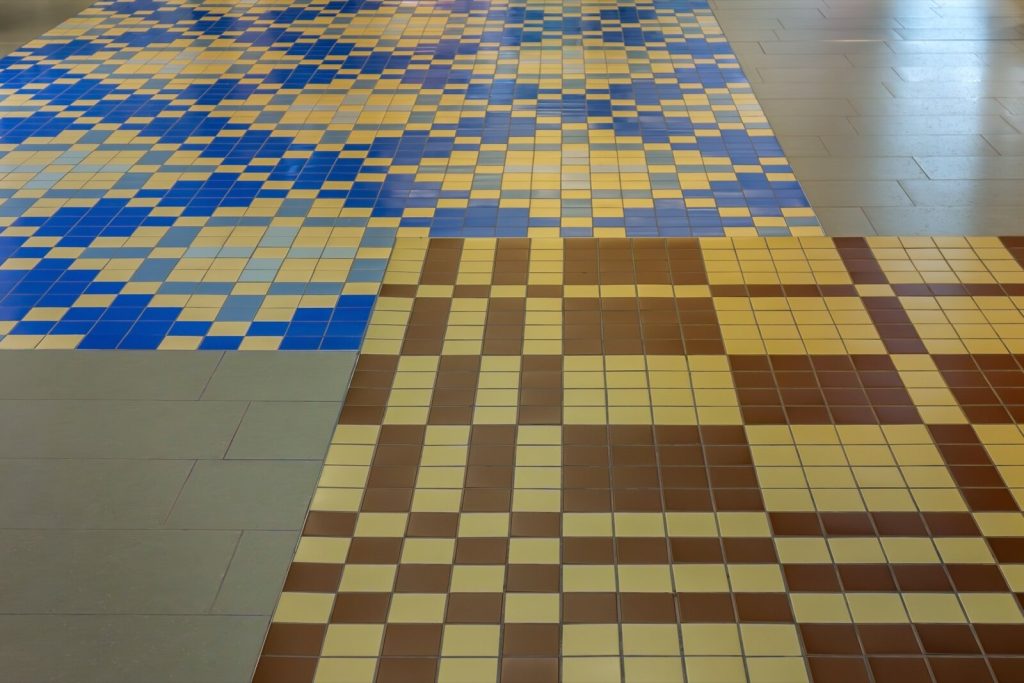
Tile patterns decide how a finished floor or wall reads long before anyone notices the tile itself. The same 600mm porcelain looks calm in a stack bond, restless in a herringbone and subtly wider in a brick bond, and the pattern you pick also changes how much tile you buy, how long the job takes and whether you end up with a floor you can feel underfoot. This guide runs through the patterns that get used on real UK jobs, what each one costs you in labour and waste, and the one technical rule that catches out more large-format installations than anything else.
We fit tiles in Bromley and across south east London every week, so the notes below are about what works when the walls are out of square and the room is 2.7m by 2.1m, not what looks good in a showroom mock-up.
Stack bond: the grid
Every joint lines up in both directions, so the tiles form a plain grid. It is the simplest pattern to set out and the least forgiving of anything else being wrong. Because the eye follows those continuous grout lines straight to the wall, a room that is out of square shows it immediately, and any variation in tile size shows up as a joint that wanders.
It suits large-format tiles, rectified edges (tiles machine-cut to a precise size after firing) and narrow joints, which is why it dominates modern bathrooms. It is a poor choice for a hand-made or heavily patterned tile with size variation, because the grid has nowhere to hide it.
Labour is at the lower end: fewer cuts, no offset to keep track of, and the setting out is a single pair of centre lines. Waste is also at the lower end, usually the standard allowance rather than anything extra.
Brick bond and the one-third offset
Brick bond, also called running bond or offset, staggers each row so the joints do not align. The traditional version offsets each row by half a tile, which is where the “brick” name comes from and what most people picture. On a small wall tile that is fine and always has been. On anything large it is a mistake, and this is the single most useful thing to know before you choose a pattern.
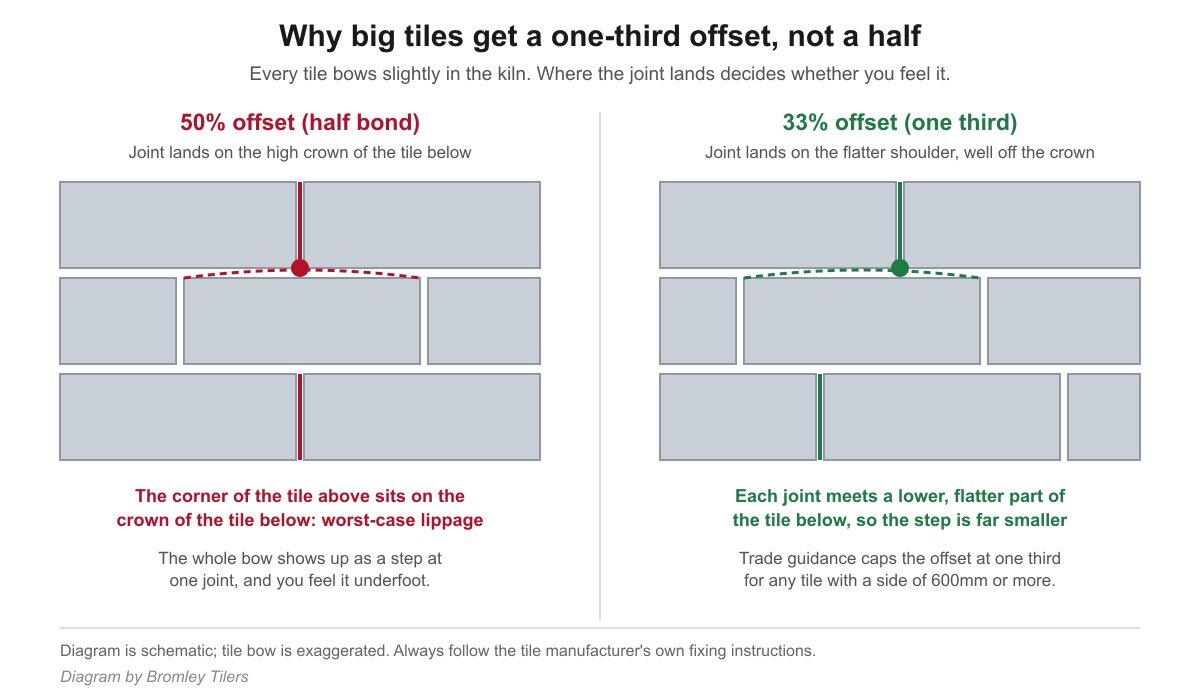
Ceramic and porcelain tiles do not come out of the kiln perfectly flat. They bow very slightly, so the middle of the tile sits a fraction higher than the corners. On a 300mm tile you will never notice. On a 1200mm plank the difference between the centre and the ends is enough to feel. Lay those in a half-bond and you place the corner of one tile directly against the crown of the tile below, which puts the entire bow into a single joint. The result is lippage: a step at the joint that catches the light, catches a mop and, on a floor, catches a bare toe.
Shifting the offset to one third moves each joint away from the crown and onto the flatter shoulder of the tile below, so the same bow is spread across three joints instead of concentrated in one. Trade guidance and most tile manufacturers’ own fixing instructions cap the offset at one third for any tile with a side of 600mm or more. Some go further and specify it for anything over 400mm. Check the box or the manufacturer’s technical sheet before you commit, because fitting a large tile in half bond against those instructions is a common reason a warranty claim gets refused.
If you want the look of a half bond on a big tile, the honest answer is to choose a smaller tile rather than ignore the rule.
Herringbone and chevron
Herringbone lays rectangular tiles at 90 degrees to each other in a zigzag, with the end of one tile meeting the side of the next. Chevron looks similar at a glance but is a different tile: the ends are cut at an angle, usually 45 degrees, so the tiles meet point to point and form a continuous V. You cannot make a true chevron from standard rectangular tiles, and anyone who tells you otherwise is planning to cut every single tile.
Both patterns are laid at either 45 degrees or 90 degrees to the room. The 45 degree version is the classic look and the more expensive one, because every tile meeting a wall needs an angled cut.
Budget for this properly. Where a straight lay might need around a tenth of the floor area again in spare tile, a 45 degree herringbone can easily need a fifth, because the offcuts from angled perimeter cuts are rarely reusable. Labour goes up by a similar order: the setting out is more involved, there are far more cuts, and each one has to be accurate because the pattern is unforgiving of a tile that is a millimetre out.
Herringbone works well on a floor in a hallway, where the zigzag pulls the eye along the length of the space, and on a splashback where the small area keeps the cost sane. In a small bathroom floor it can look busy, though a single-colour matt tile keeps it calm.
Basketweave, Versailles and other set patterns
Basketweave pairs tiles at right angles in alternating blocks, so the floor reads as woven. It is usually done in a small format and often in a bathroom, where the tighter grid gives grip and the pattern is small enough not to overwhelm the room.
The Versailles pattern, sometimes sold as a French pattern or Roman pattern, uses four or five different tile sizes that repeat in a set module. Suppliers sell it as a mixed pack for that reason. It reads as random but is not, and the repeat is usually large enough that the eye does not lock onto it. It suits stone and stone-effect porcelain in a big room, and it is genuinely difficult to set out from scratch, so buy the module rather than improvising.
Both patterns need a dry lay before anything is fixed. Setting out several tile sizes on paper rarely survives contact with a real room.
What each pattern does to your tile order
Every pattern has a wastage cost, and it is one of the few parts of a tiling job you can get exactly right in advance. Topps Tiles, for instance, works on roughly ten per cent extra for cuts and wastage as a baseline, and rounds up to whole boxes on top of that. That baseline assumes a straightforward rectangular room laid straight.
- Straight lay or stack bond, simple room: the baseline allowance is usually enough.
- Brick bond: a little above baseline, because the half or third tile that starts alternate rows leaves an offcut that only sometimes fits elsewhere.
- Diagonal, herringbone or chevron: noticeably more, commonly half again as much as the baseline or higher, because angled perimeter cuts produce offcuts that cannot be reused.
- Rooms with lots of obstacles: a WC, a basin pedestal, a chimney breast and a doorway between them will each eat a tile.
Two rules worth following regardless of pattern. Order the whole job in one go, from one batch, because tile shade varies between production batches and matching later is often impossible. And keep the spares. A box in the loft is the difference between replacing one cracked tile in an hour and re-tiling a room in five years.
Grout joints: the part people get wrong
The pattern and the joint work together, and there is a genuine minimum here rather than a matter of taste. The Tile Association’s guidance for wall tiling is that for tiles with a facial area under 0.1 square metres and no side over 600mm, joints should not be less than 2mm wide, and for tiles from 0.1 to 1 square metre with no side over 1200mm, not less than 3mm. For floor tiling the width should not be less than 3mm.
Those minimums exist because the joint absorbs the small differences in tile size, the slight movement in the building and the variation in the substrate. Pushing a large tile to a 1.5mm joint because it looks sharper removes that tolerance, and the pattern is usually where the failure shows up first: a brick bond with joints that are 2mm at one end of the wall and 4mm at the other, because the accumulated size variation had nowhere to go.
Grout colour changes how strongly the pattern reads. A matched grout makes a herringbone recede into a texture. A contrasting grout turns the same floor into a graphic. Neither is wrong, but decide before you order, because you cannot easily change your mind afterwards.
Choosing a pattern for the room you actually have
A few things that consistently matter more than the trend of the moment.
Room shape. A rectangular plank laid across the short dimension of a narrow room makes it read wider. A herringbone laid along a hallway makes it read longer. In a small square bathroom, a large tile in a simple layout with fewer grout lines usually looks bigger than a small tile in a busy one.
How square the room is. Older houses in Bromley and the surrounding area rarely have square rooms, and a pattern with strong continuous lines will announce that. Where the walls are visibly out, a diagonal or a herringbone is more forgiving than a stack bond, because there is no long straight joint running to a wall for the eye to compare against.
Where the pattern starts. Setting out matters more than the pattern itself. The aim is to avoid a sliver of tile in a visible position, so the pattern is usually centred on the most-seen sight line rather than on the geometric centre of the room. A good tiler will dry-lay the first rows and move the whole grid to kill a bad cut at the doorway or under the bath.
Slip resistance on floors. Pattern does not change a tile’s slip rating, but joint density does affect grip in practice: a small-format basketweave with plenty of grout lines gives more purchase in a wet room than one big polished slab. Choose the tile for the rating first, then the pattern.
If you are weighing up options for a specific room, our tiling guides cover the material and cost side that sits alongside this.
Frequently asked questions
What is the most popular tile pattern in UK homes?
Straight lay and brick bond between them account for the large majority of domestic tiling, because they are quick to set out, cheap in labour and waste, and they suit the large-format porcelain that most people now buy. Herringbone is the most popular of the decorative patterns, usually on hallway floors and kitchen splashbacks rather than across a whole house.
Can I lay large tiles in a half brick bond?
You can physically, but you should not, and on most large-format tiles the manufacturer’s fixing instructions tell you not to. Tiles bow slightly during firing, and a half offset puts the corner of one tile against the highest point of the tile below, which produces a visible and palpable step at the joint. Trade guidance is to cap the offset at one third for any tile with a side of 600mm or more. Check the manufacturer’s technical sheet, because fitting against those instructions can void the warranty.
How much extra tile should I order for a herringbone floor?
More than for a straight lay. A simple straight lay in a plain rectangular room typically works on around ten per cent extra for cuts and wastage. A herringbone laid at 45 degrees commonly needs half as much again or more, because every perimeter tile takes an angled cut and the offcut usually cannot be used anywhere else. Get your tiler to work it out from the actual room dimensions rather than applying a flat percentage.
Does the tile pattern affect the cost of labour?
Yes, and often by more than the extra tile does. Setting out takes longer, there are more cuts, and each cut has to be more accurate. A herringbone or a Versailles pattern is slower to lay than a stack bond of the same area, so expect a tiler’s price per square metre to reflect the pattern as well as the tile size and the state of the substrate.
Which British Standard covers tiling patterns?
The BS 5385 series covers wall and floor tiling. Part 1 deals with internal wall tiling and Part 3 with floor tiling. Part 3 was revised in May 2024, and BS 5385 Part 5:2009, which covered terrazzo and natural stone flooring, has been withdrawn with its content folded into the revised Part 3. The standards cover design and installation, including substrate preparation and joint widths, rather than prescribing which decorative pattern to use.
Should the grout match the tile or contrast with it?
It depends on how much you want the pattern to show. Matching grout makes the pattern read as a texture and hides small irregularities in the setting out. Contrasting grout makes the geometry the feature, which suits a well-executed herringbone or a metro brick bond, but it also draws attention to every joint that is not perfectly consistent. On floors, bear in mind that a very pale grout in a high-traffic area will need sealing and will show wear sooner.
Related guides
- How to Tile a Bathroom Wall: A UK Step-by-Step Guide
- How Much Does Tiling Cost in the UK? A Realistic Price Guide
- How to Remove Old Wall Tiles Without Damaging the Wall
- Porcelain vs Ceramic Tiles: Which Is Right for Your Bathroom or Kitchen?
- How to Tank and Waterproof a Wet Room Before Tiling: A Bromley Homeowner’s Guide
- Do You Need to Seal Natural Stone Tiles Before Grouting? A Tiler Explains
- How to Tile a Bathroom Floor (Including Around the Toilet)
- How to Tile a Shower: Walls, Niche and Waterproofing
- Construction Trade News: June 2026
- Bathroom Tiling Guide: How to Plan, Prep and Finish a Lasting Job
- Tile Backer Board vs Plasterboard for Bathrooms
- Best Tiles for Small Bathrooms (and How to Make a Space Look Bigger)
- Wall and Floor Tiles for a Wet Room: What Actually Works
- Tiling vs Wall Panels for a Bathroom: Which Is Better?
- Do You Tile the Floor or Walls First in a Bathroom?
- Tiling and Bathroom Trade News: Mid-June 2026
- Kitchen Tiling: Splashbacks, Walls and Floors Explained
- How to Tile a Kitchen Splashback: Step-by-Step Bromley Guide
- How to Tile Around Kitchen Sockets, Switches and Worktops
- Kitchen Splashback Tile Ideas: 12 Looks That Work
- Tiling and Bathroom Trade News: Late June 2026
- How to Lay Metro Tiles in a Herringbone Pattern
- Tiled vs Glass Splashback (and Acrylic): Which Is Best?
- How High Should a Kitchen Splashback Be Tiled? UK Heights Guide
- Tiling and Bathroom Trade News: Early July 2026
- Types of Tiles: The Complete UK Buyer’s Guide
- Porcelain vs Natural Stone Tiles: Which Should You Choose?
- Natural Stone Tiles Explained: Marble, Travertine, Slate and Limestone
- Tiling and Bathroom Trade News: Mid-July 2026
- Mosaic Tiles: Where to Use Them and How They’re Fixed
- Tile Slip Ratings Explained: R Ratings and PTV for UK Floors
- Matt vs Gloss Tiles: Which Finish Is Right for Your Room?
- Cost to Tile a Bathroom in the UK: 2026 Price Breakdown
- Polystyrene Ceiling Tiles: Are They Any Good?
- Cost to Tile a Kitchen in 2026: Floor and Splashback Prices
- Tiling and Bathroom Trade News: Mid-July 2026
- Tiling Cost Per Square Metre 2026: Labour and All-In Prices
- Tiler Day Rate UK: What Tilers Charge Per Day in 2026
- Cost to Regrout a Bathroom in 2026: UK Prices Explained
- Floor Tile Prices UK 2026: What You Will Pay Per Square Metre
- Is It Cheaper to Tile or Use Wall Panels? A UK Cost Comparison
- How to Tile: A Complete Beginner’s Guide (UK)
- How to Cut Tiles: Manual Cutter, Wet Saw and Nippers
- How to Cut Holes in Tiles for Pipes and Taps
- How to Grout Tiles (and Get Clean, Even Lines)
- Cork Flooring: Pros, Cons and Where It Works in UK Homes
- Tiling and Bathroom Trade News: Late July 2026
- How to Mix and Apply Tile Adhesive Correctly
- How to Set Out Tiles for a Perfect Layout
- How to Seal Grout and Tiles in a Bathroom (UK Guide)
- Can You Tile Over Tiles? When It Works and When It Doesn’t
- Tiling Tools List: What You Need for a Professional Finish
- How Much Tile Adhesive Do I Need? Coverage Per Square Metre
- Tiling Trade News: Topps App, Costs Up 6% (Aug 2026)
- Tile Problems: 9 Common Faults and How to Fix Each
- How to Fix Loose Tiles Without Removing Them
- Cracked Grout Repair: Why It Happens and How to Fix It
- Tiling Trade News: TTA Silica Warning, 2% Retentions
- How to Replace a Broken Tile Without Redoing the Wall
- Water Leaking Through Shower Tiles: 6 Causes and Fixes
- Remove Mouldy Silicone Sealant: A 24-Hour Reseal Job
- How to Clean Grout: What Works, and What Etches Stone
- Why Are My Floor Tiles Lifting? The 40m² Bay Rule
- Tiling Trade News: 3,841 Construction Firms Failed
- How to Lay Porcelain Paving: 1:80 Fall, 150mm Below DPC
- Grout Colour Ideas: How to Get the Shade You Chose
- Can You Paint Tiles? Yes on Walls, No in the Shower
- Decoupling Membrane for Tiles: When You Actually Need One
- Can You Tile Over a Wooden Floor? What Changed in 2024
- Tiling Cost 2026: £25 to £95 per m² Labour, UK Rates
- Tile Ideas: 7 Looks and the One Rule Each Needs
- Metro Tiles: Sizes, Bevels and the 1/3 Offset Rule
- Tile Feature Wall: The Weight Limit That Decides Yours
- Tiling Over Underfloor Heating: 14 Days Before Heat On
- How to Tile a Hallway Floor: Set Out From the Door
- Wood Effect Tiles and Marble Effect: 5 Specs to Check
- Tile Levelling Systems: The 3mm Rule That Decides It
- Tiling Trade News: Repair Work Up 1.7%, Headlam Fails
- Floor Levelling Compound: How Deep and How Long to Dry
- How to Find a Good Tiler: 9 Checks Before You Book
- Tiling Quote: The 10 Lines a Proper One Must Show
- Tile Trim: Sizes, Profiles and the One-Size-Up Rule
- Tile Spacers: 2mm or 3mm, and When to Pull Them Out
- Tiling the Fireplace: 125mm Hearths, Adhesive and Tiles
- Tiling Trade News: Shaws Sinks Reprice on 1 November
- Porcelain vs Stone Paving: Grip, Sealing and Upkeep
- Tiling a Large Floor: Movement Joints Every 10 Metres
- DIY Tiling vs Professional: 6 Jobs to Never Do Yourself
- Terracotta Tiles: Seal Before Grouting, Wait 7 Days
- Tile Drill Bits: Which Bit Won’t Crack Porcelain
- Tiling Corners With Trim: Which Profile, and When to Mitre
- Travertine Tiles: Filled or Unfilled, and How to Seal Them
- Slate Tiles: Calibrated or Riven, and How to Lay Them
- Zellige Tiles: Order 15% Extra and Fix Them Edge to Edge
- Terrazzo Tiles: Real 20mm vs Porcelain, Seal Before Grouting
- Tiling Trade News: 36% Now Add a Bathroom Accent Wall
- Split Face Tiles: Will Your Wall Take 27kg per m²?
- Tile Sealer: Which Tiles Need It and Which Type to Buy
- How to Remove Grout Haze: Which Cleaner for Which Grout
- Efflorescence on Tiles: Why It Comes Back and How to Stop It
- Tile Primer: Which Surfaces Need It and How Much to Dilute
- Epoxy Grout: Where It’s Worth It and How to Apply It
- How to Tile Stairs: Keep Every Riser the Same Height
- Shower Niche: Sizes, Height and Which Wall Can Take One
- How Many Tiles Do I Need? Add 10% to 20% by Layout
- How to Tile a Window Sill: Sill Last, Silicone at the Frame
- Tiling Trade News: Victorian Plumbing Tile Sales Up 76%
- How to Tile Around a Toilet: Lift the Pan or Cut Round It
- Tile to Carpet Transition: Pick the Strip by the Height Gap
- Tile Skirting: Leave a 6mm Gap and Seal, Never Grout
- Tile Backer Board: Cement or Foam, Which Thickness, Fixings
- Quarry Tiles: Seal Them or Not, and How to Clean Them
- Rapid Set Tile Adhesive vs Standard: 30 Mins or 24 Hours