



Can you paint tiles instead of ripping them off the wall? On walls, yes, and the result can be genuinely good for a few years. On floors it needs a different product entirely, and inside a shower enclosure the paint makers themselves tell you not to bother. That gap between what people assume tile paint does and what the tin actually permits is where most disappointing paint jobs start.
We get asked this in Bromley kitchens and bathrooms most weeks, usually by someone who has priced a retile and would rather spend a weekend and forty quid. Here is the honest version, taken from the manufacturers’ own published instructions rather than from a video of someone rolling emulsion onto their splashback.
The short answer, and the three places it does not apply
Tile paint is a real product with a real specification, not a bodge. Ronseal One Coat Tile Paint is sold for interior tiles in enamel, porcelain, fibreglass and ceramic, and Ronseal states no primer is needed. It is aimed squarely at the tiled splash areas around a sink, a bath or a cooker.
The same manufacturer then rules out three things in writing: floor tiles, tiled work surfaces, and anywhere inside a shower enclosure. Those exclusions are not fine print anyone can argue with. They are the difference between a coating that lasts and one that peels in sheets within a season, because a wall tile above a basin gets splashed, while a shower wall gets soaked, scrubbed and steam-cycled twice a day.
So the useful way to frame the question is not “can you paint tiles” but “which tiles”. Kitchen splashback: yes. Bathroom wall away from the shower: yes. Cloakroom: yes. Hall floor: only with a floor-specific paint. Shower cubicle: no.
What the two paints actually allow
There are two separate product categories here and people mix them up constantly. Wall tile paint and floor tile paint are not the same chemistry, and the floor version is not simply a tougher wall paint.
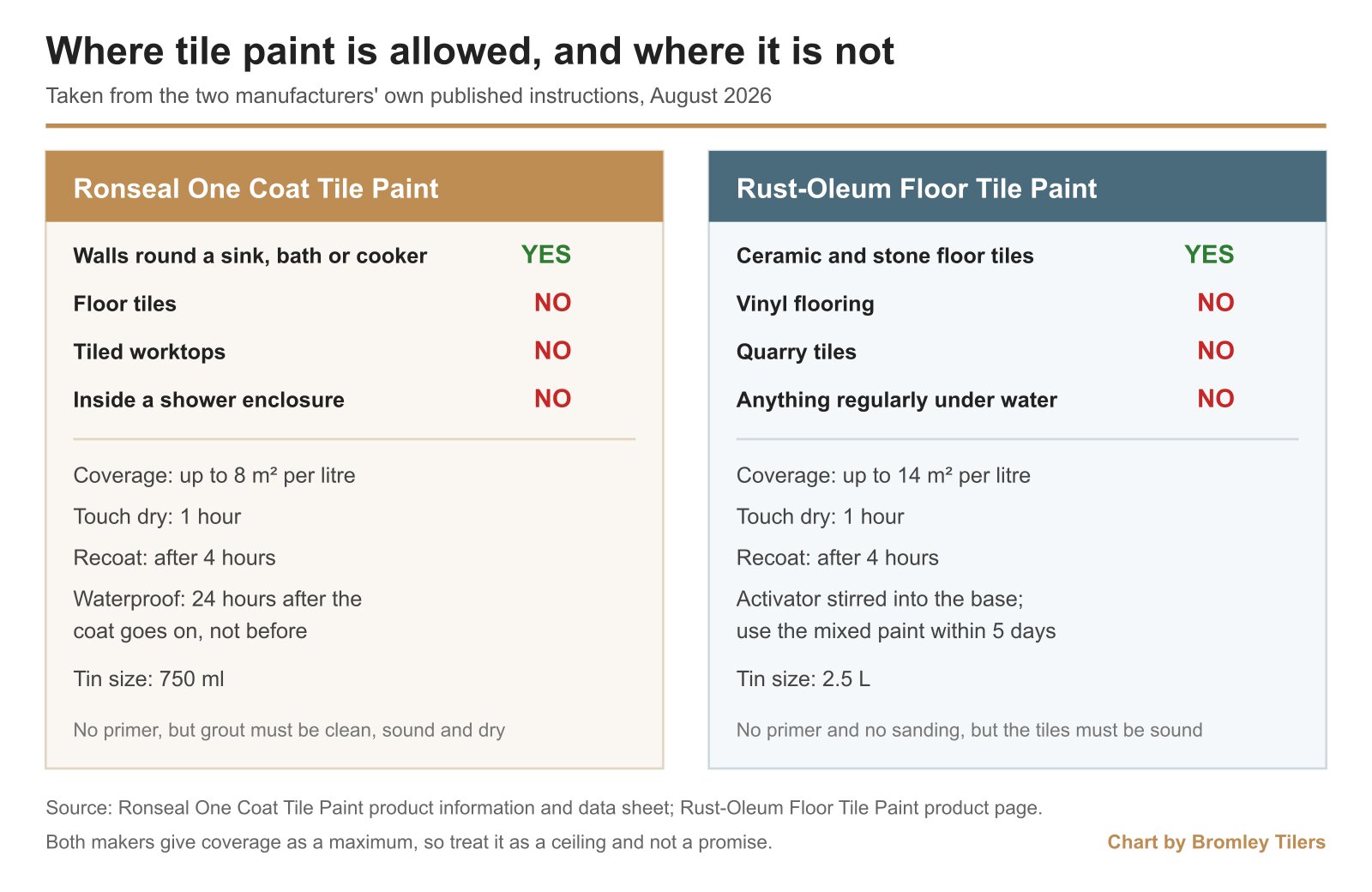
Rust-Oleum sells a floor tile paint for ceramic and stone tiled floors, supplied as a two-part system: a small activator is stirred into the base before use, and once mixed the paint has to be used within five days. Rust-Oleum quotes coverage of up to 14 square metres per litre and states that no stripping, sanding or priming is required, only that the tiles are sound, clean and dry. It rules out vinyl flooring and quarry tiles, and it is not intended for anything that sits under water regularly.
Set the two side by side and the decision more or less makes itself.
Floors need the floor product, and the prep is not optional
The temptation with a tired kitchen or hall floor is to reach for whatever tin is nearest. Do not. A wall paint on a floor will scuff at the door threshold within weeks, then wear through in the traffic line, and once it wears through in patches there is no invisible repair. You are into stripping the lot.
Even with the correct floor product, three things decide whether it holds:
- Grease. Kitchen floors carry a film of cooking grease that ordinary mopping does not shift. Degrease properly, rinse, and let it dry. Any residue is a release layer.
- Sound tiles. Paint bridges a drummy or cracked tile, it does not fix it. Tap the floor first. If a tile moves, the paint over it will crack along the same line. Loose tiles want lifting and rebedding before you go anywhere near a brush.
- Sealer residue. Natural stone and some quarry-type floors have been sealed, sometimes repeatedly. A silicone or wax-based sealer will repel a water-based paint. Test a square metre in a corner and try to scratch it off with a fingernail after it has cured.
Prep on walls: cleaner than you think, then leave it alone
Ronseal’s own method is unglamorous and worth following exactly. Clean the grout lines with a grout cleaner and wipe with a lint-free cloth. Clean the tiles with a bleach-based household cleaner, then rinse and wipe down. Avoid paper towels or cloths that shed fibres, because those fibres end up sealed into the finish.
Repair damaged grout first and let it dry fully. Painting over crumbling or blown grout locks the damage in and gives water a route behind the tile that you can no longer see.
Application is one coat, brushed on with the stroke finishing vertically on each tile, working the paint into the grout lines. A second coat is worth planning for if you are going from a strong colour to a pale one, or if the tiles are heavily patterned, because one coat will not always bury a dark green or a busy border.
Then the part everyone gets wrong: the paint is touch dry in about an hour but is not waterproof for 24 hours. That means no shower in the room, no boiling kettle under the splashback, and ideally a window open. Twenty-four hours of patience is the cheapest insurance in the job.
Once it has dried, the grout lines can be redefined with a grout pen, which is what makes the difference between a painted wall that reads as tile and one that reads as a flat painted panel.
What painted tiles look like two years on
Being straight about this matters more than selling anyone a job. A well-prepped painted splashback in a low-splash spot still looks respectable after two or three years. A painted bathroom wall behind a basin usually shows wear round the taps first, where hands, toothpaste and cleaning products land.
The failure mode is chipping rather than fading. A knock from a saucepan handle or a shampoo bottle takes a flake off down to the glaze, and because the glaze underneath is a different colour, the chip shows. You can touch it in, but the touch-in never quite matches once the original has aged.
The other thing to weigh: painted tiles are difficult to tile over later. Adhesive needs a sound, clean, absorbent or mechanically keyed surface, and a film of paint is none of those. If you paint now and retile in three years, the paint has to come off or the tiles do. Factor that into whether this is a stopgap or a decision.
When painting is the wrong call
Skip the paint and get the tiles off if any of these are true:
- Tiles are loose, drummy or cracked across more than the odd one. The substrate is the problem, and paint does not touch the substrate.
- There is black mould coming back through the grout after cleaning. That is a moisture problem behind or through the tiling, and sealing it under paint hides it rather than stopping it.
- It is a shower enclosure or a wet room. The manufacturer has already answered this one.
- The tiles sit on a wall you are about to move plumbing through anyway. You will be making good regardless, so paint buys you nothing.
- You are selling within a year and the room is the reason buyers hesitate. Painted tiles read as painted tiles at a second viewing.
The alternatives that are not paint
If the colour is the only complaint, a regrout in a different shade changes a room more than people expect, and it does not put a coating on the tile face at all. Dark grout on white metro, or a warm grey instead of a yellowed white, resets the whole wall.
If the tiles are fine but the sealant is grim, replacing the silicone is a two-hour job that makes a bathroom look years younger. If the grout is stained rather than damaged, cleaning and sealing it is cheaper than any paint.
And if you do want a paintable route with more range than tile-specific tins, multi-surface products exist: Bedec Multi Surface Paint lists ceramic tiles among its substrates, alongside melamine, plastics and radiators, and asks for smooth glossy surfaces to be lightly abraded to give a key. That extra abrasion step is the trade-off for the wider colour choice.
Frequently asked questions
Can you paint tiles in a shower?
Not inside the enclosure. Ronseal specifically excludes shower enclosures from its tile paint, along with floor tiles and tiled worktops. The wall outside the screen, in the same bathroom, is fair game.
Do you need to sand tiles before painting?
It depends on the product. Ronseal’s tile paint and Rust-Oleum’s floor tile paint both state that no priming or sanding is needed on sound, clean, dry tiles. A general multi-surface paint such as Bedec’s asks for smooth glossy surfaces to be lightly abraded first. Read the tin, not the internet.
How long does tile paint last?
On a low-splash wall with proper preparation, expect several years before it looks tired, with chips appearing before any general wear. On a floor with the correct floor product it depends almost entirely on traffic and on whether the tiles were degreased properly. Neither is permanent in the way a retile is.
Can you paint over grout as well as the tiles?
Yes, and you are meant to: the method is to work the paint into the grout lines rather than cut around them. If you want the grout to read as a separate colour afterwards, redefine the lines with a grout pen once the paint has dried.
How much tile paint do I need?
Ronseal quotes up to 8 square metres per litre for its wall tile paint, sold in 750ml tins, and Rust-Oleum quotes up to 14 square metres per litre for its floor version in 2.5 litre tins. Both are maximum figures on smooth surfaces, so buy for the area you have plus a margin, and buy a second coat’s worth if you are covering a dark or patterned tile.
Is painting tiles cheaper than retiling?
Considerably, in materials and in labour, and that is the whole appeal. The comparison is not like for like, though: a retile fixes the substrate, the falls and the waterproofing as well as the look, and it is what a buyer or a surveyor sees. Painting changes the colour and nothing else.
If you would rather have the wall done properly, or you want a second opinion on whether your tiles are sound enough to paint, Bromley Tilers covers Bromley and the surrounding boroughs.
Related guides
- How to Tile a Bathroom Wall: A UK Step-by-Step Guide
- How Much Does Tiling Cost in the UK? A Realistic Price Guide
- How to Remove Old Wall Tiles Without Damaging the Wall
- Porcelain vs Ceramic Tiles: Which Is Right for Your Bathroom or Kitchen?
- How to Tank and Waterproof a Wet Room Before Tiling: A Bromley Homeowner’s Guide
- Do You Need to Seal Natural Stone Tiles Before Grouting? A Tiler Explains
- How to Tile a Bathroom Floor (Including Around the Toilet)
- How to Tile a Shower: Walls, Niche and Waterproofing
- Construction Trade News: June 2026
- Bathroom Tiling Guide: How to Plan, Prep and Finish a Lasting Job
- Tile Backer Board vs Plasterboard for Bathrooms
- Best Tiles for Small Bathrooms (and How to Make a Space Look Bigger)
- Wall and Floor Tiles for a Wet Room: What Actually Works
- Tiling vs Wall Panels for a Bathroom: Which Is Better?
- Do You Tile the Floor or Walls First in a Bathroom?
- Tiling and Bathroom Trade News: Mid-June 2026
- Kitchen Tiling: Splashbacks, Walls and Floors Explained
- How to Tile a Kitchen Splashback: Step-by-Step Bromley Guide
- How to Tile Around Kitchen Sockets, Switches and Worktops
- Kitchen Splashback Tile Ideas: 12 Looks That Work
- Tiling and Bathroom Trade News: Late June 2026
- How to Lay Metro Tiles in a Herringbone Pattern
- Tiled vs Glass Splashback (and Acrylic): Which Is Best?
- How High Should a Kitchen Splashback Be Tiled? UK Heights Guide
- Tiling and Bathroom Trade News: Early July 2026
- Types of Tiles: The Complete UK Buyer’s Guide
- Porcelain vs Natural Stone Tiles: Which Should You Choose?
- Natural Stone Tiles Explained: Marble, Travertine, Slate and Limestone
- Tiling and Bathroom Trade News: Mid-July 2026
- Mosaic Tiles: Where to Use Them and How They’re Fixed
- Tile Slip Ratings Explained: R Ratings and PTV for UK Floors
- Matt vs Gloss Tiles: Which Finish Is Right for Your Room?
- Cost to Tile a Bathroom in the UK: 2026 Price Breakdown
- Polystyrene Ceiling Tiles: Are They Any Good?
- Cost to Tile a Kitchen in 2026: Floor and Splashback Prices
- Tiling and Bathroom Trade News: Mid-July 2026
- Tiling Cost Per Square Metre 2026: Labour and All-In Prices
- Tiler Day Rate UK: What Tilers Charge Per Day in 2026
- Cost to Regrout a Bathroom in 2026: UK Prices Explained
- Floor Tile Prices UK 2026: What You Will Pay Per Square Metre
- Is It Cheaper to Tile or Use Wall Panels? A UK Cost Comparison
- How to Tile: A Complete Beginner’s Guide (UK)
- How to Cut Tiles: Manual Cutter, Wet Saw and Nippers
- How to Cut Holes in Tiles for Pipes and Taps
- How to Grout Tiles (and Get Clean, Even Lines)
- Cork Flooring: Pros, Cons and Where It Works in UK Homes
- Tiling and Bathroom Trade News: Late July 2026
- How to Mix and Apply Tile Adhesive Correctly
- How to Set Out Tiles for a Perfect Layout
- How to Seal Grout and Tiles in a Bathroom (UK Guide)
- Can You Tile Over Tiles? When It Works and When It Doesn’t
- Tiling Tools List: What You Need for a Professional Finish
- How Much Tile Adhesive Do I Need? Coverage Per Square Metre
- Tiling Trade News: Topps App, Costs Up 6% (Aug 2026)
- Tile Problems: 9 Common Faults and How to Fix Each
- How to Fix Loose Tiles Without Removing Them
- Cracked Grout Repair: Why It Happens and How to Fix It
- Tiling Trade News: TTA Silica Warning, 2% Retentions
- How to Replace a Broken Tile Without Redoing the Wall
- Water Leaking Through Shower Tiles: 6 Causes and Fixes
- Remove Mouldy Silicone Sealant: A 24-Hour Reseal Job
- How to Clean Grout: What Works, and What Etches Stone
- Why Are My Floor Tiles Lifting? The 40m² Bay Rule
- Tiling Trade News: 3,841 Construction Firms Failed
- How to Lay Porcelain Paving: 1:80 Fall, 150mm Below DPC
- Tile Patterns: Why Big Tiles Need a One-Third Offset
- Grout Colour Ideas: How to Get the Shade You Chose
- Decoupling Membrane for Tiles: When You Actually Need One
- Can You Tile Over a Wooden Floor? What Changed in 2024
- Tiling Cost 2026: £25 to £95 per m² Labour, UK Rates
- Tile Ideas: 7 Looks and the One Rule Each Needs
- Metro Tiles: Sizes, Bevels and the 1/3 Offset Rule
- Tile Feature Wall: The Weight Limit That Decides Yours
- Tiling Over Underfloor Heating: 14 Days Before Heat On
- How to Tile a Hallway Floor: Set Out From the Door
- Wood Effect Tiles and Marble Effect: 5 Specs to Check
- Tile Levelling Systems: The 3mm Rule That Decides It
- Tiling Trade News: Repair Work Up 1.7%, Headlam Fails
- Floor Levelling Compound: How Deep and How Long to Dry
- How to Find a Good Tiler: 9 Checks Before You Book
- Tiling Quote: The 10 Lines a Proper One Must Show
- Tile Trim: Sizes, Profiles and the One-Size-Up Rule
- Tile Spacers: 2mm or 3mm, and When to Pull Them Out
- Tiling the Fireplace: 125mm Hearths, Adhesive and Tiles
- Tiling Trade News: Shaws Sinks Reprice on 1 November
- Porcelain vs Stone Paving: Grip, Sealing and Upkeep
- Tiling a Large Floor: Movement Joints Every 10 Metres
- DIY Tiling vs Professional: 6 Jobs to Never Do Yourself
- Terracotta Tiles: Seal Before Grouting, Wait 7 Days
- Tile Drill Bits: Which Bit Won’t Crack Porcelain
- Tiling Corners With Trim: Which Profile, and When to Mitre
- Travertine Tiles: Filled or Unfilled, and How to Seal Them
- Slate Tiles: Calibrated or Riven, and How to Lay Them
- Zellige Tiles: Order 15% Extra and Fix Them Edge to Edge
- Terrazzo Tiles: Real 20mm vs Porcelain, Seal Before Grouting
- Tiling Trade News: 36% Now Add a Bathroom Accent Wall
- Split Face Tiles: Will Your Wall Take 27kg per m²?
- Tile Sealer: Which Tiles Need It and Which Type to Buy
- How to Remove Grout Haze: Which Cleaner for Which Grout
- Efflorescence on Tiles: Why It Comes Back and How to Stop It
- Tile Primer: Which Surfaces Need It and How Much to Dilute
- Epoxy Grout: Where It’s Worth It and How to Apply It
- How to Tile Stairs: Keep Every Riser the Same Height
- Shower Niche: Sizes, Height and Which Wall Can Take One
- How Many Tiles Do I Need? Add 10% to 20% by Layout
- How to Tile a Window Sill: Sill Last, Silicone at the Frame
- Tiling Trade News: Victorian Plumbing Tile Sales Up 76%
- How to Tile Around a Toilet: Lift the Pan or Cut Round It
- Tile to Carpet Transition: Pick the Strip by the Height Gap