


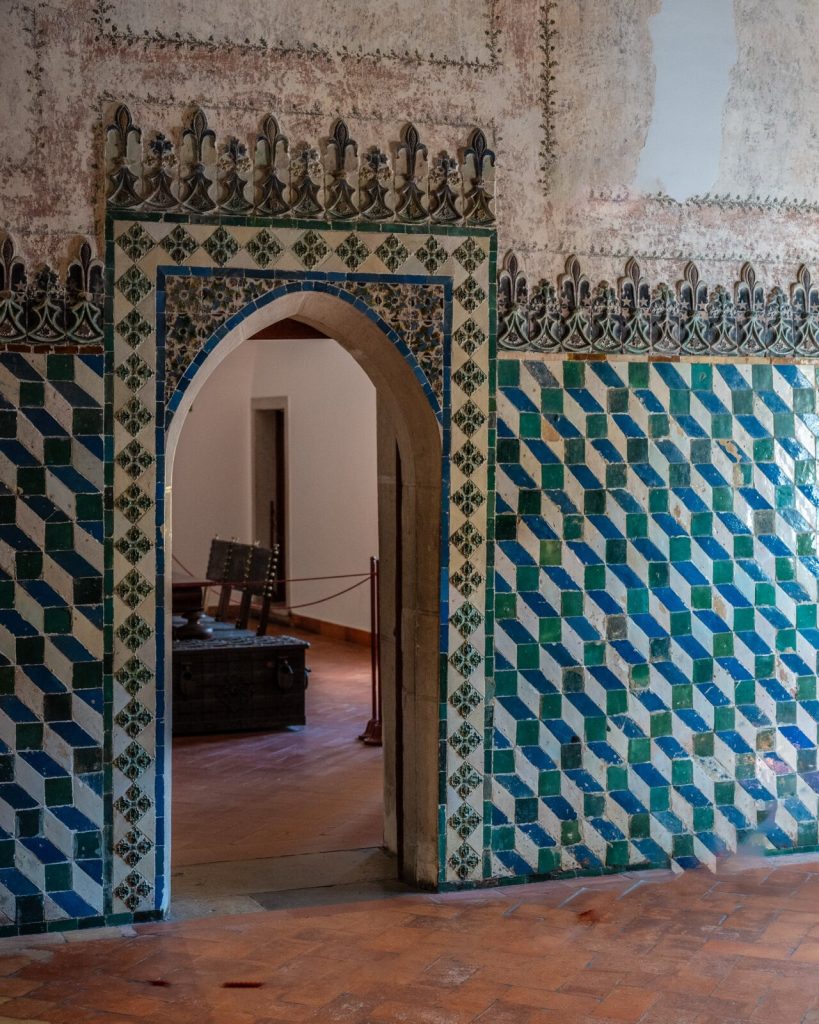
A tile feature wall is one of the few jobs where the look you want and the wall you already have can quietly disagree. Choose a chunky split-face stone or a 20mm marble and you may be asking a skimmed plasterboard partition to carry more than double what the British Standard allows. The tiles will go up. Some will also, eventually, come down.
So this page starts with the number that decides everything, then works through which materials suit which walls and the fixing rules that keep them there.
The weight limit that decides your tile feature wall
BS 5385-1:2018, the code of practice for internal ceramic, stone and mosaic wall tiling, sets a maximum weight of tiling for each type of background. The figures are per square metre, and here is the part almost every “feature wall ideas” article leaves out: the weight counts the tile plus its adhesive bed plus its grout, not the bare tile.

- Gypsum plaster: 20 kg/m2
- Gypsum plasterboard, 12.5mm, tiled direct with no plaster skim: 32 kg/m2
- Gypsum fibreboard: 40 kg/m2
- Glass-reinforced cement-based board: 50 kg/m2
- Lightweight foam-cored tile backer board: 60 kg/m2
- Sand and cement render: 64 kg/m2, effectively no restriction if it is strong and well bonded
Those figures are BS 5385-1:2018 Table 3, reproduced in full by ARDEX UK’s technical help centre. Two rules sit underneath the list, and both catch people out. First, where backgrounds are stacked using adhesive alone, say a tile backer board bonded onto existing plaster, the weakest layer sets the limit. Sticking a 60 kg board to 20 kg plaster gives you a 20 kg wall, not a 60 kg one. Second, the board figures are guide values only. A particular board may be rated higher or lower, so read its data sheet rather than the generic number.
Plywood used to appear on that list at up to 30 kg/m2. It does not any more. The 2018 revision of BS 5385-1 removed plywood and other wood-based sheets as a background for direct wall tiling, on the basis that wood is hygroscopic and its dimensional stability cannot be relied on. Ply can still sit behind a proper backer board as a structural layer, particularly where you need something to screw mechanical fixings into, but nothing gets bonded straight to it. You can read BAL’s summary of the 2018 changes for the clause wording.
Working out what your tiles actually weigh
Retailers rarely print kg/m2 on a product page, so use thickness as the proxy. Trade guidance translates the two limits people meet most often:
- 20 kg/m2 plaster is roughly the ceiling for ceramic up to 8mm thick, or natural stone up to 7mm, adhesive included.
- 32 kg/m2 plasterboard, tiled direct is roughly the ceiling for ceramic up to 12.5mm, or natural stone up to 10mm, adhesive included.
BS 5385-1 itself gives a worked example that doubles as a conversion factor: 9mm porcelain weighs approximately 18 kg/m2. Call it 2 kg per square metre for every millimetre of porcelain thickness before adhesive, and you will be close enough to make a decision. Natural stone is denser again, which is why the stone figures above sit lower than the ceramic ones.
Run a shortlist through that and the picture sharpens fast. A 6mm ceramic metro is a non-event on any sound wall. A 10mm marble-effect porcelain is comfortable on unskimmed plasterboard and marginal on plaster. Split-face slate cladding, sold at a varying 8mm to 15mm depth precisely because the face is uneven, is not going onto a skimmed stud wall without work first. Neither is a 20mm marble.
Feature wall materials, and where each one can go
Split face and stacked stone
The heaviest thing most people put on an interior wall, and the one that most often goes up on the wrong background. Treat split face as a backer-board job by default: a cement-based or foam-cored board fixed mechanically through to the studs, not bonded to plaster. It wants light raking across it from above or below, because flat side light kills the texture the stone is there for.
Marble, and marble-effect porcelain
Real marble is the least forgiving option: heavy, porous, needs sealing, and often supplied with a resin and mesh backing that changes how it must be fixed. Marble-effect porcelain gets most of the look at half the weight, needs no sealing, and at 9mm to 10mm sits happily on plasterboard.
Zellige and handmade-look tiles
Thin, light and forgiving on weight, so almost any sound background works. The catch is the opposite one: the tiles are deliberately irregular, so setting out takes far longer and you should buy a generous overage, because you will reject some.
Fluted, ribbed and 3D tiles
The most popular way to make a feature wall out of a single colour. Heavier than they look, because the profile adds material, and unforgiving of a wall out of plumb: every vertical rib magnifies a lean. Agree with your tiler which way the ribs run at internal corners.
Mosaic, glass, metal and mirror
BS 5385-1:2018 does not cover metal, plastic resin, mirror or glass tiles of a similar construction, nor natural stone slabs over 12mm thick, nor agglomerate stone. For those you follow the manufacturer’s instructions, because there is no British Standard to fall back on. Mesh-backed mosaic sheets are the easiest feature wall to fit well, and the easiest to ruin with the wrong grout colour.
Large-format tiles and panels
A single large porcelain panel gives a grout-free wall, which is the whole appeal. It also needs two fitters, a suction frame, a perfectly flat background and a solid adhesive bed. Not a first tiling project.
Choosing which wall to tile
A feature wall works when it has a reason to be there: a chimney breast, which is already a defined plane; the wall behind a bath or a freestanding basin, where the tiling also does a job; a shower end wall, which is going to be tiled anyway; or a hallway return you see on the way through the front door.
Avoid the walls broken up by a window, a radiator and a door, because the budget goes on cuts nobody sees. If there is a socket or a switch on it, decide early whether to move it. Light matters more than colour: gloss and polished finishes throw back every lamp in the room and show every ripple in the wall behind them, while matt and textured finishes hide both.
Fixing rules that keep a heavy feature wall up
Once the tile is chosen, four points decide whether it stays put.
Solid bed, not dabs. BS 5385-1:2018 says tiles with a surface area under 0.1m2 that weigh more per square metre than 70 per cent of the background’s capacity should be solidly bedded. Its own example: 9mm porcelain at about 18 kg/m2 is more than 70 per cent of plaster’s 20 kg limit, which is 14 kg, so it gets a solid bed regardless of how small the tile is. Most feature wall tiles clear that threshold, so assume a solid bed and a notched trowel sized for the tile.
Grout joints wide enough for the tile. The same standard sets minimums by facial area: 2mm for tiles under 0.1m2 with no side longer than 600mm, 3mm for tiles between 0.1m2 and 1m2 with no side longer than 1200mm, and joints on large panels scaled up pro rata, so a 3m panel wants at least 5mm. Butt-jointing a large-format tile because it looks neater is how you end up with tented tiles.
Mesh-backed stone needs checking. Thin marble, limestone and granite often arrive with a polyester resin and fibreglass mesh backing. The adhesive then bonds to the resin rather than to the stone, and polyester expands at a very different rate to stone. Trade guidance is that mesh and adhesive should not obscure more than about a quarter of the underside unless the tile is mechanically fixed, so if you cannot remove the backing, that wall needs mechanical fixings, not more adhesive.
Support the bottom course. On a heavy wall, screw a level batten where the second course starts and build up off it, so the bottom row is not carrying the wall while the adhesive is green. The batten comes off and the bottom course goes in last.
When it is a weekend job and when it is not
A light ceramic or a mesh-backed mosaic on a flat, sound, unskimmed plasterboard wall is a realistic DIY job. So is a small zellige splashback, if you have patience.
Get a tiler in when the tile is natural stone, over 10mm thick, or 600mm or larger on any side, when the wall needs boarding out first, when it is out of plumb, or when it sits inside a shower. Those are the cases where getting it wrong means stripping the wall back and starting again, which always costs more than the labour would have.
Whatever you choose, take the kg/m2 figure from the tile manufacturer, add the adhesive, and compare it with the background you actually have rather than the one you assume is behind the paint. That is the difference between a wall that lasts twenty years and one that starts sounding hollow in eighteen months. Bromley Tilers covers wall and floor tiling across Bromley and south east London if you want it checked in person.
Frequently asked questions
Can I tile a feature wall straight onto plasterboard?
Yes, if the plasterboard is sound, fixed at proper centres and has no plaster skim on it, and if your tiling weighs no more than 32 kg/m2 including adhesive and grout. That is about 12.5mm of ceramic or 10mm of natural stone. If the board has been skimmed, the limit drops to the plaster figure of 20 kg/m2, because the tiles are then held by the skim rather than the board.
Do I need to remove the plaster skim before tiling?
Only if the tiling you want exceeds 20 kg/m2. A thin ceramic is fine over a sound, well-bonded skim. For anything heavier, taking the skim back to the board, or fixing a tile backer board over the top and screwing it into the studs, is what buys you the extra capacity.
Can I tile a feature wall onto plywood?
Not directly. BS 5385-1:2018 excludes plywood and other wood-based sheets as a background for direct wall tiling. Ply can stay as a structural layer with a tile backer board fixed over it, which is also the arrangement you want if the tiles need mechanical fixings.
Is a split face stone wall too heavy for a stud wall?
Not if the wall is built and prepared for it. The stud wall itself is rarely the problem; the surface is. Split face on a mechanically fixed cement-based or foam-cored backer board is a normal specification. Split face bonded to a skimmed plasterboard wall is not.
Related guides
- How to Tile a Bathroom Wall: A UK Step-by-Step Guide
- How Much Does Tiling Cost in the UK? A Realistic Price Guide
- How to Remove Old Wall Tiles Without Damaging the Wall
- Porcelain vs Ceramic Tiles: Which Is Right for Your Bathroom or Kitchen?
- How to Tank and Waterproof a Wet Room Before Tiling: A Bromley Homeowner’s Guide
- Do You Need to Seal Natural Stone Tiles Before Grouting? A Tiler Explains
- How to Tile a Bathroom Floor (Including Around the Toilet)
- How to Tile a Shower: Walls, Niche and Waterproofing
- Bathroom Tiling Guide: How to Plan, Prep and Finish a Lasting Job
- Tile Backer Board vs Plasterboard for Bathrooms
- Best Tiles for Small Bathrooms (and How to Make a Space Look Bigger)
- Wall and Floor Tiles for a Wet Room: What Actually Works
- Tiling vs Wall Panels for a Bathroom: Which Is Better?
- Do You Tile the Floor or Walls First in a Bathroom?
- Kitchen Tiling: Splashbacks, Walls and Floors Explained
- How to Tile a Kitchen Splashback: Step-by-Step Bromley Guide
- How to Tile Around Kitchen Sockets, Switches and Worktops
- Kitchen Splashback Tile Ideas: 12 Looks That Work
- How to Lay Metro Tiles in a Herringbone Pattern
- Tiled vs Glass Splashback (and Acrylic): Which Is Best?
- How High Should a Kitchen Splashback Be Tiled? UK Heights Guide
- Types of Tiles: The Complete UK Buyer’s Guide
- Porcelain vs Natural Stone Tiles: Which Should You Choose?
- Natural Stone Tiles Explained: Marble, Travertine, Slate and Limestone
- Mosaic Tiles: Where to Use Them and How They’re Fixed
- Tile Slip Ratings Explained: R Ratings and PTV for UK Floors
- Matt vs Gloss Tiles: Which Finish Is Right for Your Room?
- Cost to Tile a Bathroom in the UK: 2026 Price Breakdown
- Polystyrene Ceiling Tiles: Are They Any Good?
- Cost to Tile a Kitchen in 2026: Floor and Splashback Prices
- Tiling Cost Per Square Metre 2026: Labour and All-In Prices
- Tiler Day Rate UK: What Tilers Charge Per Day in 2026
- Cost to Regrout a Bathroom in 2026: UK Prices Explained
- Floor Tile Prices UK 2026: What You Will Pay Per Square Metre
- Is It Cheaper to Tile or Use Wall Panels? A UK Cost Comparison
- How to Tile: A Complete Beginner’s Guide (UK)
- How to Cut Tiles: Manual Cutter, Wet Saw and Nippers
- How to Cut Holes in Tiles for Pipes and Taps
- How to Grout Tiles (and Get Clean, Even Lines)
- Cork Flooring: Pros, Cons and Where It Works in UK Homes
- How to Mix and Apply Tile Adhesive Correctly
- How to Set Out Tiles for a Perfect Layout
- How to Seal Grout and Tiles in a Bathroom (UK Guide)
- Can You Tile Over Tiles? When It Works and When It Doesn’t
- Tiling Tools List: What You Need for a Professional Finish
- How Much Tile Adhesive Do I Need? Coverage Per Square Metre
- Tile Problems: 9 Common Faults and How to Fix Each
- How to Fix Loose Tiles Without Removing Them
- Cracked Grout Repair: Why It Happens and How to Fix It
- How to Replace a Broken Tile Without Redoing the Wall
- Water Leaking Through Shower Tiles: 6 Causes and Fixes
- Remove Mouldy Silicone Sealant: A 24-Hour Reseal Job
- How to Clean Grout: What Works, and What Etches Stone
- Why Are My Floor Tiles Lifting? The 40m² Bay Rule
- How to Lay Porcelain Paving: 1:80 Fall, 150mm Below DPC
- Tile Patterns: Why Big Tiles Need a One-Third Offset
- Grout Colour Ideas: How to Get the Shade You Chose
- Can You Paint Tiles? Yes on Walls, No in the Shower
- Decoupling Membrane for Tiles: When You Actually Need One
- Can You Tile Over a Wooden Floor? What Changed in 2024
- Tiling Cost 2026: £25 to £95 per m² Labour, UK Rates
- Tile Ideas: 7 Looks and the One Rule Each Needs
- Metro Tiles: Sizes, Bevels and the 1/3 Offset Rule
- Tiling Over Underfloor Heating: 14 Days Before Heat On
- How to Tile a Hallway Floor: Set Out From the Door
- Wood Effect Tiles and Marble Effect: 5 Specs to Check
- Tile Levelling Systems: The 3mm Rule That Decides It
- Floor Levelling Compound: How Deep and How Long to Dry
- How to Find a Good Tiler: 9 Checks Before You Book
- Tiling Quote: The 10 Lines a Proper One Must Show
- Tile Trim: Sizes, Profiles and the One-Size-Up Rule
- Tile Spacers: 2mm or 3mm, and When to Pull Them Out
- Tiling the Fireplace: 125mm Hearths, Adhesive and Tiles
- Porcelain vs Stone Paving: Grip, Sealing and Upkeep
- Tiling a Large Floor: Movement Joints Every 10 Metres
- DIY Tiling vs Professional: 6 Jobs to Never Do Yourself
- Terracotta Tiles: Seal Before Grouting, Wait 7 Days
- Tile Drill Bits: Which Bit Won’t Crack Porcelain
- Tiling Corners With Trim: Which Profile, and When to Mitre
- Travertine Tiles: Filled or Unfilled, and How to Seal Them
- Slate Tiles: Calibrated or Riven, and How to Lay Them
- Zellige Tiles: Order 15% Extra and Fix Them Edge to Edge
- Terrazzo Tiles: Real 20mm vs Porcelain, Seal Before Grouting
- Split Face Tiles: Will Your Wall Take 27kg per m²?
- Tile Sealer: Which Tiles Need It and Which Type to Buy
- How to Remove Grout Haze: Which Cleaner for Which Grout
- Efflorescence on Tiles: Why It Comes Back and How to Stop It
- Tile Primer: Which Surfaces Need It and How Much to Dilute
- Epoxy Grout: Where It’s Worth It and How to Apply It
- How to Tile Stairs: Keep Every Riser the Same Height
- Shower Niche: Sizes, Height and Which Wall Can Take One
- How Many Tiles Do I Need? Add 10% to 20% by Layout
- How to Tile a Window Sill: Sill Last, Silicone at the Frame
- How to Tile Around a Toilet: Lift the Pan or Cut Round It