


Knowing how to clean grout properly is mostly a matter of knowing what your grout and your tiles are actually made of. The same oxygen bleach paste that brings a cement-grouted porcelain floor back to life will do nothing much for epoxy grout, and the vinegar trick that gets passed around online will permanently ruin a marble bathroom. Get the surface right and most discoloured joints come back with one afternoon of work. Get it wrong and you pay a stone restorer to grind the damage out.
This is the order we work through on customers’ bathrooms and kitchens across Bromley and south east London: cheapest method first, strongest method last, and a clear line where cleaning stops being the answer.
Why grout goes dark in the first place
Standard grout is a cement product, and cement is porous. Under BS EN 13888-1:2022, the standard that classifies grouts for ceramic tiles, cementitious grouts are split into CG1 (normal) and CG2 (improved), with suffix letters for the extras: A for high abrasion resistance, W for reduced water absorption. Resin grouts sit in a separate class, RG.
Those letters matter more than the colour on the tub. A plain CG1 joint drinks in soapy water, shampoo, cooking grease and the fine grit walked in on shoes. The dirt is not sitting on top of the grout waiting to be wiped off; it has soaked in, a millimetre or two down. That is why wiping does nothing and why the joints go patchy rather than evenly dirty. A CG2 W grout absorbs far less and stays presentable much longer, which is worth knowing before you regrout rather than after.
Epoxy grout is a different animal. It is effectively non-porous, so dirt genuinely does sit on the surface. If your grout is epoxy, you need less chemistry, not more.
Black speckling in the corner where the wall meets the bath or the shower tray is usually not grout at all. It is mould growing inside silicone sealant, and no cleaner reaches it.
Start with the cheapest method that might work
Before any chemistry, try hot water, a squirt of washing-up liquid and a stiff nylon grout brush. An old toothbrush is too soft and too small for a floor; a proper narrow grout brush costs a few pounds and does ten times the work.
Work a square metre at a time, scrub along the joint rather than across it, and rinse with clean water before the dirty water dries back into the grout. That last step is the one most people skip, and it is why joints often look worse an hour after cleaning than they did before.
On a floor that has simply gone dull rather than stained, this alone often finishes the job. If a square metre of test area comes up noticeably lighter, keep going and save yourself the stronger methods.
Oxygen bleach does most of the heavy lifting
For cement grout that has genuinely stained, oxygen bleach is the workhorse. The active ingredient is sodium percarbonate, sold as a laundry booster or a dedicated patio and grout cleaner. Dissolved in warm water it releases oxygen, which penetrates the porous grout and breaks the staining down inside the joint.
The practical difference from household chlorine bleach is worth understanding. Chlorine bleach mostly decolourises what it touches, so the joint looks paler for a while but the dirt is still in there and comes back. Oxygen bleach works more slowly and actually lifts the soiling out. It also does not strip the pigment out of coloured grout, which chlorine bleach happily will.
Method: mix it into a thick paste rather than a runny solution, spread it along the joints, and leave it to dwell for twenty to thirty minutes so it stays wet and keeps working. Scrub, then rinse thoroughly with clean water. Badly stained floors often need two passes. Ventilate the room and wear gloves; sodium percarbonate is alkaline and unkind to skin over a long session.
What never to use, and the one combination that is dangerous
Two rules matter more than everything else in this article.
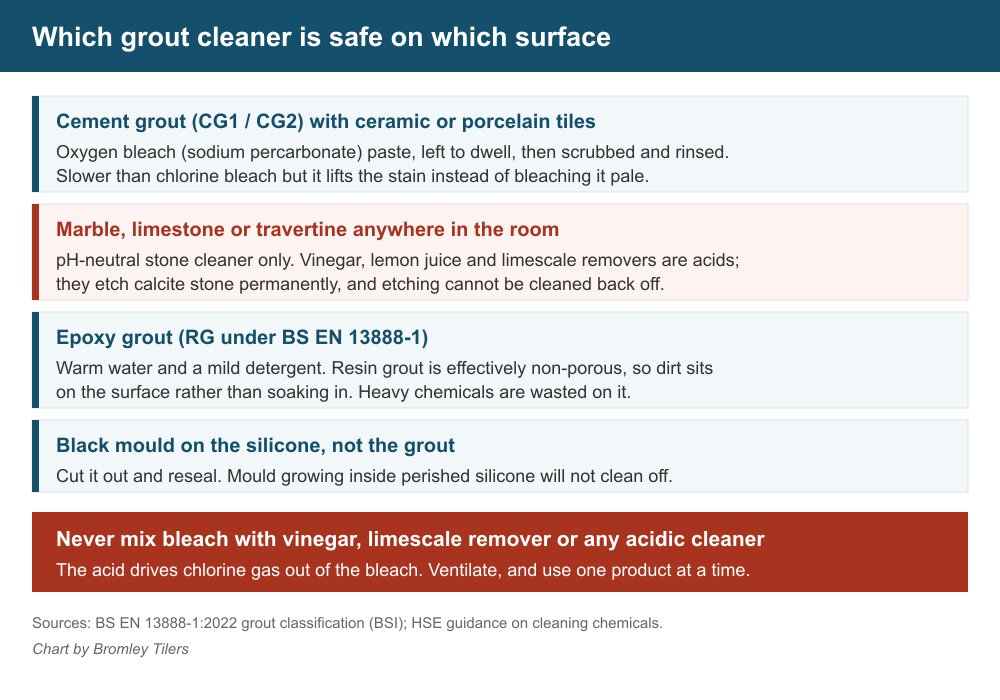
Never use acid on calcite stone. Marble, limestone and travertine react with acid. Vinegar, lemon juice, citrus cleaners and limescale removers all etch them, leaving dull cloudy patches where the polish used to be. Etching is physical damage to the stone surface, not a stain, so it cannot be cleaned off afterwards; it has to be honed and repolished. If there is any calcite stone in the room, including a stone windowsill or shelf that overspray could reach, use a pH-neutral stone cleaner and nothing else.
Never mix bleach with an acidic cleaner. Household bleach is sodium hypochlorite. Add an acid to it, which includes vinegar and most limescale and bathroom descalers, and it releases chlorine gas. In a small unventilated bathroom that is a genuine hazard, not a theoretical one. The Health and Safety Executive’s guidance on cleaning chemicals is aimed at workplaces, but the underlying point applies at home: use one product at a time, follow the label, ventilate, and never decant chemicals into an unlabelled container.
Two more to avoid: wire brushes, which scratch glazes and tear the surface off soft grout, and aggressive grinding tools used freehand, which chew the tile edges long before they finish the joint.
Steam cleaners and grout pens: what each actually achieves
A steam cleaner with a narrow detail nozzle is genuinely effective on cement grout, and it uses no chemicals at all, which makes it the sensible option in a bathroom you cannot ventilate well. Steam softens the soiling so a brush can remove it. Keep the nozzle moving, and be careful around silicone joints and any grout that is already crumbling, because concentrated steam will finish off a joint that was on its way out.
Grout pens are a different proposition. They do not clean anything; they paint over the joint with a pigmented coating. On a sound, dry, properly cleaned wall joint in a low-traffic spot, a grout pen gives a tidy result that lasts a reasonable time. On a shower floor or a kitchen floor it wears off in patches and looks worse than the discolouration did. Use one as cosmetic finishing after cleaning, never as a substitute for it, and never over damp or crumbling grout.
When cleaning is not the answer
There is a point where more scrubbing is wasted effort. Stop cleaning and fix the underlying problem if you see any of the following.
- Grout that crumbles or turns to powder under the brush. The joint has failed and needs raking out and regrouting.
- Cracked joints, or joints that have come away from the tile edge. Usually movement in the substrate, which regrouting alone will not cure.
- Black mould in the corners and around the tray or bath. That is silicone, not grout. Cut it out, dry the joint properly and reseal.
- Staining that returns within weeks in the same spot. Something is feeding it, normally water getting behind the tiles.
- Damp on the other side of the wall. Cleaning the visible surface is the least useful thing you can do at that point.
Seal it so you are not doing this again next year
Cleaning cement grout opens the pores back up, which is exactly when it is most vulnerable. An impregnating grout sealer soaks in and makes the joint water-repellent rather than sitting on top as a film. Applied to grout that is clean and fully dry, it buys you a great deal of time before the joints darken again.
Two conditions decide whether it works. The grout must be dry, which after a heavy wet clean means leaving it a full day or more, not an hour. And the sealer must be the right type for the tile as well as the grout, because some products will haze a polished porcelain or a stone surface. Test on an offcut or an out-of-sight corner first.
If you are choosing grout for a new job rather than rescuing an old one, specify a CG2 W grout for anything in a shower, a wet room or a kitchen floor. The reduced water absorption is the whole point, and the extra cost is trivial next to the labour of regrouting.
For heavily stained floors, failing joints or anything involving natural stone, it is worth getting a tiler to look before you start. You can find a member firm through The Tile Association, or see the rest of our tiling advice for Bromley homeowners.
Frequently asked questions
Does bicarbonate of soda and vinegar clean grout?
The fizzing is the two neutralising each other, which leaves you with a mildly salty solution and very little cleaning power. The bicarbonate on its own works as a gentle abrasive. The vinegar adds nothing useful and, on marble, limestone or travertine, causes permanent etching. Use oxygen bleach instead.
Will bleach whiten my grout permanently?
No. Chlorine bleach lightens the appearance of the stain rather than removing it, so the colour usually creeps back within weeks. It will also strip the pigment from grey, beige or coloured grout, leaving blotches that are harder to live with than the original discolouration.
How do I know whether my grout is cement or epoxy?
Scratch a hidden joint with a coin. Cement grout gives up a little powder; epoxy stays glossy and unmarked. Epoxy also tends to look slightly plasticky and to have been used with glass mosaic or in commercial settings. If it was grouted by a previous owner and there is no record, assume cement and treat it accordingly.
Can I clean grout on a natural stone floor at all?
Yes, with a pH-neutral cleaner made for stone, a soft brush and patience. Avoid every acid, avoid strong alkalis on polished surfaces, and never let any cleaner dry on the stone. Heavily soiled stone is one of the few cases where paying a specialist to clean and reseal is genuinely cheaper than the alternative.
How often should grout be resealed?
In a family shower, expect to reseal roughly every year or two; on a kitchen floor, every two to three years. The test is simple: drip water onto the joint. If it beads, the sealer is working. If it soaks in and darkens the grout, it is time to reseal.
Is it cheaper to clean grout or regrout?
Cleaning is far cheaper while the joints are sound. Once grout is crumbling, cracked or missing in places, cleaning is money spent on a surface that is about to fail anyway, and regrouting is the better use of the same afternoon.
Related guides
- How to Tile a Bathroom Wall: A UK Step-by-Step Guide
- How Much Does Tiling Cost in the UK? A Realistic Price Guide
- How to Remove Old Wall Tiles Without Damaging the Wall
- Porcelain vs Ceramic Tiles: Which Is Right for Your Bathroom or Kitchen?
- How to Tank and Waterproof a Wet Room Before Tiling: A Bromley Homeowner’s Guide
- Do You Need to Seal Natural Stone Tiles Before Grouting? A Tiler Explains
- How to Tile a Bathroom Floor (Including Around the Toilet)
- How to Tile a Shower: Walls, Niche and Waterproofing
- Construction Trade News: June 2026
- Bathroom Tiling Guide: How to Plan, Prep and Finish a Lasting Job
- Tile Backer Board vs Plasterboard for Bathrooms
- Best Tiles for Small Bathrooms (and How to Make a Space Look Bigger)
- Wall and Floor Tiles for a Wet Room: What Actually Works
- Tiling vs Wall Panels for a Bathroom: Which Is Better?
- Do You Tile the Floor or Walls First in a Bathroom?
- Tiling and Bathroom Trade News: Mid-June 2026
- Kitchen Tiling: Splashbacks, Walls and Floors Explained
- How to Tile a Kitchen Splashback: Step-by-Step Bromley Guide
- How to Tile Around Kitchen Sockets, Switches and Worktops
- Kitchen Splashback Tile Ideas: 12 Looks That Work
- Tiling and Bathroom Trade News: Late June 2026
- How to Lay Metro Tiles in a Herringbone Pattern
- Tiled vs Glass Splashback (and Acrylic): Which Is Best?
- How High Should a Kitchen Splashback Be Tiled? UK Heights Guide
- Tiling and Bathroom Trade News: Early July 2026
- Types of Tiles: The Complete UK Buyer’s Guide
- Porcelain vs Natural Stone Tiles: Which Should You Choose?
- Natural Stone Tiles Explained: Marble, Travertine, Slate and Limestone
- Tiling and Bathroom Trade News: Mid-July 2026
- Mosaic Tiles: Where to Use Them and How They’re Fixed
- Tile Slip Ratings Explained: R Ratings and PTV for UK Floors
- Matt vs Gloss Tiles: Which Finish Is Right for Your Room?
- Cost to Tile a Bathroom in the UK: 2026 Price Breakdown
- Polystyrene Ceiling Tiles: Are They Any Good?
- Cost to Tile a Kitchen in 2026: Floor and Splashback Prices
- Tiling and Bathroom Trade News: Mid-July 2026
- Tiling Cost Per Square Metre 2026: Labour and All-In Prices
- Tiler Day Rate UK: What Tilers Charge Per Day in 2026
- Cost to Regrout a Bathroom in 2026: UK Prices Explained
- Floor Tile Prices UK 2026: What You Will Pay Per Square Metre
- Is It Cheaper to Tile or Use Wall Panels? A UK Cost Comparison
- How to Tile: A Complete Beginner’s Guide (UK)
- How to Cut Tiles: Manual Cutter, Wet Saw and Nippers
- How to Cut Holes in Tiles for Pipes and Taps
- How to Grout Tiles (and Get Clean, Even Lines)
- Cork Flooring: Pros, Cons and Where It Works in UK Homes
- Tiling and Bathroom Trade News: Late July 2026
- How to Mix and Apply Tile Adhesive Correctly
- How to Set Out Tiles for a Perfect Layout
- How to Seal Grout and Tiles in a Bathroom (UK Guide)
- Can You Tile Over Tiles? When It Works and When It Doesn’t
- Tiling Tools List: What You Need for a Professional Finish
- How Much Tile Adhesive Do I Need? Coverage Per Square Metre
- Tiling Trade News: Topps App, Costs Up 6% (Aug 2026)
- Tile Problems: 9 Common Faults and How to Fix Each
- How to Fix Loose Tiles Without Removing Them
- Cracked Grout Repair: Why It Happens and How to Fix It
- Tiling Trade News: TTA Silica Warning, 2% Retentions
- How to Replace a Broken Tile Without Redoing the Wall
- Water Leaking Through Shower Tiles: 6 Causes and Fixes
- Remove Mouldy Silicone Sealant: A 24-Hour Reseal Job
- Why Are My Floor Tiles Lifting? The 40m² Bay Rule
- Tiling Trade News: 3,841 Construction Firms Failed
- How to Lay Porcelain Paving: 1:80 Fall, 150mm Below DPC
- Tile Patterns: Why Big Tiles Need a One-Third Offset
- Grout Colour Ideas: How to Get the Shade You Chose
- Can You Paint Tiles? Yes on Walls, No in the Shower
- Decoupling Membrane for Tiles: When You Actually Need One
- Can You Tile Over a Wooden Floor? What Changed in 2024
- Tiling Cost 2026: £25 to £95 per m² Labour, UK Rates
- Tile Ideas: 7 Looks and the One Rule Each Needs
- Metro Tiles: Sizes, Bevels and the 1/3 Offset Rule
- Tile Feature Wall: The Weight Limit That Decides Yours
- Tiling Over Underfloor Heating: 14 Days Before Heat On
- How to Tile a Hallway Floor: Set Out From the Door
- Wood Effect Tiles and Marble Effect: 5 Specs to Check
- Tile Levelling Systems: The 3mm Rule That Decides It
- Tiling Trade News: Repair Work Up 1.7%, Headlam Fails
- Floor Levelling Compound: How Deep and How Long to Dry
- How to Find a Good Tiler: 9 Checks Before You Book
- Tiling Quote: The 10 Lines a Proper One Must Show
- Tile Trim: Sizes, Profiles and the One-Size-Up Rule
- Tile Spacers: 2mm or 3mm, and When to Pull Them Out
- Tiling the Fireplace: 125mm Hearths, Adhesive and Tiles
- Tiling Trade News: Shaws Sinks Reprice on 1 November
- Porcelain vs Stone Paving: Grip, Sealing and Upkeep
- Tiling a Large Floor: Movement Joints Every 10 Metres
- DIY Tiling vs Professional: 6 Jobs to Never Do Yourself
- Terracotta Tiles: Seal Before Grouting, Wait 7 Days
- Tile Drill Bits: Which Bit Won’t Crack Porcelain
- Tiling Corners With Trim: Which Profile, and When to Mitre
- Travertine Tiles: Filled or Unfilled, and How to Seal Them
- Slate Tiles: Calibrated or Riven, and How to Lay Them
- Zellige Tiles: Order 15% Extra and Fix Them Edge to Edge
- Terrazzo Tiles: Real 20mm vs Porcelain, Seal Before Grouting
- Tiling Trade News: 36% Now Add a Bathroom Accent Wall
- Split Face Tiles: Will Your Wall Take 27kg per m²?
- Tile Sealer: Which Tiles Need It and Which Type to Buy
- How to Remove Grout Haze: Which Cleaner for Which Grout
- Efflorescence on Tiles: Why It Comes Back and How to Stop It
- Tile Primer: Which Surfaces Need It and How Much to Dilute
- Epoxy Grout: Where It’s Worth It and How to Apply It
- How to Tile Stairs: Keep Every Riser the Same Height
- Shower Niche: Sizes, Height and Which Wall Can Take One
- How Many Tiles Do I Need? Add 10% to 20% by Layout
- How to Tile a Window Sill: Sill Last, Silicone at the Frame
- Tiling Trade News: Victorian Plumbing Tile Sales Up 76%
- How to Tile Around a Toilet: Lift the Pan or Cut Round It
- Tile to Carpet Transition: Pick the Strip by the Height Gap
- Tile Skirting: Leave a 6mm Gap and Seal, Never Grout
- Tile Backer Board: Cement or Foam, Which Thickness, Fixings
- Quarry Tiles: Seal Them or Not, and How to Clean Them
- Rapid Set Tile Adhesive vs Standard: 30 Mins or 24 Hours