


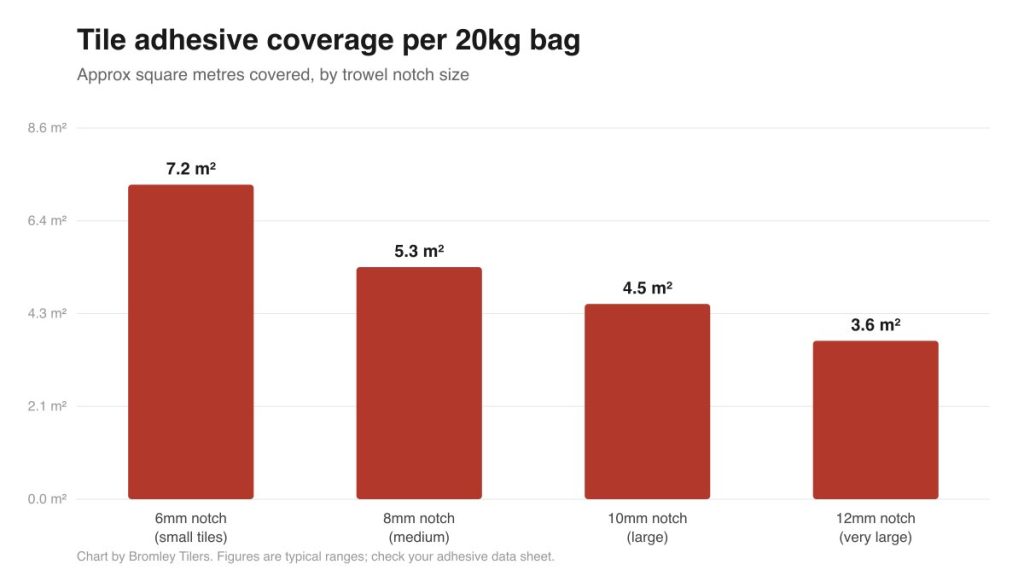
How much tile adhesive do I need? As a working rule, a 20kg bag of standard cement-based adhesive covers roughly 3 to 5m2 of tiling, so a typical bathroom wall or a small floor swallows one or two bags. The exact figure swings a lot with your trowel notch size, the tile format and how flat the wall or floor is underneath. Get the sum wrong and you either run out mid-job (adhesive skins over while you drive back to the merchant) or leave half a bag to harden in the shed. This guide gives you the coverage rates, a simple way to work out bags and grout, and the mistakes that waste the most product.
Adhesive coverage per bag: the numbers that matter
Cement-based powder adhesive is sold mainly in 20kg bags. Coverage is quoted in kilograms per square metre, and the bed depth left by your notched trowel is what sets that figure. Manufacturer data sheets vary, but the industry rules of thumb line up closely:
- 6mm notch, small tiles under 150mm: about 2.5 to 3kg/m2, so a 20kg bag covers around 6.5 to 8m2.
- 8mm notch, medium tiles 150 to 300mm: about 3.5 to 4kg/m2, roughly 5 to 5.7m2 per bag.
- 10mm notch, large tiles 300 to 600mm: about 4 to 5kg/m2, roughly 4 to 5m2 per bag.
- 12mm notch, very large or floor tiles over 600mm: about 5 to 6kg/m2, roughly 3.3 to 4m2 per bag.
For a quick real-world anchor: BAL White Star Plus is quoted at 4 to 5m2 per 20kg bag, and Mapei Keraflex Maxi S1 at 4 to 6m2, both depending on trowel and substrate. Ready-mixed tub adhesive is different again. It only suits dry walls and small light tiles, and a 15kg tub typically covers about 4 to 5m2 at a thin bed. Never use ready-mixed on floors or in a shower.
How to work out how many bags you need
Four steps get you a reliable number:
- Measure the area in square metres. Length times height for a wall, length times width for a floor. Add each surface together.
- Pick the coverage rate from the list above that matches your trowel and tile size. If you are unsure, use the higher kilogram figure so you buy slightly over rather than under.
- Divide the area by the metres-per-bag figure. A 6m2 bathroom floor in 300mm porcelain at 4.5m2 per bag needs 6 divided by 4.5, so two bags.
- Add 10% for waste. Cuts, buttering, an uneven wall and the scrapings left on the trowel all eat product. On bigger jobs 10% is the minimum.
Two things quietly increase how much you use. An out-of-flat wall or floor forces a thicker bed to take up the hollows, and large-format tiles usually need back-buttering, where you skim the back of the tile as well as combing the wall. Both can push consumption up by a third or more, which is another reason to round up.
Why coverage rules exist: solid bed and voids
Coverage is not just about running out of adhesive. British Standard BS 5385 sets minimum adhesive contact behind a tile, because voids trap water, let tiles drum and crack, and cause failures in wet and cold areas. In practice you want close to full coverage on floors and in showers, and at least 80% on dry interior walls. Combing in one direction and then flattening the ridges, plus back-buttering big tiles, is how you hit that. If your coverage rate looks far higher than the figures above, your bed is probably too thin to leave a solid contact once the ridges are pressed flat.
How much grout do I need?
Grout is easier to underestimate because the quantity depends on four things at once: tile length, tile width, tile thickness and joint width. Small tiles with lots of joints drink grout; large tiles with thin joints barely touch it. Typical coverage from a standard cement grout works out roughly as:
- Mosaic, 25mm tiles, 2mm joints: around 1 to 1.2kg/m2.
- 100 x 100 x 6mm wall tiles, 2mm joints: around 0.4kg/m2.
- 300 x 300 x 8mm floor tiles, 3mm joints: around 0.3kg/m2.
- 600 x 600 x 10mm porcelain, 3mm joints: around 0.2kg/m2.
So a 10m2 floor in 600mm porcelain needs only about 2kg of grout, while the same area in mosaic could need 10 to 12kg. If you want the underlying maths, grout use in kg/m2 is close to ((tile length + width) divided by (length times width)) times joint width times tile thickness times 1.6, with all measurements in millimetres. Most people are better off using the manufacturer’s online calculator or the table on the bag and adding 10% for waste.
Buying tips that save money and hassle
Buy adhesive and grout in one trip once you have the area, so batches and colours match. Cement grout colour can vary slightly between production batches, which shows on a large floor if you top up later. Keep bags dry and off a cold concrete floor, because powder adhesive absorbs moisture and goes lumpy. Check the shelf life too: most cement adhesives are best used within about a year of the date on the bag. And if the job is a shower, a wet room or a large-format floor, it is worth having a professional set out and fix it, since coverage faults there are expensive to put right. If you are in the Bromley and South East London area, you can talk to our tiling team about a quote.
Frequently asked questions
How much tile adhesive do I need for a standard bathroom?
A typical bathroom with around 10 to 12m2 of wall and floor tiling in medium tiles usually needs three to four 20kg bags, allowing 10% for waste. Confirm against your own measured area and trowel size before buying.
How many square metres does a 20kg bag of tile adhesive cover?
Roughly 3 to 5m2 for most jobs. Small wall tiles with a 6mm trowel can reach 6.5m2 or more, while large floor tiles with a 12mm trowel may only give 3 to 4m2.
Is ready-mixed or powder adhesive better?
Powder cement-based adhesive is stronger, sets by chemical cure and is the only safe choice for floors, showers and heavier tiles. Ready-mixed tubs suit small, light tiles on dry interior walls only.
How much extra should I buy for waste?
Add at least 10% to both adhesive and grout. On uneven surfaces, with back-buttered large tiles, or on complex layouts with many cuts, 15% is safer.
Can I use the leftover adhesive tomorrow?
No. Once cement-based adhesive is mixed with water it starts to cure and cannot be revived by adding more water. Mix only what you can lay before it stiffens, usually within about 30 minutes to an hour depending on the product.
Related guides
- How to Tile a Bathroom Wall: A UK Step-by-Step Guide
- How Much Does Tiling Cost in the UK? A Realistic Price Guide
- How to Remove Old Wall Tiles Without Damaging the Wall
- Porcelain vs Ceramic Tiles: Which Is Right for Your Bathroom or Kitchen?
- How to Tank and Waterproof a Wet Room Before Tiling: A Bromley Homeowner’s Guide
- Do You Need to Seal Natural Stone Tiles Before Grouting? A Tiler Explains
- How to Tile a Bathroom Floor (Including Around the Toilet)
- How to Tile a Shower: Walls, Niche and Waterproofing
- Bathroom Tiling Guide: How to Plan, Prep and Finish a Lasting Job
- Tile Backer Board vs Plasterboard for Bathrooms
- Best Tiles for Small Bathrooms (and How to Make a Space Look Bigger)
- Wall and Floor Tiles for a Wet Room: What Actually Works
- Tiling vs Wall Panels for a Bathroom: Which Is Better?
- Do You Tile the Floor or Walls First in a Bathroom?
- Kitchen Tiling: Splashbacks, Walls and Floors Explained
- How to Tile a Kitchen Splashback: Step-by-Step Bromley Guide
- How to Tile Around Kitchen Sockets, Switches and Worktops
- Kitchen Splashback Tile Ideas: 12 Looks That Work
- How to Lay Metro Tiles in a Herringbone Pattern
- Tiled vs Glass Splashback (and Acrylic): Which Is Best?
- How High Should a Kitchen Splashback Be Tiled? UK Heights Guide
- Types of Tiles: The Complete UK Buyer’s Guide
- Porcelain vs Natural Stone Tiles: Which Should You Choose?
- Natural Stone Tiles Explained: Marble, Travertine, Slate and Limestone
- Mosaic Tiles: Where to Use Them and How They’re Fixed
- Tile Slip Ratings Explained: R Ratings and PTV for UK Floors
- Matt vs Gloss Tiles: Which Finish Is Right for Your Room?
- Cost to Tile a Bathroom in the UK: 2026 Price Breakdown
- Polystyrene Ceiling Tiles: Are They Any Good?
- Cost to Tile a Kitchen in 2026: Floor and Splashback Prices
- Tiling Cost Per Square Metre 2026: Labour and All-In Prices
- Tiler Day Rate UK: What Tilers Charge Per Day in 2026
- Cost to Regrout a Bathroom in 2026: UK Prices Explained
- Floor Tile Prices UK 2026: What You Will Pay Per Square Metre
- Is It Cheaper to Tile or Use Wall Panels? A UK Cost Comparison
- How to Tile: A Complete Beginner’s Guide (UK)
- How to Cut Tiles: Manual Cutter, Wet Saw and Nippers
- How to Cut Holes in Tiles for Pipes and Taps
- How to Grout Tiles (and Get Clean, Even Lines)
- Cork Flooring: Pros, Cons and Where It Works in UK Homes
- How to Mix and Apply Tile Adhesive Correctly
- How to Set Out Tiles for a Perfect Layout
- How to Seal Grout and Tiles in a Bathroom (UK Guide)
- Can You Tile Over Tiles? When It Works and When It Doesn’t
- Tiling Tools List: What You Need for a Professional Finish
- Tile Problems: 9 Common Faults and How to Fix Each
- How to Fix Loose Tiles Without Removing Them
- Cracked Grout Repair: Why It Happens and How to Fix It
- How to Replace a Broken Tile Without Redoing the Wall
- Water Leaking Through Shower Tiles: 6 Causes and Fixes
- Remove Mouldy Silicone Sealant: A 24-Hour Reseal Job
- How to Clean Grout: What Works, and What Etches Stone
- Why Are My Floor Tiles Lifting? The 40m² Bay Rule
- How to Lay Porcelain Paving: 1:80 Fall, 150mm Below DPC
- Tile Patterns: Why Big Tiles Need a One-Third Offset
- Grout Colour Ideas: How to Get the Shade You Chose
- Can You Paint Tiles? Yes on Walls, No in the Shower
- Decoupling Membrane for Tiles: When You Actually Need One
- Can You Tile Over a Wooden Floor? What Changed in 2024
- Tiling Cost 2026: £25 to £95 per m² Labour, UK Rates
- Tile Ideas: 7 Looks and the One Rule Each Needs
- Metro Tiles: Sizes, Bevels and the 1/3 Offset Rule
- Tile Feature Wall: The Weight Limit That Decides Yours
- Tiling Over Underfloor Heating: 14 Days Before Heat On
- How to Tile a Hallway Floor: Set Out From the Door
- Wood Effect Tiles and Marble Effect: 5 Specs to Check
- Tile Levelling Systems: The 3mm Rule That Decides It
- Floor Levelling Compound: How Deep and How Long to Dry
- How to Find a Good Tiler: 9 Checks Before You Book
- Tiling Quote: The 10 Lines a Proper One Must Show
- Tile Trim: Sizes, Profiles and the One-Size-Up Rule
- Tile Spacers: 2mm or 3mm, and When to Pull Them Out
- Tiling the Fireplace: 125mm Hearths, Adhesive and Tiles
- Porcelain vs Stone Paving: Grip, Sealing and Upkeep
- Tiling a Large Floor: Movement Joints Every 10 Metres
- DIY Tiling vs Professional: 6 Jobs to Never Do Yourself
- Terracotta Tiles: Seal Before Grouting, Wait 7 Days
- Tile Drill Bits: Which Bit Won’t Crack Porcelain
- Tiling Corners With Trim: Which Profile, and When to Mitre
- Travertine Tiles: Filled or Unfilled, and How to Seal Them
- Slate Tiles: Calibrated or Riven, and How to Lay Them
- Zellige Tiles: Order 15% Extra and Fix Them Edge to Edge
- Terrazzo Tiles: Real 20mm vs Porcelain, Seal Before Grouting
- Split Face Tiles: Will Your Wall Take 27kg per m²?
- Tile Sealer: Which Tiles Need It and Which Type to Buy
- How to Remove Grout Haze: Which Cleaner for Which Grout
- Efflorescence on Tiles: Why It Comes Back and How to Stop It
- Tile Primer: Which Surfaces Need It and How Much to Dilute
- Epoxy Grout: Where It’s Worth It and How to Apply It
- How to Tile Stairs: Keep Every Riser the Same Height
- Shower Niche: Sizes, Height and Which Wall Can Take One
- How Many Tiles Do I Need? Add 10% to 20% by Layout
- How to Tile a Window Sill: Sill Last, Silicone at the Frame
- How to Tile Around a Toilet: Lift the Pan or Cut Round It