


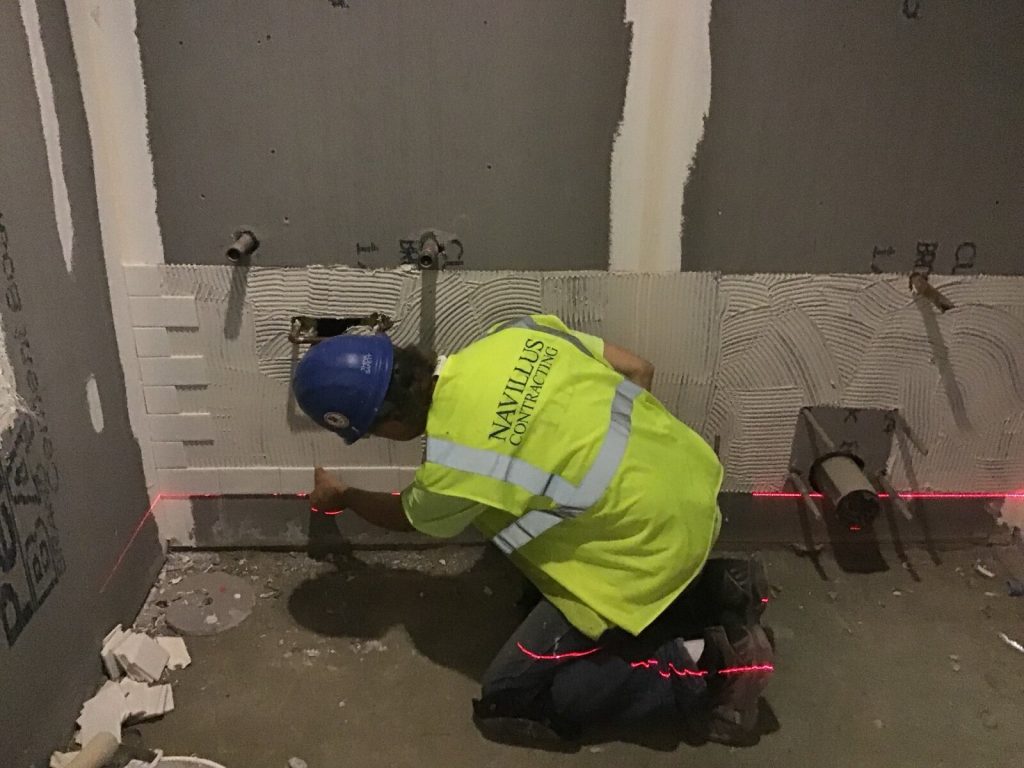
The honest answer to DIY tiling vs professional work has less to do with your skill with a trowel than with what sits behind the tile. A straight run of ceramic on a sound, dry plastered wall is a weekend job that most people finish well. A wet room floor, a large-format porcelain wall, or heavy tiles over plasterboard is where DIY jobs fail, and they rarely fail on the day. They fail six months later, once the adhesive has cured, the heating has been through a winter and the building has moved.
What follows is the line most professional tilers draw: the six jobs worth paying for, the standards that decide them, and the work you can genuinely take on yourself.
Why DIY tiling fails later, not on the day
Tiling looks like a surface finish. It behaves like a rigid structure glued to something that moves: timber floors deflect, screeds shrink, plaster carries only so much weight, and underfloor heating cycles the whole assembly twice a day. The tile itself is almost never the problem.
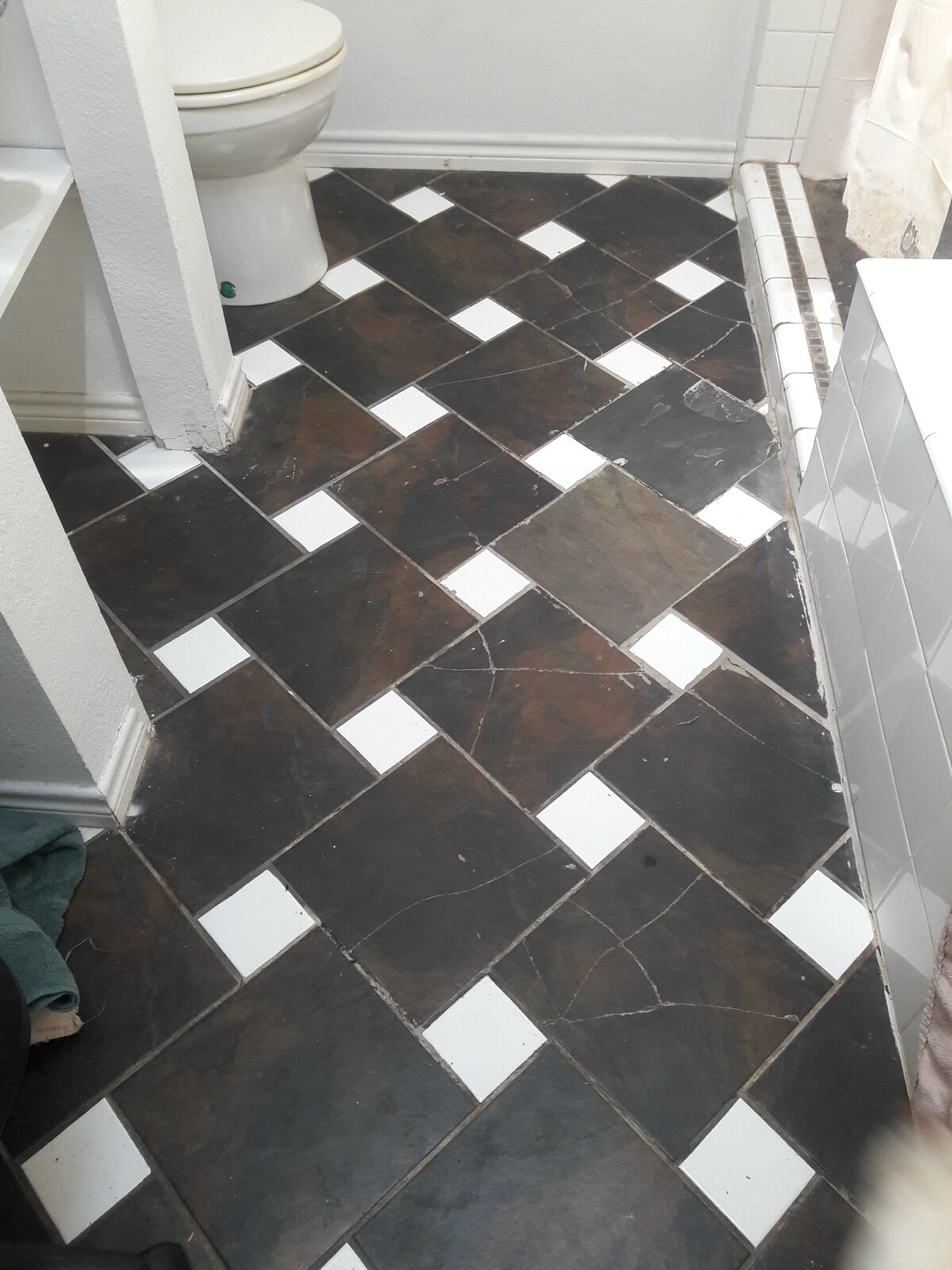
The rules that govern all of this are published as BS 5385, the British Standard code of practice for wall and floor tiling. It runs to five parts: internal ceramic wall tiling, external wall tiling, internal floor tiling, tiling in specific conditions such as wet areas, and terrazzo and natural stone floors. A competent tiler works to it without thinking about it. Most DIY guides never mention it exists.
Two provisions catch homeowners more than any others. The first is background weight. The second is movement.
The weight limits that rule out most heavy DIY tiling
Every background has a maximum weight of tiling it can carry when tiles are fixed with adhesive alone. The figures adhesive manufacturers publish from BS 5385-1 are these:
- Gypsum plaster: 20 kg per square metre
- 12.5mm gypsum plasterboard: 32 kg per square metre
- Gypsum fibreboard: 40 kg per square metre
- Glass-reinforced cement backer board: 50 kg per square metre
- Foam-cored tile backer board: 60 kg per square metre
- Sand and cement render: 64 kg per square metre
A 10mm porcelain tile weighs somewhere around 18 to 20 kg per square metre before you add adhesive and grout. Put that on skim-coated plaster with a 20 kg limit and you have already used the allowance. Where tiling exceeds 70 per cent of the background’s capacity, BS 5385-1 calls for solid bedding rather than the dot-and-dab or partial coverage a lot of DIY work relies on, whatever the tile size.
Where several backgrounds meet on one wall, and they usually do around a shower, the weakest one sets the limit for the whole area. That is why a professional will often strip a wall back and board it rather than tile over what is there.
The 2018 revision of Part 1 added one more change worth knowing: plywood and other wood-based sheets and boards should no longer be used as a background for direct tiling. Older DIY advice still tells people to overboard a floor or wall in ply and tile straight onto it. That guidance is out of date.
The six jobs to leave to a professional tiler
These are the jobs where the cost of getting it wrong is a strip-out, not a touch-up.
1. Wet rooms and anything with a tiled shower floor. Tile adhesive and grout are not a waterproofing layer. A wet room needs a tanking system, a fall to the drain built into the screed rather than fudged with adhesive, and correctly sealed junctions at the floor-to-wall corner and around the drain. Tiling in wet areas is covered by BS 5385 Part 4 precisely because normal practice is not enough. A leak here goes into a ceiling below and is found by a damp patch, not by looking at the tiles.
2. Large-format tiles. Anything from 600mm upwards is heavy, unforgiving of a flat-but-not-flat wall, and needs full solid bedding with no voids. A single void under a large tile becomes a crack the first time something is dropped on it. Handling alone is a two-person job.
3. Floors with underfloor heating. The system has to be commissioned and heat-cycled before tiling, the adhesive and grout have to be rated for it, and movement joints need to be closer together. BS 5385-3 puts intermediate joints in a normal internal floor at 8 to 10 metre centres, reduced to around 5 metres where there is underfloor heating or strong solar gain. Miss those and the floor tents or the grout crazes across the middle of the room.
4. Any floor where the movement joints are not obvious. Perimeter joints are needed wherever a floor dimension is more than 2 metres between restraining surfaces, intermediate joints break a large floor into fields of no more than 10 by 10 metres, and those fields should stay roughly square, with sides no more than twice as long as they are wide. Almost nobody fits perimeter joints on a DIY job, because the skirting hides the gap and it feels wasteful. It is the single most common cause of a floor lifting.
5. Suspended timber floors. The deflection limit, the overboarding specification and the decoupling layer all have to be right before a tile goes down, and plywood is no longer an acceptable direct background. This is a structural judgement, not a tiling one.
6. Removing old floor tiles in a house built before 2000. The Health and Safety Executive is clear that asbestos was added to PVC and thermoplastic floor tiles, and that asbestos bitumen adhesive was used to stick floor tiles down. Lifting intact tiles carefully is one thing. Sanding, grinding or scraping back a black bitumen bed to level a subfloor is exactly the activity that releases fibres. If you have vinyl or thermoplastic tiles of any age in an older house, have them tested before anyone touches them. The HSE guidance on where asbestos is found lists both the tiles and the adhesive.
The electrical trap in a bathroom
A tiling job in a bathroom often quietly becomes an electrical job: a shaver socket moves, a downlight is added, the extractor is relocated to suit the new tile layout. In England, a room containing a bath or shower is a special location under Part P of the Building Regulations. Installing a new circuit, replacing the consumer unit, or altering an existing circuit inside that space is notifiable building work and has to be certified, whoever does it. Approved Document P, whose current edition dates from 2013, sets out what counts.
Unnotified work in a bathroom turns up in a conveyancing search years later and costs more to regularise than it would have cost to do properly.
The jobs you can sensibly do yourself
None of this means DIY tiling is a bad idea. It means the useful question is which surface you are tiling, not whether you are handy.
- A kitchen splashback on sound plaster, in a light ceramic or metro tile. Low weight, small area, no water sitting on it.
- Half-height ceramic wall tiling in a bathroom away from the shower enclosure, again in a light tile within the background’s weight limit.
- Regrouting and replacing silicone. Slow, tedious, entirely learnable, and it restores a tired bathroom for the price of materials.
- Replacing a handful of cracked tiles where you have spares and the substrate underneath is sound.
- A small, square, ground-floor concrete floor that is flat, dry and has no heating in it.
One detail worth getting right even on a simple job: grout joint widths. BS 5385-1 sets minimums by tile size, at least 2mm for tiles under 0.1 square metres with no side longer than 600mm, at least 3mm between 0.1 and 1 square metre, and wider for large panels. The fashion for hairline joints comes from showrooms, where the tiles were laid on a perfectly flat panel. On a real wall a joint that thin has nowhere to absorb the tolerance in the tiles themselves.
How to judge whether a tiler is any good
The questions that separate a tiler from someone with a tile cutter are about the background, not the finish.
- Ask what they are going to do about the substrate, and listen for whether backer board comes up before you mention it.
- Ask where the movement joints go, and whether the quote includes a perimeter joint.
- Ask what tanking system they use in a shower area, by name.
- Ask whether the tiles you have chosen are within the weight limit for the wall, and what they would do if they are not.
- Ask for the quote to break out preparation separately from tiling. A quote that is one line for a whole bathroom hides where the corners will be cut.
Our Bromley tiling team is asked about most of these jobs after the fact rather than before. The Tile Association is the UK trade body for the wall and floor tiling industry. It runs a member directory and a technical inspection service for anyone unhappy with a recent tiling job, which is a genuine route to an independent opinion if a dispute starts. Our own notes on how to find a good tiler and what should be in a tiling quote go further into the paperwork side.
Frequently asked questions
Is DIY tiling cheaper than hiring a professional?
On labour, yes. On the whole job, only if it lasts. Tools, cutters, backer board, tanking and the tiles you break while learning eat into the saving, and a floor that has to come up and be relaid costs more than the original quote plus new tiles. The saving is real on splashbacks and small wall areas, and shrinks fast on floors and wet areas.
Can I tile straight onto plasterboard?
Yes, within limits. Unskimmed 12.5mm plasterboard takes up to 32 kg per square metre of tiling, which covers most light ceramic wall tiles but not heavy porcelain or stone. Skimmed plaster drops the limit to 20 kg per square metre. In a shower enclosure, plasterboard is the wrong background regardless of weight, because it needs a waterproof backer board instead. See our comparison of tile backer board against plasterboard.
Can I still tile onto plywood?
Not as a direct background. The 2018 revision of BS 5385-1 removed plywood and other wood-based boards from the list of acceptable backgrounds for direct tiling, on the basis that sheet quality had become too variable to rely on. Use a purpose-made tile backer board instead.
How do I know if my floor needs movement joints?
If any dimension between restraining surfaces is over 2 metres, it needs a perimeter joint. If the floor is more than about 10 metres across, or has underfloor heating, or runs through a doorway into another room, it needs intermediate joints as well. A tiler who says a domestic floor is too small to bother is usually thinking about the skirting hiding the gap rather than the standard.
Do I need permission for the electrics if I am only retiling?
Only if you touch them. Retiling around an existing socket or light is not notifiable. Moving, adding or altering a circuit inside a room containing a bath or shower is, under Part P in England, and needs to be done by someone able to certify it.
What should I do if a tiling job has already failed?
Photograph it, stop using the area if water is getting behind the tiles, and put the complaint in writing to the tiler before anything is removed, because stripping the tiles destroys the evidence. If that goes nowhere, an independent technical inspection through the trade body gives you a written opinion on whether the work met the standard.
Related guides
- How to Tile a Bathroom Wall: A UK Step-by-Step Guide
- How Much Does Tiling Cost in the UK? A Realistic Price Guide
- How to Remove Old Wall Tiles Without Damaging the Wall
- Porcelain vs Ceramic Tiles: Which Is Right for Your Bathroom or Kitchen?
- How to Tank and Waterproof a Wet Room Before Tiling: A Bromley Homeowner’s Guide
- Do You Need to Seal Natural Stone Tiles Before Grouting? A Tiler Explains
- How to Tile a Bathroom Floor (Including Around the Toilet)
- How to Tile a Shower: Walls, Niche and Waterproofing
- Construction Trade News: June 2026
- Bathroom Tiling Guide: How to Plan, Prep and Finish a Lasting Job
- Tile Backer Board vs Plasterboard for Bathrooms
- Best Tiles for Small Bathrooms (and How to Make a Space Look Bigger)
- Wall and Floor Tiles for a Wet Room: What Actually Works
- Tiling vs Wall Panels for a Bathroom: Which Is Better?
- Do You Tile the Floor or Walls First in a Bathroom?
- Tiling and Bathroom Trade News: Mid-June 2026
- Kitchen Tiling: Splashbacks, Walls and Floors Explained
- How to Tile a Kitchen Splashback: Step-by-Step Bromley Guide
- How to Tile Around Kitchen Sockets, Switches and Worktops
- Kitchen Splashback Tile Ideas: 12 Looks That Work
- Tiling and Bathroom Trade News: Late June 2026
- How to Lay Metro Tiles in a Herringbone Pattern
- Tiled vs Glass Splashback (and Acrylic): Which Is Best?
- How High Should a Kitchen Splashback Be Tiled? UK Heights Guide
- Tiling and Bathroom Trade News: Early July 2026
- Types of Tiles: The Complete UK Buyer’s Guide
- Porcelain vs Natural Stone Tiles: Which Should You Choose?
- Natural Stone Tiles Explained: Marble, Travertine, Slate and Limestone
- Tiling and Bathroom Trade News: Mid-July 2026
- Mosaic Tiles: Where to Use Them and How They’re Fixed
- Tile Slip Ratings Explained: R Ratings and PTV for UK Floors
- Matt vs Gloss Tiles: Which Finish Is Right for Your Room?
- Cost to Tile a Bathroom in the UK: 2026 Price Breakdown
- Polystyrene Ceiling Tiles: Are They Any Good?
- Cost to Tile a Kitchen in 2026: Floor and Splashback Prices
- Tiling and Bathroom Trade News: Mid-July 2026
- Tiling Cost Per Square Metre 2026: Labour and All-In Prices
- Tiler Day Rate UK: What Tilers Charge Per Day in 2026
- Cost to Regrout a Bathroom in 2026: UK Prices Explained
- Floor Tile Prices UK 2026: What You Will Pay Per Square Metre
- Is It Cheaper to Tile or Use Wall Panels? A UK Cost Comparison
- How to Tile: A Complete Beginner’s Guide (UK)
- How to Cut Tiles: Manual Cutter, Wet Saw and Nippers
- How to Cut Holes in Tiles for Pipes and Taps
- How to Grout Tiles (and Get Clean, Even Lines)
- Cork Flooring: Pros, Cons and Where It Works in UK Homes
- Tiling and Bathroom Trade News: Late July 2026
- How to Mix and Apply Tile Adhesive Correctly
- How to Set Out Tiles for a Perfect Layout
- How to Seal Grout and Tiles in a Bathroom (UK Guide)
- Can You Tile Over Tiles? When It Works and When It Doesn’t
- Tiling Tools List: What You Need for a Professional Finish
- How Much Tile Adhesive Do I Need? Coverage Per Square Metre
- Tiling Trade News: Topps App, Costs Up 6% (Aug 2026)
- Tile Problems: 9 Common Faults and How to Fix Each
- How to Fix Loose Tiles Without Removing Them
- Cracked Grout Repair: Why It Happens and How to Fix It
- Tiling Trade News: TTA Silica Warning, 2% Retentions
- How to Replace a Broken Tile Without Redoing the Wall
- Water Leaking Through Shower Tiles: 6 Causes and Fixes
- Remove Mouldy Silicone Sealant: A 24-Hour Reseal Job
- How to Clean Grout: What Works, and What Etches Stone
- Why Are My Floor Tiles Lifting? The 40m² Bay Rule
- Tiling Trade News: 3,841 Construction Firms Failed
- How to Lay Porcelain Paving: 1:80 Fall, 150mm Below DPC
- Tile Patterns: Why Big Tiles Need a One-Third Offset
- Grout Colour Ideas: How to Get the Shade You Chose
- Can You Paint Tiles? Yes on Walls, No in the Shower
- Decoupling Membrane for Tiles: When You Actually Need One
- Can You Tile Over a Wooden Floor? What Changed in 2024
- Tiling Cost 2026: £25 to £95 per m² Labour, UK Rates
- Tile Ideas: 7 Looks and the One Rule Each Needs
- Metro Tiles: Sizes, Bevels and the 1/3 Offset Rule
- Tile Feature Wall: The Weight Limit That Decides Yours
- Tiling Over Underfloor Heating: 14 Days Before Heat On
- How to Tile a Hallway Floor: Set Out From the Door
- Wood Effect Tiles and Marble Effect: 5 Specs to Check
- Tile Levelling Systems: The 3mm Rule That Decides It
- Tiling Trade News: Repair Work Up 1.7%, Headlam Fails
- Floor Levelling Compound: How Deep and How Long to Dry
- How to Find a Good Tiler: 9 Checks Before You Book
- Tiling Quote: The 10 Lines a Proper One Must Show
- Tile Trim: Sizes, Profiles and the One-Size-Up Rule
- Tile Spacers: 2mm or 3mm, and When to Pull Them Out
- Tiling the Fireplace: 125mm Hearths, Adhesive and Tiles
- Tiling Trade News: Shaws Sinks Reprice on 1 November
- Porcelain vs Stone Paving: Grip, Sealing and Upkeep
- Tiling a Large Floor: Movement Joints Every 10 Metres
- Terracotta Tiles: Seal Before Grouting, Wait 7 Days
- Tile Drill Bits: Which Bit Won’t Crack Porcelain