


Tile movement joints are the flexible breaks in a tiled floor or wall that let the tiles, adhesive and base expand, shrink and settle without cracking. They are the part of a tiling job most often left out, because a room looks finished without them and the failure can take a year to appear. When it does, it shows up as a ridge of tiles lifting in the middle of a kitchen floor, a crack running in a straight line across several tiles, or grout crumbling out of an internal corner.
This page sets out where movement joints go, the spacing figures that tiling product makers publish from BS 5385, what changes on heated floors and outdoors, and how to tell whether a floor you already have was laid without them.
Why tiles need movement joints
A ceramic or porcelain tile barely changes size. The things around it do. A new sand and cement screed keeps shrinking as it dries. Timber floors swell and shrink with the seasons. Underfloor heating warms the whole floor every morning and lets it cool at night.
The Tile Association lists drying shrinkage, moisture and thermal change as the natural sources of stress in a tile system, and says those stresses can cause loss of adhesion, bulging or cracking. A movement joint does not stop the movement. It gives it somewhere to go, by splitting one rigid sheet of tiles into smaller sections that can each move a little on their own.
Grout cannot do this job. Cement grout is rigid once it cures, so a grout line in the place where a movement joint should be simply becomes the crack.
The kinds of movement joint
Palace Chemicals’ technical director sets out the floor joints in plain terms, and the same names are used across the trade:
- Structural joints run through the tile, the screed and the floor slab. They must line up exactly with the joints already built into the slab, and they take the largest movement.
- Perimeter joints run round the edges of a floor, where the tiles meet the walls.
- Intermediate joints divide a large floor into bays.
- Connecting joints sit where tiling meets another part of the building, such as a step, a door frame or a window frame.
Where tile movement joints go on floors
BS 5385 is the British Standard code of practice for wall and floor tiling. The full text is a paid document, but manufacturers print its floor positions in their fitting instructions. The installation sheet for Tile Rite’s floor expansion joint gives these positions “as per BS5385”:
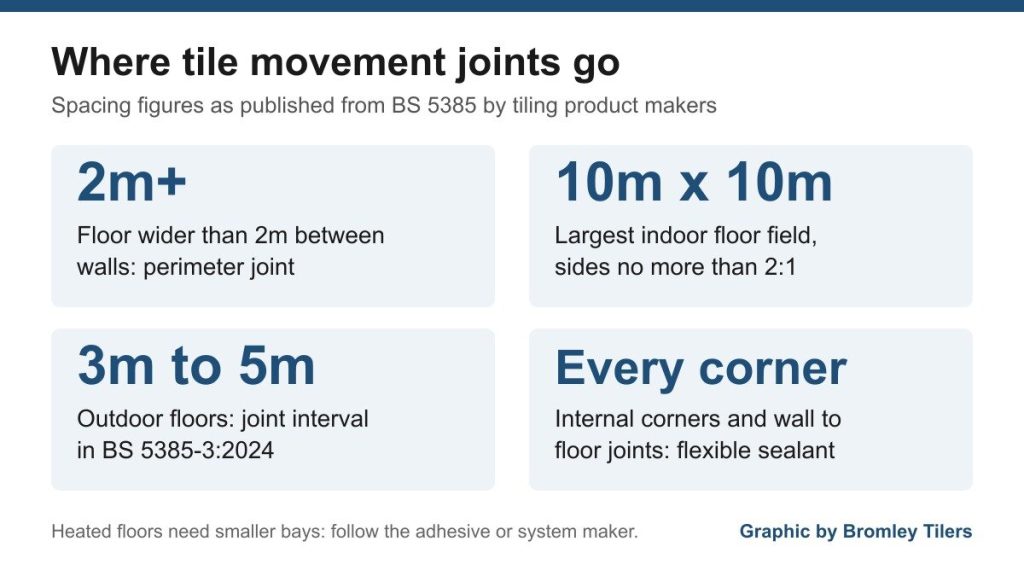
- Perimeter joint: needed where a tiled floor measures more than 2m between restraining surfaces such as walls.
- Intermediate joints: where the distance between perimeter joints is more than 10m, divide the floor into fields of no more than 10m x 10m, kept as close to square as possible, with sides no more than 2:1.
- Structural joints: where the building has one, carry it right through to the tiled surface.
Instarmac’s training notes for tilers add a few places that catch people out:
- directly above supporting walls or structural beams on a suspended floor, because the floor is stiffer there than either side of it;
- over day joints and saw cuts in the subfloor, where the movement is unknown;
- between separate underfloor heating zones, so each can heat and cool on its own;
- around pillars, kitchen islands built into the floor and any other fixed feature that interrupts the tiling.
In practice, most rooms in a Bromley semi are under 10m in every direction, so the intermediate joint rule rarely applies indoors. The perimeter joint almost always does. On a typical floor it is simply a gap of a few millimetres left between the last row of tiles and the wall, hidden by the skirting or filled with a flexible sealant.
Heated floors need smaller bays
This is where the published figures stop agreeing. The Tile Rite instruction sheet says that over underfloor heating the furthest distance between intermediate joints should be no more than 3.5m, on top of the perimeter joints. Instarmac’s notes give a maximum bay of 25 square metres for heated floors.
The honest answer is that the system you use sets the rule. The adhesive maker, the underfloor heating maker and any uncoupling membrane maker each publish their own spacing, and the warranty depends on following it. Take the tightest of them. Palace Chemicals also points out that a flexible S1 adhesive and an uncoupling membrane together can reduce the number of joints a floor needs, but only as the membrane maker specifies.
Our page on tiling over underfloor heating covers commissioning the system before tiling, which matters just as much.
Outdoor tiling: joints every 3m to 5m
Outdoor porcelain takes far more punishment than an indoor floor: frost, rain and full summer sun on dark slabs. The 2024 revision of BS 5385 Part 3 made the rule explicit. As quoted by both the Tile Association and Palace Chemicals, intermediate movement joints in external floor tiling should be placed at intervals between 3m and 5m.
The standard also says the spacing should come down further depending on sun exposure, expected movement in the base, the size and darkness of the tiles and the width of the tile joints. So a south-facing patio laid in large dark grey slabs needs joints toward the 3m end of the range, not the 5m end.
Two more figures from the Tile Association’s guidance on external floors: floor tiles should never be laid with joints narrower than 3mm, and outdoor tiling should not be done unless the temperature is above 5°C and rising. See our page on outdoor tiles for choosing the slab itself.
Walls, corners and bathrooms
Wall tiling needs movement joints too, though they are smaller and easier to hide. Instarmac’s guidance puts them:
- at every internal corner between walls, and where walls meet the ceiling;
- at every junction between a wall and a floor;
- where the tiling crosses from one background to another, for example from plasterboard to blockwork, with the tiles left short at the change;
- over any movement joint already built into the wall, lined up with it and at least as wide;
- both across and up large walls, at anywhere from 3m to 10m depending on the building design.
In a bathroom this means the internal corners of a shower enclosure, the line where wall tiles meet the bath or shower tray, and the joint between wall and floor tiles should be flexible sealant, not grout. A bath drops slightly every time it is filled, and a grouted joint along its edge will crack within months. When that sealant goes mouldy, cut it out and replace it rather than covering it: our page on replacing mouldy silicone shows how.
Silicone or a movement joint profile
There are two ways to form the joint.
Flexible sealant
A sanitary silicone or another sealant rated for movement, gunned into a clean gap of the right width. It suits internal corners, wall to floor junctions and perimeter gaps.
Pre-formed profiles
Palace Chemicals describes these as PVC or metal anchoring legs joined by a flexible synthetic movement zone. The legs are bedded into the adhesive as the tiles go down, so the profile sits flush with the tile face. Instarmac’s notes match the material to the use: PVC for most homes, aluminium for general commercial work, brass or stainless steel for heavy commercial and factory floors. Profiles are the better choice in the middle of a floor, where a silicone line would be walked on daily.
Whichever you use, the joint must go through the full depth of the tile and the adhesive. A joint that is only a cosmetic strip of silicone on top of solid grout does nothing.
Signs a floor was laid without them
These are the usual clues that a floor is short of movement joints:
- tiles tenting, where two rows push up against each other in a ridge;
- a crack running straight across several tiles, often in line with a joint in the screed below;
- grout cracking along the wall line or round an island;
- a run of tiles that sound hollow when tapped, usually starting from one edge.
Tenting tiles can lift suddenly and are a trip hazard, so do not wait on them. Our pages on why tiles lift and hollow sounding tiles explain how to judge whether a floor can be repaired or needs lifting.
If you are planning a new floor in Bromley or south east London and want the joints designed in from the start, Bromley Tilers can set them out with the tile layout so they sit in line with the grout pattern and barely show.
Frequently asked questions
Do I need movement joints in a small bathroom floor?
The published rule is that a perimeter joint is needed where a floor is more than 2m between walls, so many small bathroom floors are on the edge of it. In practice, leave a perimeter gap anyway and seal it, along with the joint where the floor meets the bath or shower tray. It costs nothing and removes a common cause of cracked grout.
Can I grout over a movement joint?
No. Rigid cement grout locks the two sides together and the joint stops working. Fill movement joints with a flexible sealant or use a pre-formed profile.
How wide should a tile movement joint be?
It depends on the floor size, the bed and the tile type, so there is no single figure. Profile makers state the movement each profile can take; size it to the movement you expect and the spacing your adhesive and heating makers specify.
Are movement joints needed on walls as well as floors?
Yes. Internal corners, wall to ceiling joints, wall to floor joints and changes of background material all need a flexible joint. On large walls, joints are also needed across and up the wall.
What spacing does BS 5385 give for outdoor tiles?
BS 5385-3:2024 says intermediate movement joints in external floor tiling should be at intervals between 3m and 5m, closer still for sunny, dark or large format installations.
Can an uncoupling membrane replace movement joints?
Not entirely. A membrane with a flexible adhesive can reduce how many intermediate joints a floor needs, but perimeter joints and joints over structural joints are still required. Follow the membrane maker’s instructions.
Sources: The Tile Association, External Floor Tiling Incorporating Movement Joints (January 2025); Palace Chemicals, Movement joints and uncoupling membranes (October 2024); Tile Rite floor expansion joint installation sheet; Instarmac training academy notes on movement joints.
Related guides
- How to Tile a Bathroom Wall: A UK Step-by-Step Guide
- How Much Does Tiling Cost in the UK? A Realistic Price Guide
- How to Remove Old Wall Tiles Without Damaging the Wall
- Porcelain vs Ceramic Tiles: Which Is Right for Your Bathroom or Kitchen?
- How to Tank and Waterproof a Wet Room Before Tiling: A Bromley Homeowner’s Guide
- Do You Need to Seal Natural Stone Tiles Before Grouting? A Tiler Explains
- How to Tile a Bathroom Floor (Including Around the Toilet)
- How to Tile a Shower: Walls, Niche and Waterproofing
- Construction Trade News: June 2026
- Bathroom Tiling Guide: How to Plan, Prep and Finish a Lasting Job
- Tile Backer Board vs Plasterboard for Bathrooms
- Best Tiles for Small Bathrooms (and How to Make a Space Look Bigger)
- Wall and Floor Tiles for a Wet Room: What Actually Works
- Tiling vs Wall Panels for a Bathroom: Which Is Better?
- Do You Tile the Floor or Walls First in a Bathroom?
- Tiling and Bathroom Trade News: Mid-June 2026
- Kitchen Tiling: Splashbacks, Walls and Floors Explained
- How to Tile a Kitchen Splashback: Step-by-Step Bromley Guide
- How to Tile Around Kitchen Sockets, Switches and Worktops
- Kitchen Splashback Tile Ideas: 12 Looks That Work
- Tiling and Bathroom Trade News: Late June 2026
- How to Lay Metro Tiles in a Herringbone Pattern
- Tiled vs Glass Splashback (and Acrylic): Which Is Best?
- How High Should a Kitchen Splashback Be Tiled? UK Heights Guide
- Tiling and Bathroom Trade News: Early July 2026
- Types of Tiles: The Complete UK Buyer’s Guide
- Porcelain vs Natural Stone Tiles: Which Should You Choose?
- Natural Stone Tiles Explained: Marble, Travertine, Slate and Limestone
- Tiling and Bathroom Trade News: Mid-July 2026
- Mosaic Tiles: Where to Use Them and How They’re Fixed
- Tile Slip Ratings Explained: R Ratings and PTV for UK Floors
- Matt vs Gloss Tiles: Which Finish Is Right for Your Room?
- Cost to Tile a Bathroom in the UK: 2026 Price Breakdown
- Polystyrene Ceiling Tiles: Are They Any Good?
- Cost to Tile a Kitchen in 2026: Floor and Splashback Prices
- Tiling and Bathroom Trade News: Mid-July 2026
- Tiling Cost Per Square Metre 2026: Labour and All-In Prices
- Tiler Day Rate UK: What Tilers Charge Per Day in 2026
- Cost to Regrout a Bathroom in 2026: UK Prices Explained
- Floor Tile Prices UK 2026: What You Will Pay Per Square Metre
- Is It Cheaper to Tile or Use Wall Panels? A UK Cost Comparison
- How to Tile: A Complete Beginner’s Guide (UK)
- How to Cut Tiles: Manual Cutter, Wet Saw and Nippers
- How to Cut Holes in Tiles for Pipes and Taps
- How to Grout Tiles (and Get Clean, Even Lines)
- Cork Flooring: Pros, Cons and Where It Works in UK Homes
- Tiling and Bathroom Trade News: Late July 2026
- How to Mix and Apply Tile Adhesive Correctly
- How to Set Out Tiles for a Perfect Layout
- How to Seal Grout and Tiles in a Bathroom (UK Guide)
- Can You Tile Over Tiles? When It Works and When It Doesn’t
- Tiling Tools List: What You Need for a Professional Finish
- How Much Tile Adhesive Do I Need? Coverage Per Square Metre
- Tiling Trade News: Topps App, Costs Up 6% (Aug 2026)
- Tile Problems: 9 Common Faults and How to Fix Each
- How to Fix Loose Tiles Without Removing Them
- Cracked Grout Repair: Why It Happens and How to Fix It
- Tiling Trade News: TTA Silica Warning, 2% Retentions
- How to Replace a Broken Tile Without Redoing the Wall
- Water Leaking Through Shower Tiles: 6 Causes and Fixes
- Remove Mouldy Silicone Sealant: A 24-Hour Reseal Job
- How to Clean Grout: What Works, and What Etches Stone
- Why Are My Floor Tiles Lifting? The 40m² Bay Rule
- Tiling Trade News: 3,841 Construction Firms Failed
- How to Lay Porcelain Paving: 1:80 Fall, 150mm Below DPC
- Tile Patterns: Why Big Tiles Need a One-Third Offset
- Grout Colour Ideas: How to Get the Shade You Chose
- Can You Paint Tiles? Yes on Walls, No in the Shower
- Decoupling Membrane for Tiles: When You Actually Need One
- Can You Tile Over a Wooden Floor? What Changed in 2024
- Tiling Cost 2026: £25 to £95 per m² Labour, UK Rates
- Tile Ideas: 7 Looks and the One Rule Each Needs
- Metro Tiles: Sizes, Bevels and the 1/3 Offset Rule
- Tile Feature Wall: The Weight Limit That Decides Yours
- Tiling Over Underfloor Heating: 14 Days Before Heat On
- How to Tile a Hallway Floor: Set Out From the Door
- Wood Effect Tiles and Marble Effect: 5 Specs to Check
- Tile Levelling Systems: The 3mm Rule That Decides It
- Tiling Trade News: Repair Work Up 1.7%, Headlam Fails
- Floor Levelling Compound: How Deep and How Long to Dry
- How to Find a Good Tiler: 9 Checks Before You Book
- Tiling Quote: The 10 Lines a Proper One Must Show
- Tile Trim: Sizes, Profiles and the One-Size-Up Rule
- Tile Spacers: 2mm or 3mm, and When to Pull Them Out
- Tiling the Fireplace: 125mm Hearths, Adhesive and Tiles
- Tiling Trade News: Shaws Sinks Reprice on 1 November
- Porcelain vs Stone Paving: Grip, Sealing and Upkeep
- Tiling a Large Floor: Movement Joints Every 10 Metres
- DIY Tiling vs Professional: 6 Jobs to Never Do Yourself
- Terracotta Tiles: Seal Before Grouting, Wait 7 Days
- Tile Drill Bits: Which Bit Won’t Crack Porcelain
- Tiling Corners With Trim: Which Profile, and When to Mitre
- Travertine Tiles: Filled or Unfilled, and How to Seal Them
- Slate Tiles: Calibrated or Riven, and How to Lay Them
- Zellige Tiles: Order 15% Extra and Fix Them Edge to Edge
- Terrazzo Tiles: Real 20mm vs Porcelain, Seal Before Grouting
- Tiling Trade News: 36% Now Add a Bathroom Accent Wall
- Split Face Tiles: Will Your Wall Take 27kg per m²?
- Tile Sealer: Which Tiles Need It and Which Type to Buy
- How to Remove Grout Haze: Which Cleaner for Which Grout
- Efflorescence on Tiles: Why It Comes Back and How to Stop It
- Tile Primer: Which Surfaces Need It and How Much to Dilute
- Epoxy Grout: Where It’s Worth It and How to Apply It
- How to Tile Stairs: Keep Every Riser the Same Height
- Shower Niche: Sizes, Height and Which Wall Can Take One
- How Many Tiles Do I Need? Add 10% to 20% by Layout
- How to Tile a Window Sill: Sill Last, Silicone at the Frame
- Tiling Trade News: Victorian Plumbing Tile Sales Up 76%
- How to Tile Around a Toilet: Lift the Pan or Cut Round It
- Tile to Carpet Transition: Pick the Strip by the Height Gap
- Tile Skirting: Leave a 6mm Gap and Seal, Never Grout
- Tile Backer Board: Cement or Foam, Which Thickness, Fixings
- Quarry Tiles: Seal Them or Not, and How to Clean Them
- Rapid Set Tile Adhesive vs Standard: 30 Mins or 24 Hours
- Can You Tile Onto Plaster? Yes, Up to 20kg per m²
- How to Tile a Balcony: 1.5-2% Fall, Drain Mat, 150mm Upstand
- Electric Tile Cutter: When You Need One and Which Disc
- Victorian Floor Tiles: Sizes, Repairs and When to Replace
- Marble Tiles: White Rapid-Set Adhesive, Seal Before Grouting
- Tiling on Anhydrite Screed: 0.5% Moisture, Sand, Then Prime
- Tiling Trade News: Domus Buyout After Headlam Collapse
- How High to Tile a Bathroom: 1.2m Line vs Floor to Ceiling
- Can You Tile Over Paint? Strip Emulsion, Key Gloss First
- Hollow Sounding Tiles: When to Leave Them, When to Lift