


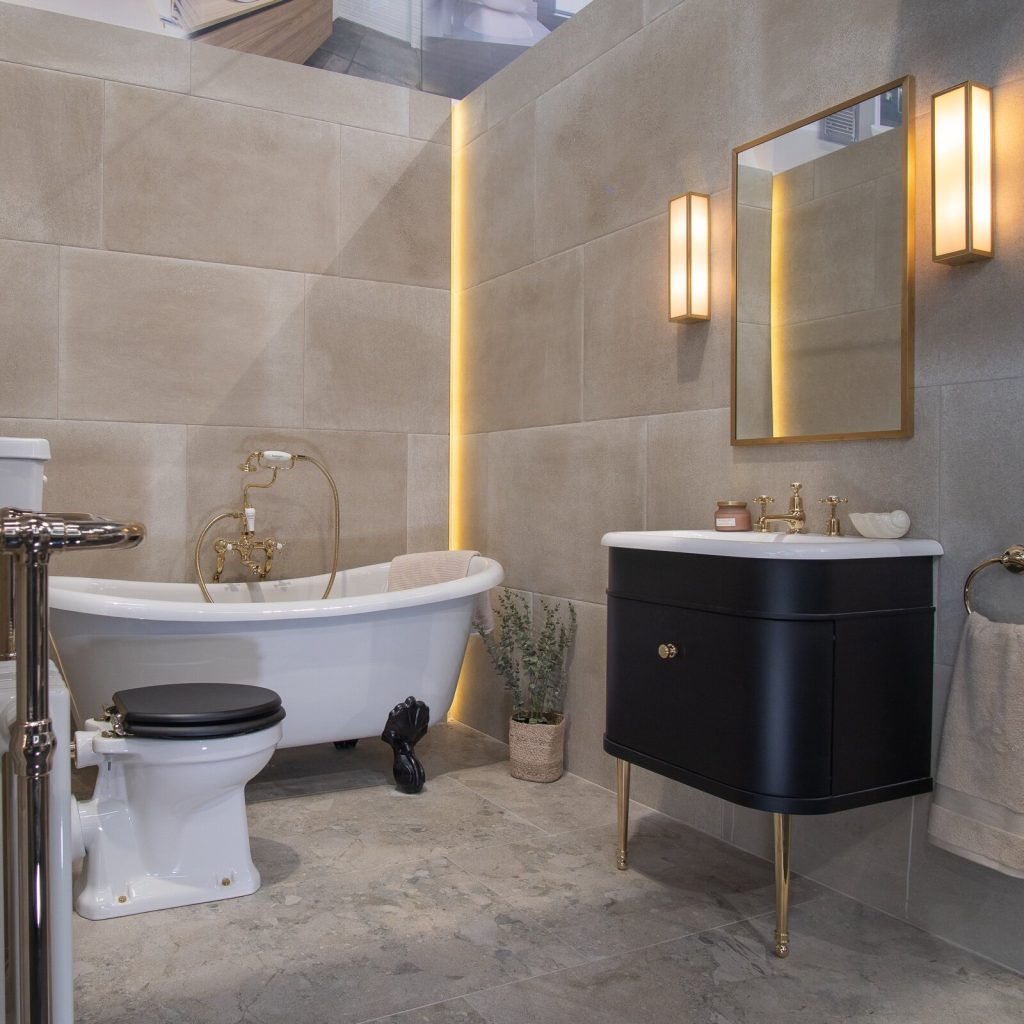
Most tile ideas fall apart at the same point: the look is chosen from a photograph, and the thing that decides whether it works, the size of the tile, the flatness of the wall behind it, the width of the joint, is settled later by whoever turns up to fit it. Get that order the wrong way round and a £40 per square metre tile can finish worse than a £14 one.
What follows is seven looks worth having in a UK home, and the single rule that decides each one. None of it needs a designer. All of it needs settling before the tiles are ordered.
Large format walls: the wall behind decides everything
Big tiles, 600 x 1200mm and up, are the reason bathrooms photograph so well now. Fewer joints, fewer lines, more of the pattern in the stone or the concrete effect visible in one piece. The catch is that a big rigid tile cannot follow a wavy wall. It bridges the hollows and rocks on the high spots, and every high spot shows up as lippage, a lip at the joint you can feel with a fingernail and see in raking light.
The standard that matters is surface regularity. Under BS 5385-3, the British Standard for internal floor tiling, a substrate is judged by laying a 2 metre straight edge on it: the gap underneath should be no more than 3mm. That is the grade known as SR1. If your walls or floor do not achieve it, the honest answer is not a thicker bed of adhesive, it is skimming, boarding or levelling compound first, priced as a separate line on the quote.
So ask a tiler to check the substrate with a straight edge before you buy large format, and do not read a levelling system, the clips and wedges that hold neighbouring tiles flush while the adhesive sets, as an admission of failure. On tiles over 600mm it is normal practice.
Wood-effect planks: a third, not a half
Plank tiles that look like oak or ash are the most requested floor in the country, and the most commonly ruined. The instinct is to lay them like real floorboards, with each row offset half a plank. On a long porcelain tile that is the one pattern to avoid.
Porcelain planks are not perfectly flat. A slight bow along the length is normal and within tolerance. Offset a plank by 50% and the highest point of one tile, its middle, lands against the lowest point of its neighbour, the end. The result is a ridge at every joint, running the length of the floor.
The industry answer is to keep the offset to a maximum of a third for tiles with a long side over roughly 450mm, and less if the manufacturer says so. A third offset reads as a natural floor, is far more forgiving, and is what a good tiler will propose without being asked. If you want the half offset look, use a shorter tile.
Metro tiles: the joint changes the look more than the tile does
A white 200 x 100mm metro tile is the cheapest tile in the shop and can look like anything from a Victorian dairy to a Brooklyn coffee bar. What moves it between those two is not the tile, it is the joint.
Wide joints in a mid grey read traditional and utilitarian. Narrow joints in bright white read modern and quiet, and hide the fact that the tile is cheap. Dark grout with white metro is a strong graphic look that also shows every wobble in the setting out, so it demands a good fitter and a straight wall.
Minimum joint widths are not a matter of taste. Guidance from The Tile Association follows the tile size: “For tiles with a facial area <0.1 m2 with no side over 600mm long, joints should not be less than 2mm wide. For tiles with a facial area 0.1m2 to 1m2 with no side over 1200 mm long, joints should not be less than 3mm wide.” Rectified porcelain, ground to size after firing so the edges are exact, is what allows the very narrow joints you see in showrooms, and at that width the grout choice matters more, not less.
Marble-look porcelain in a bathroom: check the wet grip first
Marble-effect porcelain gives you the veining without the sealing, the staining or the price of real stone. On walls it is close to faultless. On a bathroom or shower floor, the finish is the whole question.
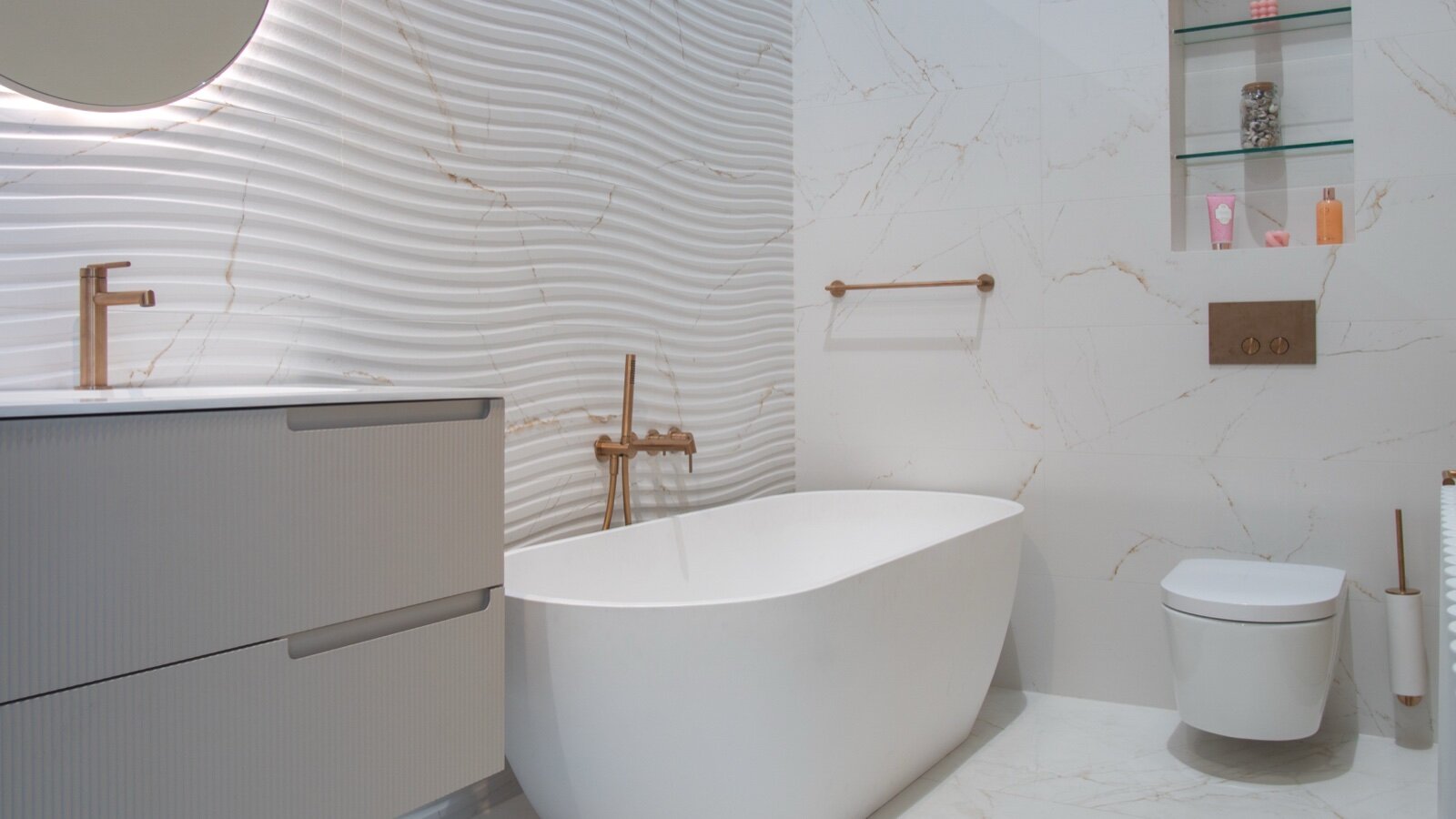
The measure used in Britain is the pendulum test, and the number is the pendulum test value. A wet PTV of 36 or above is the threshold at which the Health and Safety Executive treats a floor as having a low slip potential. High polish marble effect tiles, wet, routinely sit far below that. In a family bathroom or a level access shower that is not a detail, it is the difference between a floor that works and a floor somebody falls on.
The workable version: polished or lightly honed on the walls, a matt or textured version of the same tile on the floor, ideally from the same range so the veining matches. Ask the supplier for the wet PTV, not just an R rating from a shod ramp test, which is measured a different way and does not translate to a barefoot bathroom.
Chequerboard and Victorian hallway patterns: set out from the door
Black and white chequerboard, or a proper geometric Victorian hallway floor, is the single biggest visual upgrade available to a period terrace, and Bromley, Beckenham and the surrounding streets are full of houses built for it.
The rule here is setting out. A patterned floor has to be centred on the sightline you actually use, which in a terrace hallway is the view from the front door, not the geometric centre of an irregular room. Get that wrong and the pattern runs out of square against the skirting, which no amount of good tiling afterwards will fix. Insist on a dry lay, the tiles loose on the floor, before a bag of adhesive is opened, and stand at the front door to look at it.
The other decision is the border. A border and corner detail costs more in labour than in tiles because of the cutting, and it is what makes a modern reproduction read as authentic rather than as a chessboard.
A mosaic niche or feature panel: small area, high impact, high labour
Mosaic earns its keep in small doses: a shower niche, a strip behind a vanity, a panel behind a freestanding bath. Across a whole wall it is expensive, busy and slow to fix.
Two things to know first. Mosaic on a sheet still needs a flat, properly prepared background, and because the joints are so numerous the grout is a far larger share of the finished surface than with any other tile, so grout colour dominates the result. In a shower, glass and stone mosaics also need a fixing and grout combination suited to constant wetting.
In a wet area the bedding matters more than anywhere else. British Standard practice for areas subject to frequent wetting is that tiles are solidly bedded so voids behind them are eliminated, which in practice means full adhesive coverage and no dot and dab.
Grout colour: the cheapest change with the largest effect
If you are only going to make one decision after choosing the tile, make it this one. Grout either draws the grid or dissolves it.
- Match the tile and the surface reads as one continuous plane. Best for large format and for making a small room feel bigger.
- Contrast the tile and you get a pattern, a grid, a graphic. Best for metro, chequerboard and anywhere the layout is the point.
- Mid grey on a floor is the pragmatic choice. White floor grout looks superb for about six weeks in a house with a hallway, a dog or children.
One caution on very narrow joints: at around 1mm, some grouts are difficult to work into the joint properly, and the colour reads darker than the sample board. Ask to see the grout made up next to the actual tile before committing to it across a whole bathroom.
Putting it together in a Bromley home
Most local jobs run the same way. A 1930s semi or a Victorian terrace with walls nowhere near SR1 flat, an owner holding a photograph of a 1200mm tile, and a budget that assumed tiling was one line on a quote. The fix is not a cheaper tile, it is preparation: level the floor, board or skim the walls, then fit the tile you wanted.
If you are weighing up the whole job rather than just the look, our tiling cost guide sets out UK labour rates, and the porcelain tiles guide covers what the different grades and finishes mean. For anything in a shower or wet room, read the wet room tiles guide before you choose a floor finish.
Frequently asked questions
What size tile makes a small bathroom look bigger?
Larger tiles with grout matched to the tile colour, because fewer visible joints means fewer lines breaking up the surface. The limit is practical rather than visual: a 1200mm tile in a small room generates a lot of cutting around the door, the pipework and the sanitaryware, so the tile that looks best in a photograph can be the one with most of its cost in labour.
Can I use the same tile on the walls and the floor?
Often yes, and it is a good look, but check two things. The tile must be rated for floor use, since wall tiles are usually thinner and softer, and the floor version needs adequate wet slip resistance. Many ranges solve this by offering a polished wall tile and a matt floor tile with the same face pattern.
Is a herringbone floor a bad idea with large planks?
Not bad, but expensive and demanding. Herringbone multiplies cutting, waste and setting out time, and long planks in herringbone are unforgiving of any bow in the tile or any dip in the floor. Expect to pay noticeably more in labour and to allow more waste than for a straight or third offset layout.
How much extra should I order?
Ten per cent over the measured area is the usual allowance for straight layouts, and more for diagonal, herringbone or patterned work where cutting waste is higher. Buy it all at once and check the batch numbers match, because shade varies between batches and a mid job top up rarely blends invisibly.
Should I choose the grout before or after the tiles?
After the tile, but before the tiler starts. Ask for a physical sample of the grout mixed and dried against the actual tile, since grout colour cards are printed rather than made from the product and are only an approximation.
Related guides
- How to Tile a Bathroom Wall: A UK Step-by-Step Guide
- How Much Does Tiling Cost in the UK? A Realistic Price Guide
- How to Remove Old Wall Tiles Without Damaging the Wall
- Porcelain vs Ceramic Tiles: Which Is Right for Your Bathroom or Kitchen?
- How to Tank and Waterproof a Wet Room Before Tiling: A Bromley Homeowner’s Guide
- Do You Need to Seal Natural Stone Tiles Before Grouting? A Tiler Explains
- How to Tile a Bathroom Floor (Including Around the Toilet)
- How to Tile a Shower: Walls, Niche and Waterproofing
- Construction Trade News: June 2026
- Bathroom Tiling Guide: How to Plan, Prep and Finish a Lasting Job
- Tile Backer Board vs Plasterboard for Bathrooms
- Best Tiles for Small Bathrooms (and How to Make a Space Look Bigger)
- Wall and Floor Tiles for a Wet Room: What Actually Works
- Tiling vs Wall Panels for a Bathroom: Which Is Better?
- Do You Tile the Floor or Walls First in a Bathroom?
- Tiling and Bathroom Trade News: Mid-June 2026
- Kitchen Tiling: Splashbacks, Walls and Floors Explained
- How to Tile a Kitchen Splashback: Step-by-Step Bromley Guide
- How to Tile Around Kitchen Sockets, Switches and Worktops
- Kitchen Splashback Tile Ideas: 12 Looks That Work
- Tiling and Bathroom Trade News: Late June 2026
- How to Lay Metro Tiles in a Herringbone Pattern
- Tiled vs Glass Splashback (and Acrylic): Which Is Best?
- How High Should a Kitchen Splashback Be Tiled? UK Heights Guide
- Tiling and Bathroom Trade News: Early July 2026
- Types of Tiles: The Complete UK Buyer’s Guide
- Porcelain vs Natural Stone Tiles: Which Should You Choose?
- Natural Stone Tiles Explained: Marble, Travertine, Slate and Limestone
- Tiling and Bathroom Trade News: Mid-July 2026
- Mosaic Tiles: Where to Use Them and How They’re Fixed
- Tile Slip Ratings Explained: R Ratings and PTV for UK Floors
- Matt vs Gloss Tiles: Which Finish Is Right for Your Room?
- Cost to Tile a Bathroom in the UK: 2026 Price Breakdown
- Polystyrene Ceiling Tiles: Are They Any Good?
- Cost to Tile a Kitchen in 2026: Floor and Splashback Prices
- Tiling and Bathroom Trade News: Mid-July 2026
- Tiling Cost Per Square Metre 2026: Labour and All-In Prices
- Tiler Day Rate UK: What Tilers Charge Per Day in 2026
- Cost to Regrout a Bathroom in 2026: UK Prices Explained
- Floor Tile Prices UK 2026: What You Will Pay Per Square Metre
- Is It Cheaper to Tile or Use Wall Panels? A UK Cost Comparison
- How to Tile: A Complete Beginner’s Guide (UK)
- How to Cut Tiles: Manual Cutter, Wet Saw and Nippers
- How to Cut Holes in Tiles for Pipes and Taps
- How to Grout Tiles (and Get Clean, Even Lines)
- Cork Flooring: Pros, Cons and Where It Works in UK Homes
- Tiling and Bathroom Trade News: Late July 2026
- How to Mix and Apply Tile Adhesive Correctly
- How to Set Out Tiles for a Perfect Layout
- How to Seal Grout and Tiles in a Bathroom (UK Guide)
- Can You Tile Over Tiles? When It Works and When It Doesn’t
- Tiling Tools List: What You Need for a Professional Finish
- How Much Tile Adhesive Do I Need? Coverage Per Square Metre
- Tiling Trade News: Topps App, Costs Up 6% (Aug 2026)
- Tile Problems: 9 Common Faults and How to Fix Each
- How to Fix Loose Tiles Without Removing Them
- Cracked Grout Repair: Why It Happens and How to Fix It
- Tiling Trade News: TTA Silica Warning, 2% Retentions
- How to Replace a Broken Tile Without Redoing the Wall
- Water Leaking Through Shower Tiles: 6 Causes and Fixes
- Remove Mouldy Silicone Sealant: A 24-Hour Reseal Job
- How to Clean Grout: What Works, and What Etches Stone
- Why Are My Floor Tiles Lifting? The 40m² Bay Rule
- Tiling Trade News: 3,841 Construction Firms Failed
- How to Lay Porcelain Paving: 1:80 Fall, 150mm Below DPC
- Tile Patterns: Why Big Tiles Need a One-Third Offset
- Grout Colour Ideas: How to Get the Shade You Chose
- Can You Paint Tiles? Yes on Walls, No in the Shower
- Decoupling Membrane for Tiles: When You Actually Need One
- Can You Tile Over a Wooden Floor? What Changed in 2024
- Tiling Cost 2026: £25 to £95 per m² Labour, UK Rates
- Metro Tiles: Sizes, Bevels and the 1/3 Offset Rule
- Tile Feature Wall: The Weight Limit That Decides Yours
- Tiling Over Underfloor Heating: 14 Days Before Heat On